


Simvastatin induces neuroprotection in 6-OHDA-lesioned PC12 via the PI3K/AKT/caspase 3 pathway and anti-inflammatory responses
- PMID: 23279934
- PMCID: PMC6493537
- DOI: 10.1111/cns.12053
Simvastatin induces neuroprotection in 6-OHDA-lesioned PC12 via the PI3K/AKT/caspase 3 pathway and anti-inflammatory responses
Abstract
Background: In addition to their original applications for lowering cholesterol, statins display multiple neuroprotective effects. Inflammatory reactions and the PI3K/AKT/caspase 3 pathway are strongly implicated in dopaminergic neuronal death in Parkinson's disease (PD). This study aims to investigate how simvastatin affects 6-hydroxydopamine-lesioned PC12 via regulating PI3K/AKT/caspase 3 and modulating inflammatory mediators.
Methods: 6-hydroxydopamine-treated PC12 cells were used to investigate the neuroprotection of simvastatin, its association with the PI3K/AKT/caspase 3 pathway, and antiinflammatory responses. Dopamine transporters (DAT) and tyrosine hydroxylase (TH) were examined in 6-hydroxydopamine-treated PC12 after simvastatin treatment.
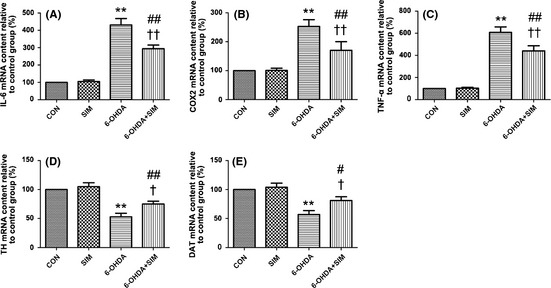
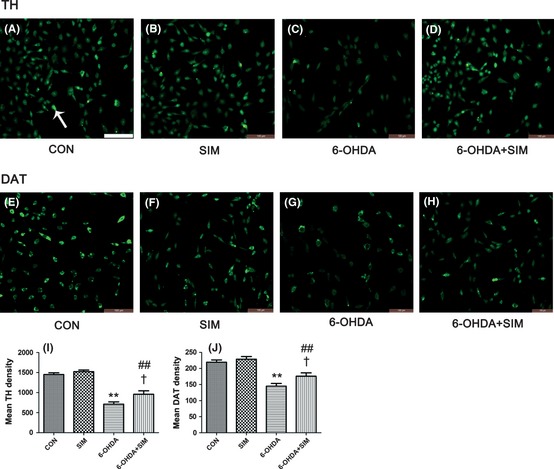
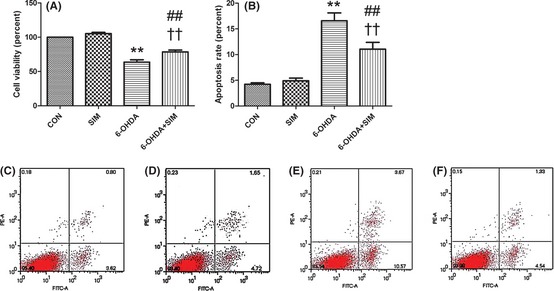
Results: Simvastatin-mediated neuroprotection was associated with a robust reduction in the upregulation induced by 6-OHDA of inflammatory mediators including IL-6, COX2, and TNF-α. The downregulated DAT and TH levels in 6-OHDA-lesioned PC12 were restored after simvastatin treatment. Simvastatin reversed 6-OHDA-induced downregulation of PI3K/Akt phosphorylation and attenuated 6-OHDA-induced upregulation of caspase 3 in PC12. Furthermore, the PI3K inhibitor LY294002 pronouncedly abolished the simvastatin-mediated attenuation in caspase 3.
Conclusions: Our results demonstrate that simvastatin provides robust neuroprotection against dopaminergic neurodegeneration, partially via antiinflammatory mechanisms and the PI3K/Akt/caspase 3 pathway. These findings contribute to a better understanding of the critical roles of simvastatin in treating PD and might elucidate the molecular mechanisms of simvastatin effects in PD.
© 2012 Blackwell Publishing Ltd.
Conflict of interest statement
The authors declare no conflict of interest.
Figures

References
-
- Dolga AM, Nijholt IM, Ostroveanu A, Ten Bosch Q, Luiten PG, Eisel UL. Lovastatin induces neuroprotection through tumor necrosis factor receptor 2 signaling pathways. J Alzheimers Dis 2008;13:111–122. - PubMed
-
- Wang Q, Yan J, Chen X, et al. Statins: Multiple neuroprotective mechanisms in neurodegenerative diseases. Exp Neurol 2011;230:27–34. - PubMed
-
- Arboleda G, Morales LC, Benítez B, Arboleda H. Regulation of ceramide‐induced neuronal death: Cell metabolism meets neurodegeneration. Brain Res Rev 2009;59:333–346. - PubMed
Publication types
MeSH terms
Substances
LinkOut - more resources
Full Text Sources
Medical
Research Materials
