. 2013 Feb 8;288(6):4405-15.
doi: 10.1074/jbc.M112.432344. Epub 2012 Dec 31.

C/EBP homologous protein (CHOP) contributes to suppression of metabolic genes during endoplasmic reticulum stress in the liver

Affiliations

C/EBP homologous protein (CHOP) contributes to suppression of metabolic genes during endoplasmic reticulum stress in the liver

Madhusudana R Chikka et al. J Biol Chem. .

Abstract

The unfolded protein response (UPR) senses stress in the endoplasmic reticulum (ER) and initiates signal transduction cascades that culminate in changes to gene regulation. Long recognized as a means for improving ER protein folding through up-regulation of ER chaperones, the UPR is increasingly recognized to play a role in the regulation of metabolic pathways. ER stress is clearly connected to altered metabolism in tissues such as the liver, but the mechanisms underlying this connection are only beginning to be elucidated. Here, working exclusively in vivo, we tested the hypothesis that the UPR-regulated CCAAT/enhancer-binding protein (C/EBP) homologous protein (CHOP) participates in the transcriptional regulation of metabolism during hepatic ER stress. We found that metabolic dysregulation was associated with induction of eIF2α signaling and CHOP up-regulation during challenge with tunicamycin or Velcade. CHOP was necessary for suppression of genes encoding the transcriptional master regulators of lipid metabolism: Cebpa, Ppara, and Srebf1. This action of CHOP required a contemporaneous CHOP-independent stress signal. CHOP bound directly to C/EBP-binding regions in the promoters of target genes, whereas binding of C/EBPα and C/EBPβ to the same regions was diminished during ER stress. Our results thus highlight a role for CHOP in the transcriptional regulation of metabolism.


Figures
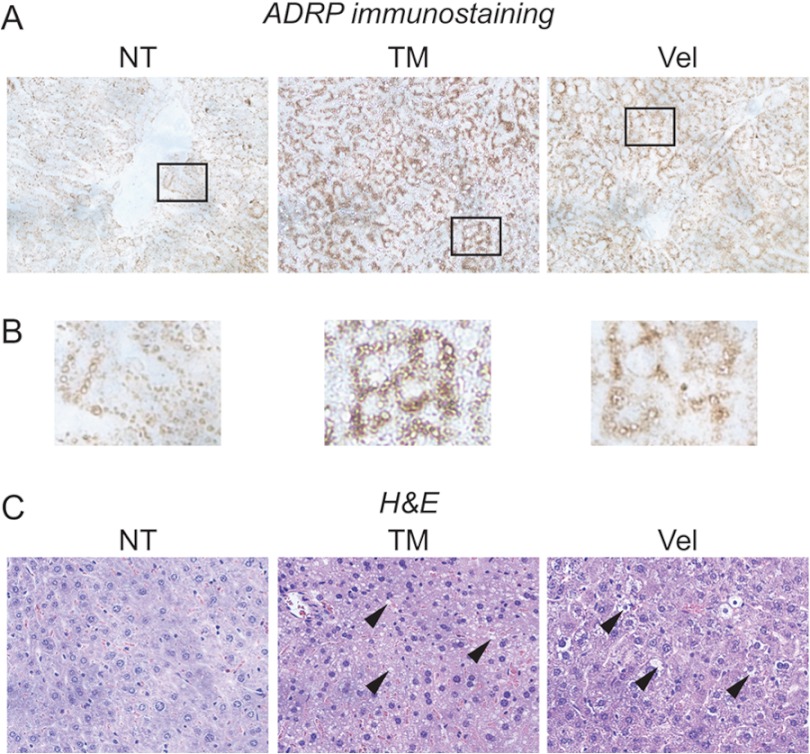
FIGURE 1.
FIGURE 1.
TM and Velcade promote hepatic lipid accumulation. A, wild-type C57BL/6J mice were injected intraperitoneally with TM or Velcade (Vel) at 1 mg/kg of body weight or with vehicle (non-treated (NT)). 24 h after challenge, livers were resected, and formalin-fixed paraffin-embedded sections were analyzed by IHC using an antibody against the lipid droplet marker protein ADRP. Samples were imaged using a 20× objective. Representative images from multiple animals are shown. B, zoomed-in images from A are shown. C, samples prepared similarly to those in A but stained with H&E are shown. Arrowheads denote non-eosinophilic cytoplasmic vacuoles.
FIGURE 2.
FIGURE 2.
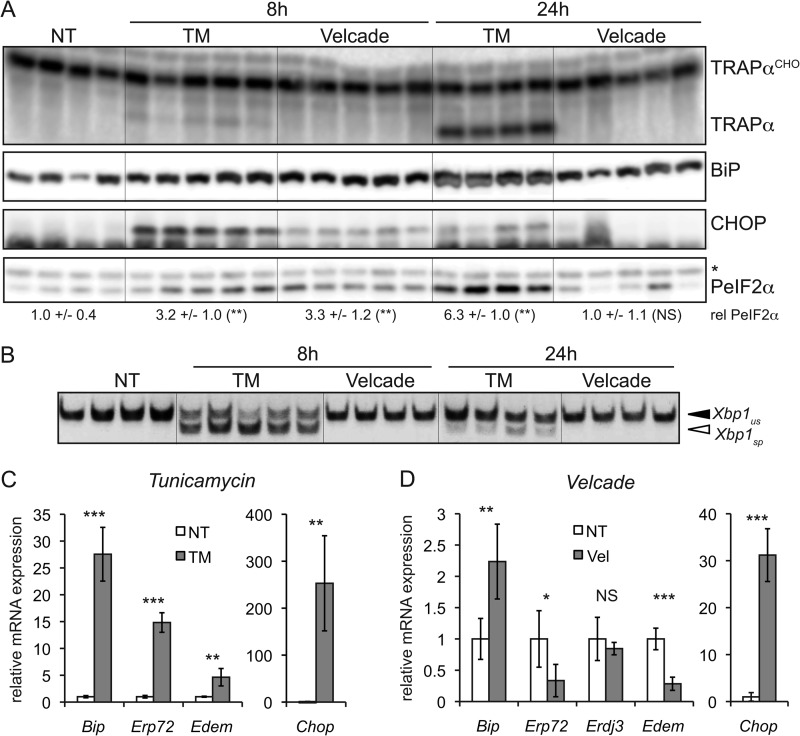
eIF2α signaling is common to TM and Velcade challenge. A, wild-type animals were challenged with TM or Velcade as described in the legend to Fig. 1, and livers were taken after 8 or 24 h of challenge. Samples were analyzed by immunoblotting for the indicated proteins. Glycosylated (TRAPαCHO) and unglycosylated forms of the ER-resident glycoprotein TRAPα are indicated. The asterisk represents a nonspecific band that indicates equivalent loading. The relative (rel) amount of phosphorylated eIF2α (PeIF2α) was quantitated by densitometry and is given below the blot. NT, non-treated. *, p < 0.05; **, p < 0.01; ***, p < 0.001; NS, p > 0.05 by two-tailed Student's t test. Error term represents means ± S.D. B, RNA was isolated from liver samples of animals treated as described for A, and the presence of spliced (sp) and unspliced (us) Xbp1 mRNAs was detected by RT-PCR. The image is black-to-white inverted for visual clarity. C and D, RNA prepared as described for B was analyzed by qRT-PCR for expression of the indicated genes in animals treated for 8 h with TM or Velcade (Vel). Expression was normalized to Gapdh and Hprt and is expressed relative to the level in vehicle-treated animals (n = three to five animals per group).
FIGURE 3.
FIGURE 3.
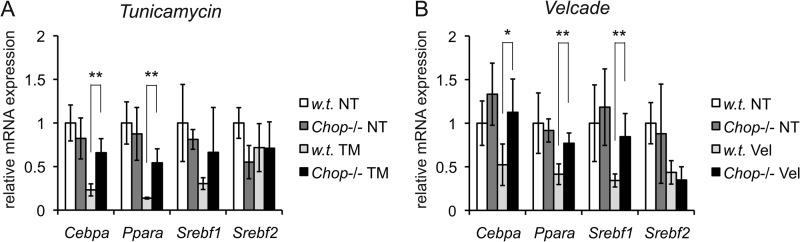
Expression of metabolic master regulators is suppressed in a CHOP-dependent manner. A and B, wild-type or Chop−/− mice were challenged with TM or Velcade for 8 h. Expression of Cebpa, Ppara, Srebf1, and Srebf2 in the liver was assessed by qRT-PCR as in the legend to Fig. 2 (n = three to five animals per group). *, p < 0.05; **, p < 0.01. NT, non-treated.
FIGURE 4.
FIGURE 4.
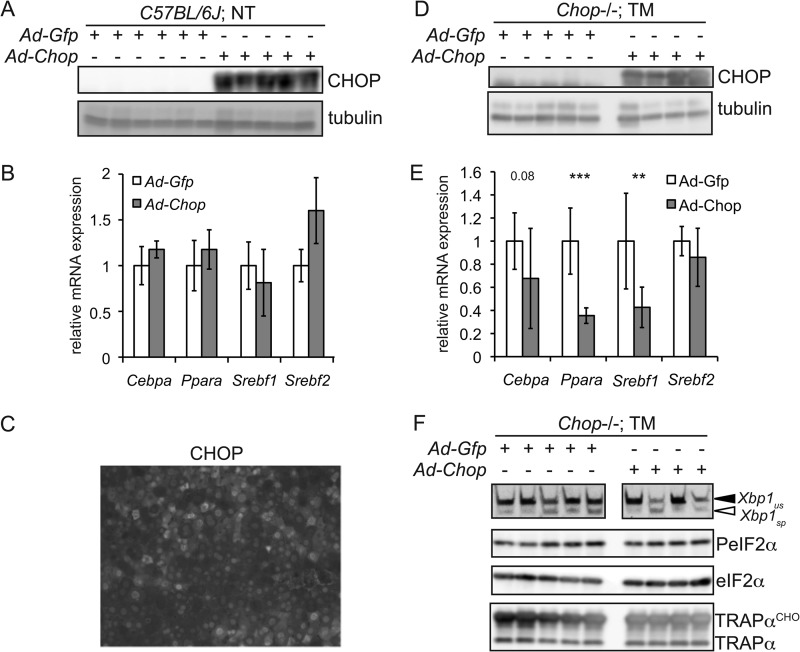
CHOP suppresses metabolic genes in the presence of a concomitant ER stress signal. A, wild-type mice were infected with recombinant adenovirus expressing either GFP (Ad-Gfp) or CHOP (Ad-Chop) by tail vein injection. Livers were analyzed by immunoblotting for expression of CHOP or tubulin as a loading control. NT, non-treated. B, expression of the indicated mRNAs from animals in A was assessed by qRT-PCR. C, formalin-fixed paraffin-embedded liver sections from Chop−/− animals injected with Ad-Chop were assessed for expression of CHOP by fluorescent IHC. A representative image is shown. Note that the majority of cells show CHOP-positive nuclei. D, Chop−/− animals were infected with Ad-Gfp or Ad-Chop. Animals were then challenged with 1 mg/kg TM for 8 h. Expression of CHOP and tubulin was assessed by immunoblotting of liver lysates. E, expression of the indicated mRNAs from two separate experiments as described for D was assessed by qRT-PCR (Ad-Gfp, n = 8; Ad-Chop, n = 9). **, p < 0.01; ***, p < 0.001. F, livers from animals treated as described for D were assessed for Xbp1 splicing by RT-PCR or for eIF2α phosphorylation (PeIF2α) and TRAPα glycosylation (TRAPαCHO) by immunoblotting. Spliced (sp) and unspliced (us) Xbp1 mRNAs are shown.
FIGURE 5.
FIGURE 5.
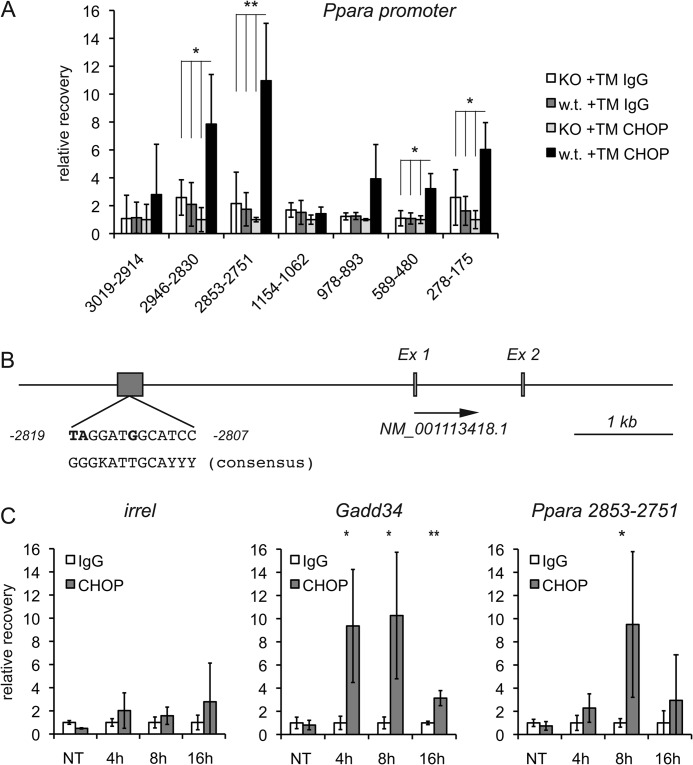
CHOP binds directly to the Ppara promoter/enhancer. A, wild-type or Chop−/− mice were treated with 1 mg/kg TM for 8 h. Livers were fixed in formaldehyde, homogenized, and sonicated to shear chromatin, and immune complexes were purified using anti-CHOP monoclonal antibody or an equal mass of normal mouse IgG. Recovered DNA was amplified by qPCR, and recovery is expressed relative to that in Chop−/− animals using anti-CHOP antibody after quantitating recovery relative to immunoprecipitation input. The numbers indicate bases upstream of the Ppara TSS. t tests were performed comparing recovery in wild-type TM-treated animals using anti-CHOP antibody against all other conditions. The most conservative p value among these comparisons is shown and is indicated only when all three comparisons were significant. Error bars represent S.D. from four animals per group. *, p < 0.05; **, p < 0.01. KO, knock-out. B, a scaled schematic of the Ppara promoter/enhancer region shows the TSS (arrow) and the region of CHOP binding, along with a comparison of the Ppara sequence and the C/EBPα-CHOP consensus sequence, with non-matching bases in boldface. Ex, exon. C, wild-type animals were treated with vehicle (non-treated (NT)) or 1 mg/kg TM for the indicated times, followed by ChIP using anti-CHOP or control antibody. The strongest CHOP-binding region of the Ppara promoter, the known CHOP-binding region of the Gadd34 promoter (28), or an irrelevant promoter sequence (irrel) was amplified by qPCR. Recovery is expressed relative to non-immune IgG at each time point (n = 3).
FIGURE 6.
FIGURE 6.
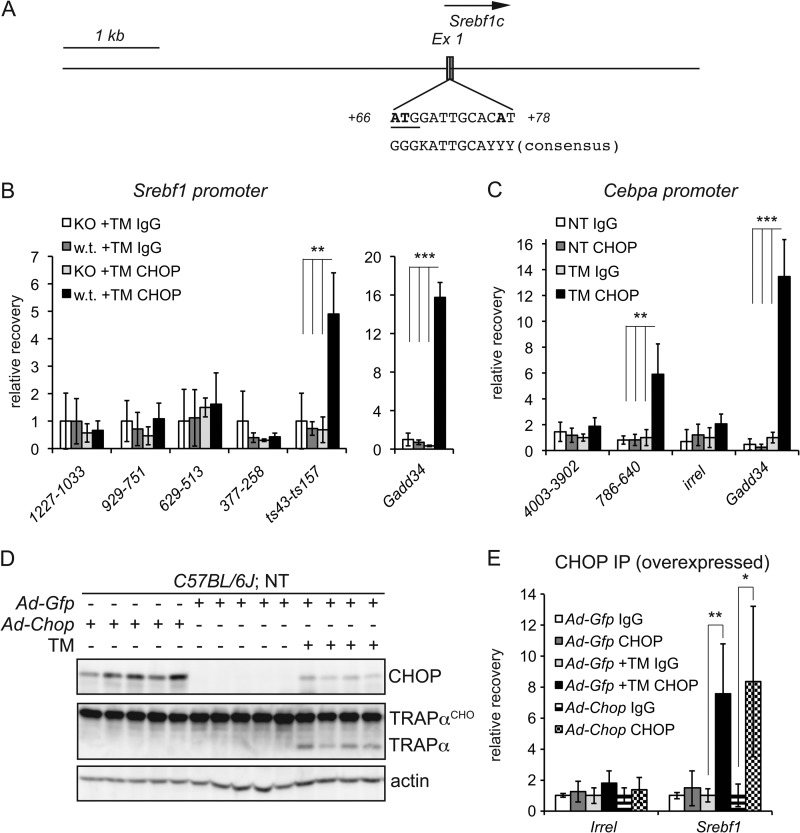
CHOP binds to the Srebf1c and Cebpa promoter/enhancer regions. A, a scaled schematic of the Srebf1c promoter/enhancer region shows the TSS (arrow) along with the putative CHOP-binding region, which overlaps exon 1 (Ex 1) and contains the indicated C/EBPα-CHOP-like binding site. Non-matching bases are in boldface. The site overlaps the SREBF1c start codon, which is underlined. B, binding of CHOP to the Srebf1c 1-kb proximal promoter was analyzed by ChIP as described in the legend to Fig. 5A. ts43-ts157 denotes a region 43–157 bp downstream of the TSS and encompassing the putative C/EBPα-CHOP site. Binding is given relative to Chop−/− animals using a non-immune antibody. For comparison, CHOP binding to the Gadd34 promoter from the same experiment is shown (n = 4). **, p < 0.01; ***, p < 0.001. KO, knock-out. C, CHOP binding to a region ∼700 bp upstream of the Cebpa TSS is shown, along with a more distal region 4 kb upstream and an irrelevant genomic sequence (irrel) as negative controls and the Gadd34 promoter as a positive control (n = 4). NT, non-treated. D, wild-type animals were injected with Ad-Gfp or Ad-Chop as described in the legend to Fig. 4, and one group of Ad-Gfp-injected animals was treated with TM for 8 h to induce endogenous CHOP expression. Expression of CHOP and efficacy of TM treatment as determined by immunoblotting are shown. TRAPαCHO, glycosylated TRAPα. E, binding of CHOP to an irrelevant genomic region or to the ts43-ts157 region of the Srebf1 promoter was tested by ChIP in four animals per group from the experiment shown in D. *, p < 0.05.
FIGURE 7.
FIGURE 7.
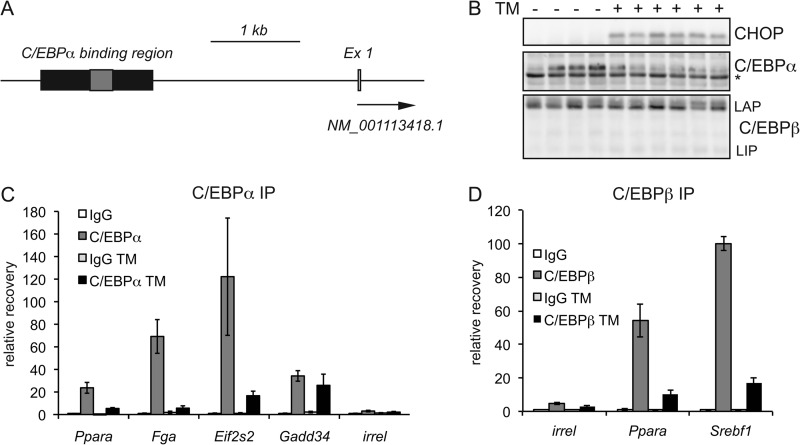
CHOP binds to C/EBPα sites in diverse promoters. A, a schematic of the Ppara promoter shows overlap between the ChIP-defined CHOP-binding region (gray box) and a C/EBPα-binding region defined by ChIP-seq (black box) (40). Ex 1, exon 1. B, expression of C/EBPα and the LIP and LAP (liver-enriched transcriptional activating protein) forms of C/EBPβ following 8 h of treatment with TM as determined by immunoblotting. The asterisk indicates a nonspecific band showing equal loading. For C/EBPα, only the long form of the protein is shown; the 30-kDa short form could not be unambiguously identified. C, promoter/enhancer regions from the indicated genes were assessed for C/EBPα binding by ChIP (IP). For Ppara and Gadd34, primers spanning CHOP-binding regions were used for qPCR. For Fga and Eif2s2, primers covered regions identified by ChIP-seq. Association with an irrelevant genomic sequence (irrel) is also shown. ChIP used anti-C/EBPα or control antibody in animals treated for 8 h with vehicle or 1 mg/kg TM (n = 4). D, binding of C/EBPβ (using an antibody that recognizes both LAP and LIP forms of the protein) to the CHOP-binding sites of the Ppara and Srebf1 promoters or to an irrelevant genomic sequence was assessed by ChIP after 8 h of TM challenge.

References

    1. Walter P., Ron D. (2011) The unfolded protein response: from stress pathway to homeostatic regulation. Science 334, 1081–1086 - PubMed
    1. Rutkowski D. T., Hegde R. S. (2010) Regulation of basal cellular physiology by the homeostatic unfolded protein response. J. Cell Biol. 189, 783–794 - PMC - PubMed
    1. Harding H. P., Novoa I., Zhang Y., Zeng H., Wek R., Schapira M., Ron D. (2000) Regulated translation initiation controls stress-induced gene expression in mammalian cells. Mol. Cell 6, 1099–1108 - PubMed
    1. Harding H. P., Zhang Y., Bertolotti A., Zeng H., Ron D. (2000) Perk is essential for translational regulation and cell survival during the unfolded protein response. Mol. Cell 5, 897–904 - PubMed
    1. Kang S. W., Rane N. S., Kim S. J., Garrison J. L., Taunton J., Hegde R. S. (2006) Substrate-specific translocational attenuation during ER stress defines a pre-emptive quality control pathway. Cell 127, 999–1013 - PMC - PubMed

Publication types

MeSH terms

Substances