


The p-i Concept: Pharmacological Interaction of Drugs With Immune Receptors
- PMID: 23282405
- PMCID: PMC3651037
- DOI: 10.1097/WOX.0b013e3181778282
The p-i Concept: Pharmacological Interaction of Drugs With Immune Receptors
Abstract
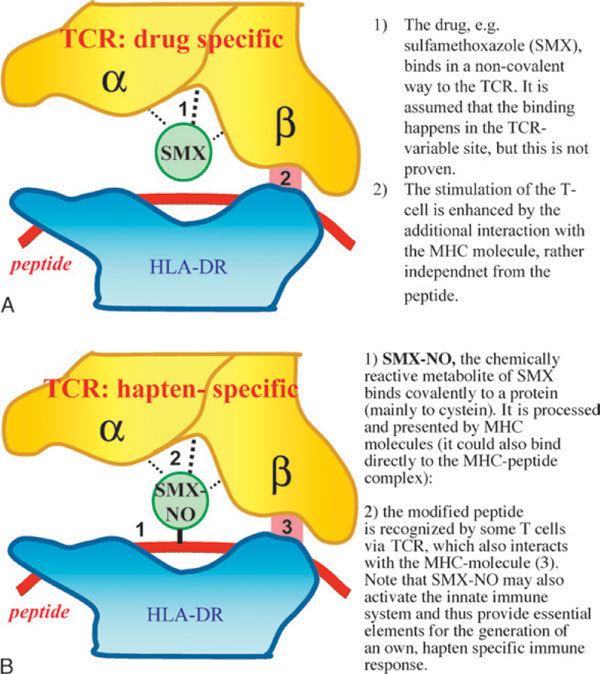
The immune response in drug hypersensitivity is normally explained by the hapten hypothesis. It postulates that drugs with a molecular weight of less than 1000 D are too small to cause an immune response per se. However, if a chemically reactive drug or drug metabolite binds covalently to a protein and thus forms a so-called hapten-carrier complex, this modified protein can induce an immune response. This concept has recently been supplemented by the p-i concept (or pharmacological interaction with immune receptors), which postulates that some drugs that lack hapten characteristics can bind directly and reversibly (noncovalently) to immune receptors and thereby stimulate the cells. For example, a certain drug may bind to a particular T-cell receptor, and this binding suffices to stimulate the T cell to secrete cytokines, to proliferate, and to exert cytotoxicity. The p-i concept has major implications for our understanding of drug interaction with the specific immune system and for drug hypersensitivity reactions. It is based on extensive investigations of T-cell clones reacting with the drug and recently of hybridoma cells transfected with the drug-specific T-cell receptor for antigen (TCR). It is a highly specific interaction dependent on the expression of a TCR into which the drug can bind with sufficient affinity to cause signaling. Small modification of the drug structure may already abrogate reactivity. Stimulation of T cells occurs within minutes as revealed by rapid Ca influx after drug addition to drug-specific T-cell clones or hybridoma cells, thus, before metabolism and processing can occur. As the immune system can only react in an immunologic way, the symptoms arising after drug stimulation of immune receptors imitate an immune response after recognition of a peptide antigen, although it is actually a pharmacological stimulation of some T cells via their TCRs. Clinically, the p-i concept could explain the sometimes rapid appearance of symptoms without previous sensitizations and the sometimes chaotic immune reaction of drug hypersensitivity with participation of different immune mechanisms while normal immune reactions to antigens are highly coordinated. Nevertheless, because the reactions lead to expansion of drug-reactive cells, many features such as skin test reactivity and stronger reactivity upon reexposure are identical to real immune reactions.
Figures

References
-
- Pichler WJ. Drug Hypersensitivity. 2007. Karger, Basel.
-
- Gamerdinger K, Moulon C, Karp DR, Van Bergen J, Koning F, Wild D. et al. A new type of metal recognition by human T cells: contact residues for peptide-independent bridging of T cell receptor and major histocompatibility complex by nickel. J Exp Med. 2003;1:1345–1353. doi: 10.1084/jem.20030121. - DOI - PMC - PubMed
LinkOut - more resources
Full Text Sources
Research Materials
Miscellaneous
