


Food sharing in vampire bats: reciprocal help predicts donations more than relatedness or harassment
- PMID: 23282995
- PMCID: PMC3574350
- DOI: 10.1098/rspb.2012.2573
Food sharing in vampire bats: reciprocal help predicts donations more than relatedness or harassment
Abstract
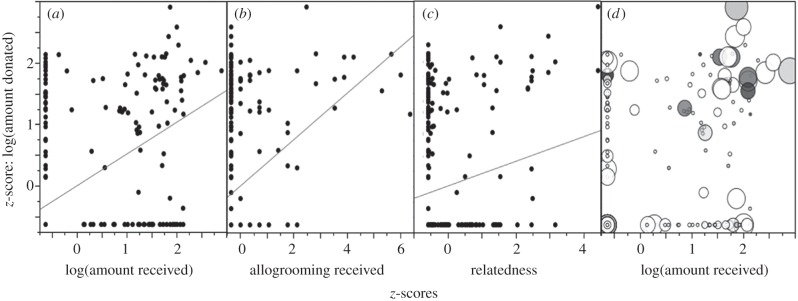
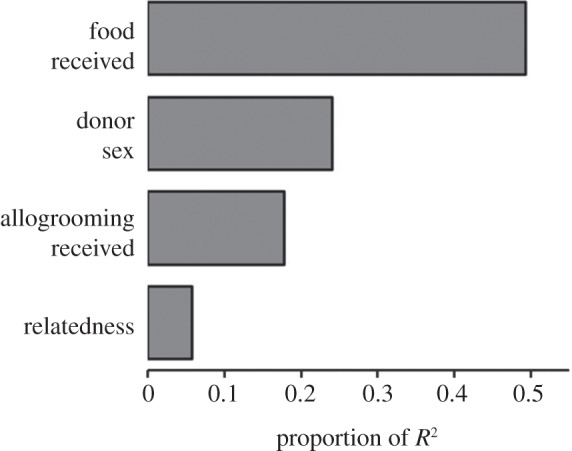
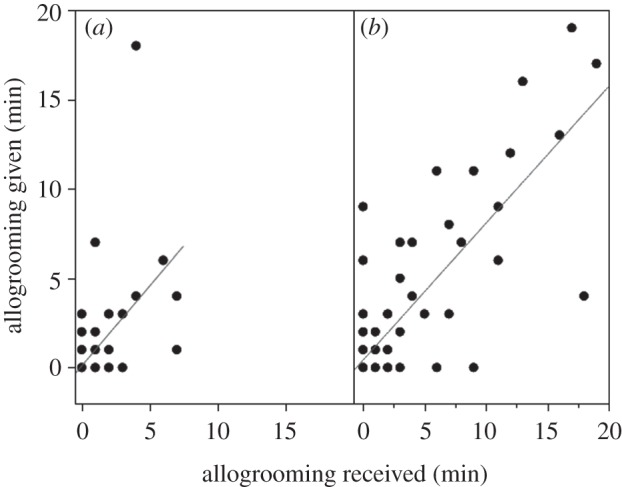
Common vampire bats often regurgitate food to roost-mates that fail to feed. The original explanation for this costly helping behaviour invoked both direct and indirect fitness benefits. Several authors have since suggested that food sharing is maintained solely by indirect fitness because non-kin food sharing could have resulted from kin recognition errors, indiscriminate altruism within groups, or harassment. To test these alternatives, we examined predictors of food-sharing decisions under controlled conditions of mixed relatedness and equal familiarity. Over a 2 year period, we individually fasted 20 vampire bats (Desmodus rotundus) and induced food sharing on 48 days. Surprisingly, donors initiated food sharing more often than recipients, which is inconsistent with harassment. Food received was the best predictor of food given across dyads, and 8.5 times more important than relatedness. Sixty-four per cent of sharing dyads were unrelated, approaching the 67 per cent expected if nepotism was absent. Consistent with social bonding, the food-sharing network was consistent and correlated with mutual allogrooming. Together with past work, these findings support the hypothesis that food sharing in vampire bats provides mutual direct fitness benefits, and is not explained solely by kin selection or harassment.
Figures
Comment in
-
Social evolution: reciprocity there is.Curr Biol. 2013 Jun 3;23(11):R486-8. doi: 10.1016/j.cub.2013.04.041. Curr Biol. 2013. PMID: 23743416
References
-
- West S, Griffin A, Gardner A. 2007. Evolutionary explanations for cooperation. Curr. Biol. 17, R661–R672 10.1016/j.cub.2007.06.004 (doi:10.1016/j.cub.2007.06.004) - DOI - PubMed
-
- Griffin A, West S. 2003. Kin discrimination and the benefit of helping in cooperatively breeding vertebrates. Science 302, 634. 10.1126/science.1089402 (doi:10.1126/science.1089402) - DOI - PubMed
-
- Ratnieks F, Wenseleers T. 2008. Altruism in insect societies and beyond: voluntary or enforced? Trends Ecol. Evol. 23, 45–52 10.1016/j.tree.2007.09.013 (doi:10.1016/j.tree.2007.09.013) - DOI - PubMed
-
- Noë R, Hammerstein P. 1994. Biological markets: supply and demand determine the effect of partner choice in cooperation, mutualism and mating. Behav. Ecol. Sociobiol. 35, 1–11 10.1007/BF00167053 (doi:10.1007/BF00167053) - DOI
-
- Fruteau C, Lemoine S, Hellard E, van Damme E, Noë R. 2011. When females trade allogrooming for allogrooming: testing partner control and partner choice models of cooperation in two primate species. Anim. Behav. 81, 1223–1230 10.1016/j.anbehav.2011.03.008 (doi:10.1016/j.anbehav.2011.03.008) - DOI
Publication types
MeSH terms
LinkOut - more resources
Full Text Sources
Other Literature Sources
Miscellaneous
