


Socioeconomic trajectories from birth to adolescence and risk factors for noncommunicable disease: prospective analyses
- PMID: 23283158
- PMCID: PMC3508416
- DOI: 10.1016/j.jadohealth.2012.06.022
Socioeconomic trajectories from birth to adolescence and risk factors for noncommunicable disease: prospective analyses
Abstract
Purpose: To evaluate the associations between family socioeconomic trajectories from 0 to 11 years of age and risk factors for noncommunicable disease at 15 years.
Methods: Individuals born in the city of Pelotas, Brazil, in 1993 are part of a birth cohort study. Socioeconomic position, collected at birth and at 11 years of age, was our main exposure. Risk factors for chronic disease were collected at 15 years. Body mass index was transformed into Z score using the World Health Organization standard. Transport and leisure-time physical activity, smoking, and alcohol consumption were assessed by self-report. Blood pressure was measured using a digital sphygmomanometer.
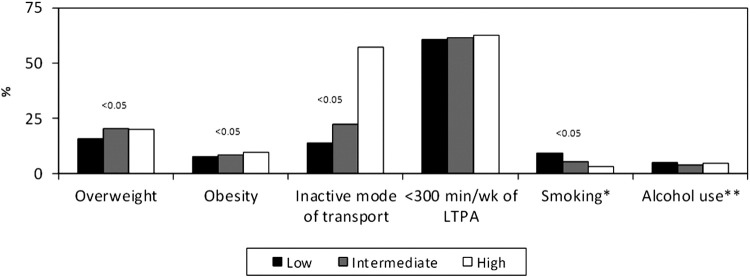
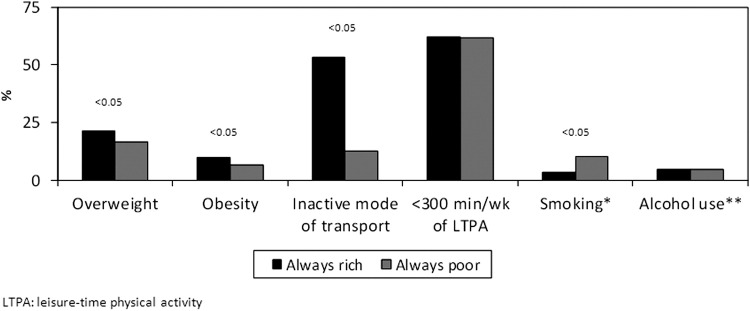
Results: Of 5,249 cohort members, 85.7% were located at the 15-year follow-up visit. Rich adolescents were more likely to be overweight, be obese, and not use active modes of transport to school. Poor adolescents were more likely to smoke. In relation to socioeconomic trajectories, the odds of obesity were 46% higher among those who were "always rich" compared with those who were "always poor"; the odds of use of an inactive mode of transportation were 326% greater among the "always rich" than the "always poor," whereas the reverse was observed for smoking (odds of 200%). The "always rich" had one-half the odds of walking or cycling to school compared with those who became wealthy in the studied period.
Conclusions: Adolescent socioeconomic position is a stronger determinant of risk factors for noncommunicable diseases than socioeconomic trajectories. However, trajectories do matter, particularly in terms of use of active transportation to school.
Copyright © 2012 Society for Adolescent Health and Medicine. Published by Elsevier Inc. All rights reserved.
Figures
References
-
- Huotari P., Nupponen H., Mikkelsson L. Adolescent physical fitness and activity as predictors of adulthood activity. J Sports Sci. 2011;29:1135–1141. - PubMed
-
- Paul S.L., Blizzard L., Patton G.C. Parental smoking and smoking experimentation in childhood increase the risk of being a smoker 20 years later: The childhood determinants of adult health study. Addiction. 2008;103:846–853. - PubMed
-
- Marmot M., Friel S., Bell R. Closing the gap in a generation: Health equity through action on the social determinants of health. Lancet. 2008;372:1661–1669. - PubMed
Publication types
MeSH terms
Grants and funding
LinkOut - more resources
Full Text Sources
Medical
