. 2013 Jan 2;33(1):64-71.
doi: 10.1523/JNEUROSCI.2371-12.2013.

Sortilin and SorLA display distinct roles in processing and trafficking of amyloid precursor protein

Affiliations

Sortilin and SorLA display distinct roles in processing and trafficking of amyloid precursor protein

Camilla Gustafsen et al. J Neurosci. .

Abstract

The development and progression of Alzheimer's disease is linked to excessive production of toxic amyloid-β peptide, initiated by β-secretase cleavage of the amyloid precursor protein (APP). In contrast, soluble APPα (sAPPα) generated by the α-secretase is known to stimulate dendritic branching and enhance synaptic function. Regulation of APP processing, and the shift from neurotrophic to neurotoxic APP metabolism remains poorly understood, but the cellular localization of APP and its interaction with various receptors is considered important. We here identify sortilin as a novel APP interaction partner. Like the related APP receptor SorLA, sortilin is highly expressed in the CNS, but whereas SorLA mainly colocalizes with APP in the soma, sortilin interacts with APP in neurites. The presence of sortilin promotes α-secretase cleavage of APP, unlike SorLA, which inhibits the generation of all soluble products. Also, sortilin and SorLA both bind and mediate internalization of sAPP but to different cellular compartments. The interaction involves the 6A domain of APP, present in both neuronal and non-neuronal APP isoforms. This is important as sAPP receptors described so far only bind the non-neuronal isoforms, leaving SorLA and sortilin as the only receptors for sAPP generated by neurons. Together, our findings establish sortilin, as a novel APP interaction partner that influences both production and cellular uptake of sAPP.


Figures
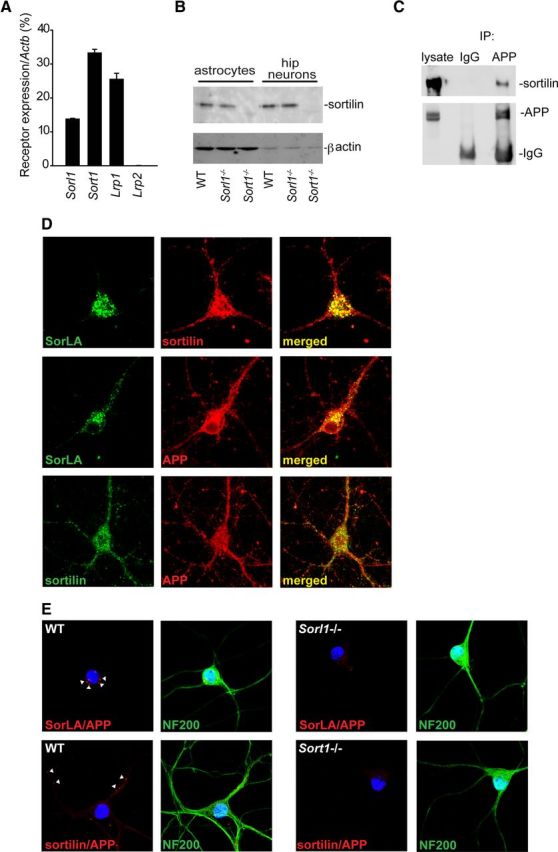
Figure 1.
Figure 1.
Sortilin is highly expressed in the CNS and colocalize with APP in neurites of hippocampal neurons. A, Quantitative RT-PCR analysis of the receptor genes Sort1, Sorl1, Lrp1, and Lrp2. Expression was normalized to Actb (β-actin) levels (mean values with SDs, n = 4 mice). B, Western blot (WB) analysis of sortilin in astrocytes and neurons obtained from WT, Sorl1−/−, and Sort1−/− mice. Note the difference in protein concentration between astrocyte and neuron lysates. C, Immunoprecipitation (IP) of sortilin and APP from hippocampal neurons. Unspecific IgG was used as control. Precipitated proteins were analyzed by WB. D, Immunofluorescence staining of sortilin, SorLA, and APP in WT hippocampal neurons. E, PLA analysis of WT hippocampal neurons followed by immunostaining for neurofilament 200 (NF200). Red spots (marked with white arrowheads) indicate colocalization of APP with sortilin and SorLA, respectively. Sort1−/− and Sorl1−/− neurons are included as negative controls.
Figure 2.
Figure 2.
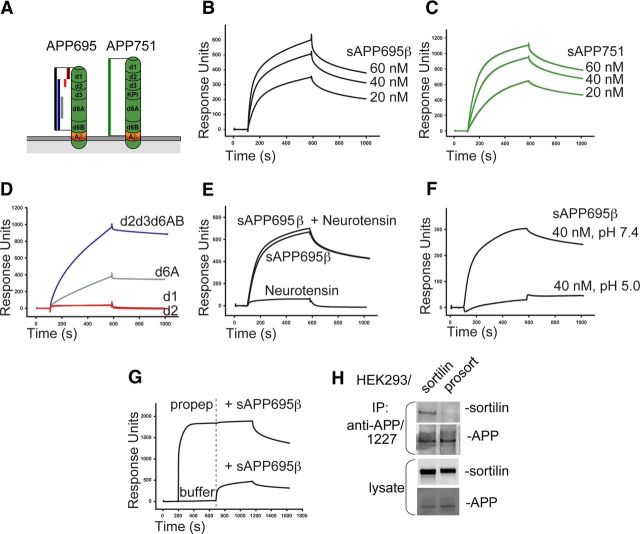
Mature sortilin interacts with APP isoforms 695 and 751 at neutral pH. A, The domain structure of APP isoforms 695 and 751 depicted with color code. B–G, SPR analysis of the interaction between APP fragments and immobilized sortilin (extracellular domain) demonstrating binding of sAPP695β (B) and sAPP751 (C) at concentrations of 20–60 nm, and APP fragments (60 nm) containing the domain 6A (d6A) (D). The interaction between sAPP695β (40 nm) and sortilin was not by inhibited by neurotensin (E), but by acidic pH (F). In addition, the interaction was inhibited by GST-sortilin propeptide (propep) binding to sortilin before addition of sAPP695β (indicated by a dotted line; G). H, Co-IP analysis of APP and sortilin from HEK293 cells transfected with sortilin or prosortilin. Precipitated proteins were analyzed by WB. Please note the difference in molecular weight between sortilin and prosortilin.
Figure 3.
Figure 3.
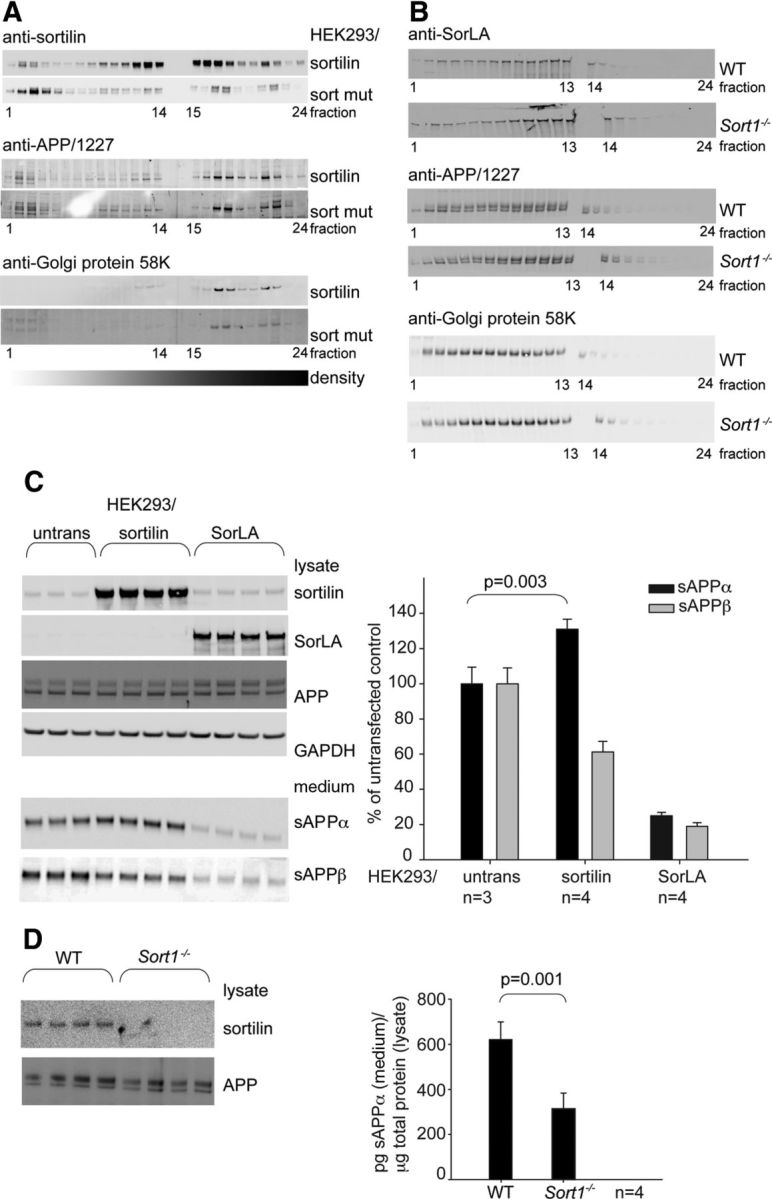
Sortilin pushes APP toward production of sAPPα. A, Subcellular fractionation by Optiprep gradient centrifugation of HEK293 cells stably transfected with sortilin or sort mut. WB analysis of sortilin, endogenous APP, and Golgi protein 58K in fractions 1–24. B, Subcellular distribution of APP in whole brain homogenates from WT and Sort1−/− mice assess by continuous sucrose gradient centrifugation. WB analysis of SorLA, APP, and Golgi protein 58K in fractions 1–24. C, The APP metabolism in HEK293 cells stably transfected as indicated was analyzed by WB detection of sAPPα and sAPPβ in 48 h conditioned medium. Bands were quantified by densitometry and bar graphs show mean values (n as indicated) with SD of the sAPP levels in percentage of untransfected control. The expression of sortilin, SorLA, APP, and GAPDH in the corresponding lysates is shown. D, The level of sAPPα in conditioned medium of hippocampal neurons obtained from WT and Sort1−/− mice was analyzed by ELISA. Bar graphs show mean values with SD (n = 4) of pg sAPPα/μg total protein in the corresponding lysate. WBs show expression of APP and sortilin in lysates.
Figure 4.
Figure 4.
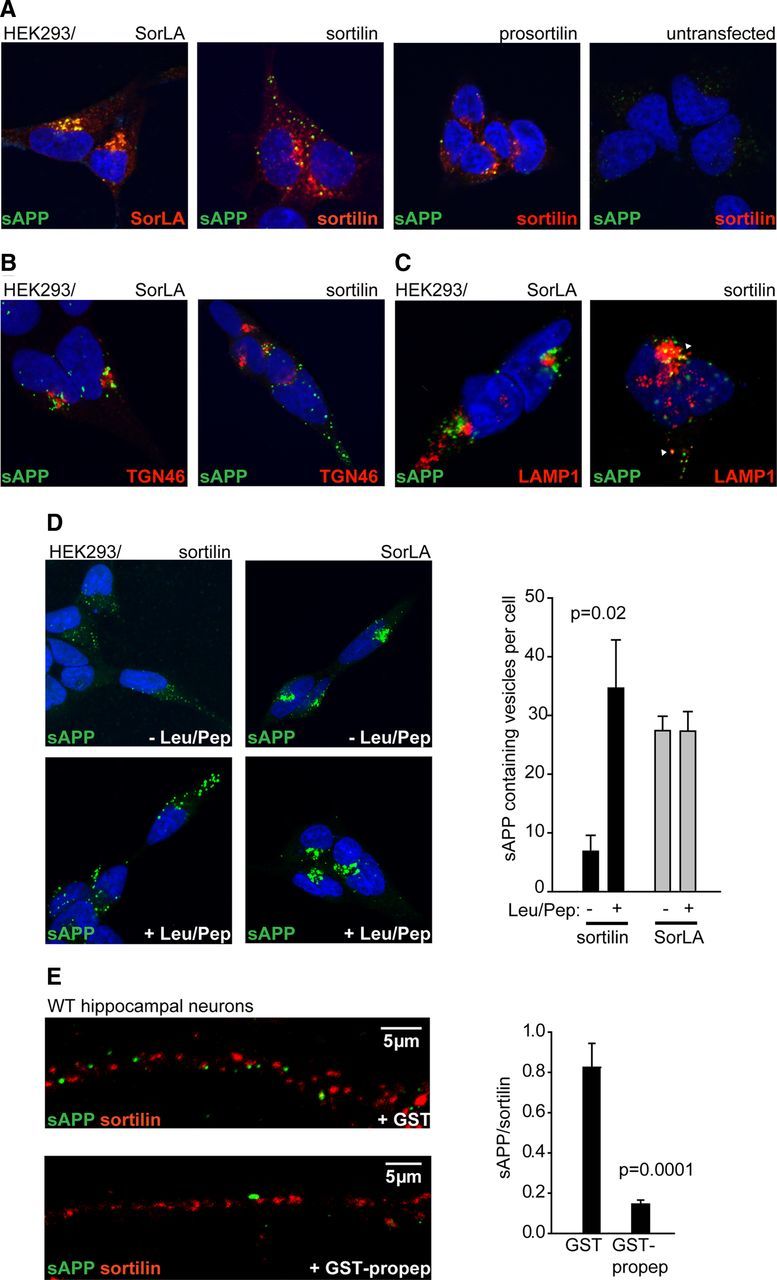
Sortilin and SorLA direct sAPP to distinct cellular compartments. A–C, HEK293 cells, transfected as indicated, were incubated with 20 nm Alexa Fluor 488-labeled sAPP751 for 40 min at 37°C. Cells were subsequently stained with anti-sortilin/F11 or anti-SorLA/20C11 antibodies (A), anti-TGN46 (B), or anti-LAMP1 (C; arrowheads indicate colocalization). D, Uptake of sAPP in sortilin or SorLA-transfected cells pretreated with lysosomal protease inhibitors leupeptin/pepstatin (Leu/Pep). Number of sAPP-containing vesicles were quantified and mean values with SEM is shown as bar graphs, n = 30 cells/condition. E, The uptake of sAPP (20 nm) in WT hippocampal neurites with addition of receptor propeptide fused to GST (3 μm) or GST alone was inspected in at least 100 cells per coverslip from eight coverslips from two independent cultures. The number of sAPP-positive vesicles in randomly selected neurites was quantified and normalized to the number of sortilin-positive vesicles, and is shown as bar graphs of mean values. Error bars indicate SEM.

References

    1. Andersen OM, Reiche J, Schmidt V, Gotthardt M, Spoelgen R, Behlke J, von Arnim CA, Breiderhoff T, Jansen P, Wu X, Bales KR, Cappai R, Masters CL, Gliemann J, Mufson EJ, Hyman BT, Paul SM, Nykjaer A, Willnow TE. Neuronal sorting protein-related receptor sorLA/LR11 regulates processing of the amyloid precursor protein. Proc Natl Acad Sci U S A. 2005;102:13461–13466. - PMC - PubMed
    1. Andersen OM, Schmidt V, Spoelgen R, Gliemann J, Behlke J, Galatis D, McKinstry WJ, Parker MW, Masters CL, Hyman BT, Cappai R, Willnow TE. Molecular dissection of the interaction between amyloid precursor protein and its neuronal trafficking receptor SorLA/LR11. Biochemistry. 2006;45:2618–2628. - PubMed
    1. Bour A, Little S, Dodart JC, Kelche C, Mathis C. A secreted form of the beta-amyloid precursor protein (sAPP695) improves spatial recognition memory in OF1 mice. Neurobiol Learn Mem. 2004;81:27–38. - PubMed
    1. Cam JA, Zerbinatti CV, Knisely JM, Hecimovic S, Li Y, Bu G. The low density lipoprotein receptor-related protein 1B retains beta-amyloid precursor protein at the cell surface and reduces amyloid-beta peptide production. J Biol Chem. 2004;279:29639–29646. - PubMed
    1. Cramer JF, Gustafsen C, Behrens MA, Oliveira CL, Pedersen JS, Madsen P, Petersen CM, Thirup SS. GGA autoinhibition revisited. Traffic. 2010;11:259–273. - PubMed

Publication types

Substances