Review
. 2013 Jan 1;5(1):a011106.
doi: 10.1101/cshperspect.a011106.

Where killers meet--permeabilization of the outer mitochondrial membrane during apoptosis

Affiliations
Review

Where killers meet--permeabilization of the outer mitochondrial membrane during apoptosis

Tom Bender et al. Cold Spring Harb Perspect Biol. .

Abstract

Although mitochondria are usually considered as supporters of life, they are also involved in cellular death. Mitochondrial outer membrane permeabilization (MOMP) is a crucial event during apoptosis because it causes the release of proapoptotic factors from the mitochondrial intermembrane space to the cytosol. MOMP is mainly controlled by the Bcl-2 family of proteins, which consists of both proapoptotic and antiapoptotic members. We discuss the current understanding of how activating and inhibitory interactions within this family lead to the activation and oligomerization of MOMP effectors Bax and Bak, which result in membrane permeabilization. The order of events leading to MOMP is then highlighted step by step, emphasizing recent discoveries regarding the formation of Bax/Bak pores on the outer mitochondrial membrane. Besides the Bcl-2 proteins, the mitochondrial organelle contributes to and possibly regulates MOMP, because mitochondrial resident proteins and membrane lipids are prominently involved in the process.


Figures
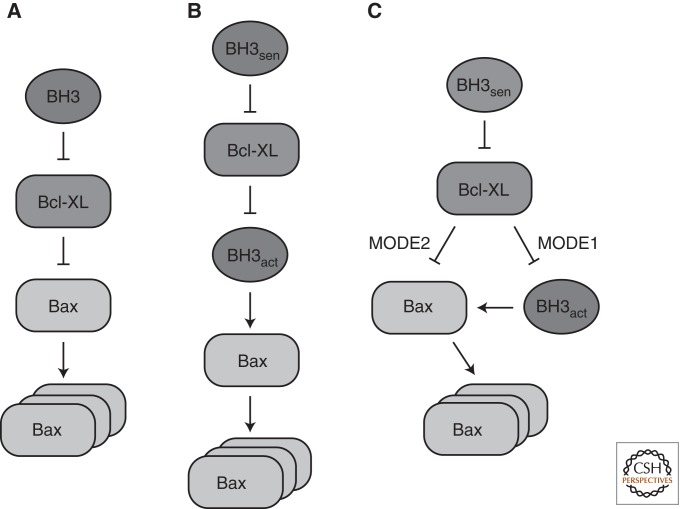
Figure 1.
Figure 1.
Models for activation of MOMP effectors. (A) Derepressor model. (B) Direct activator model. (C) Current model, which is a refinement of the two former models. Antiapoptotic Bcl-2-like Bcl-XL proteins inhibit both direct activator BH3-proteins (MODE1) and effectors Bax and Bak (MODE2). Inhibition through Bcl-XL is relieved by sensitizer BH3-only proteins.
Figure 2.
Figure 2.
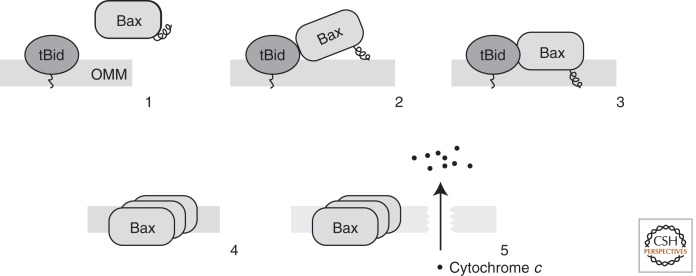
The order of events leading to MOMP. At first, an activator BH3 protein like tBid is targeted to the membrane (Step 1), which binds and recruits Bax to the membrane (Step 2). Upon activation, Bax exposes its carboxy-terminal membrane-anchor helix and becomes membrane integrated (Step 3). Activated Bax homo-oligomerizes (Step 4), which causes the formation of pores so that proapoptotic contents of the mitochondrial intermembrane space like cytochrome c can be released (Step 5).
Figure 3.
Figure 3.
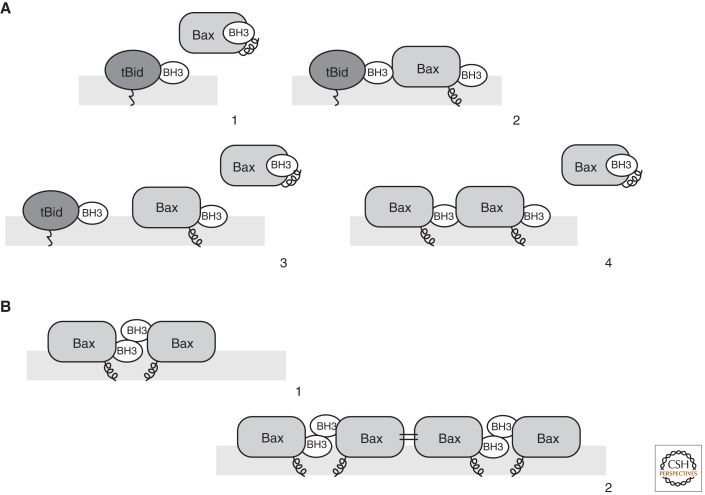
Bax activation and oligomerization. (A) Asymmetric autoactivation of Bax. Membrane-embedded tBid interacts through its BH3 domain with Bax at its rear pocket (Step 1). This results not only in the exposure of the Bax carboxy-terminal helix, but also in the exposure of the BH3 domain of Bax (Step 2). According to the asymmetric autoactivation model, the exposed BH3 domain of Bax can recruit further Bax molecules to the OMM (Step 3) and activate them (Step 4). (B) Symmetric dimer formation causes Bax oligomerization. Activated Bax, which exposes its BH3 domain, forms symmetric dimers by a reciprocal interaction of one molecule’s BH3 domain with the hydrophobic groove of another, and vice versa (Step 1). Bax dimers can then form higher-order oligomers through another symmetric interaction involving the α-helices 6 at the surface opposite from the BH3–groove interaction (Step 2).

References

    1. Annis MG, Soucie EL, Dlugosz PJ, Cruz-Aguado JA, Penn LZ, Leber B, Andrews DW 2005. Bax forms multispanning monomers that oligomerize to permeabilize membranes during apoptosis. EMBO J 24: 2096–2103 - PMC - PubMed
    1. Antonsson B, Conti F, Ciavatta A, Montessuit S, Lewis S, Martinou I, Bernasconi L, Bernard A, Mermod JJ, Mazzei G, et al. 1997. Inhibition of Bax channel-forming activity by Bcl-2. Science 277: 370–372 - PubMed
    1. Baines CP, Kaiser RA, Purcell NH, Blair NS, Osinska H, Hambleton MA, Brunskill EW, Sayen MR, Gottlieb RA, Dorn GW, et al. 2005. Loss of cyclophilin D reveals a critical role for mitochondrial permeability transition in cell death. Nature 434: 658–662 - PubMed
    1. Baines CP, Kaiser RA, Sheiko T, Craigen WJ, Molkentin JD 2007. Voltage-dependent anion channels are dispensable for mitochondrial-dependent cell death. Nat Cell Biol 9: 550–555 - PMC - PubMed
    1. Basanez G, Sharpe JC, Galanis J, Brandt TB, Hardwick JM, Zimmerberg J 2002. Bax-type apoptotic proteins porate pure lipid bilayers through a mechanism sensitive to intrinsic monolayer curvature. J Biol Chem 277: 49360–49365 - PubMed

Publication types

MeSH terms

Substances

LinkOut - more resources