. 2013 Jan 1;3(1):a011718.
doi: 10.1101/cshperspect.a011718.

The molecular basis of α-thalassemia

Affiliations

The molecular basis of α-thalassemia

Douglas R Higgs. Cold Spring Harb Perspect Med. .

Abstract

The globin gene disorders including the thalassemias are among the most common human genetic diseases with more than 300,000 severely affected individuals born throughout the world every year. Because of the easy accessibility of purified, highly specialized, mature erythroid cells from peripheral blood, the hemoglobinopathies were among the first tractable human molecular diseases. From the 1970s onward, the analysis of the large repertoire of mutations underlying these conditions has elucidated many of the principles by which mutations occur and cause human genetic diseases. This work will summarize our current knowledge of the α-thalassemias, illustrating how detailed analysis of this group of diseases has contributed to our understanding of the general molecular mechanisms underlying many orphan and common diseases.


Figures
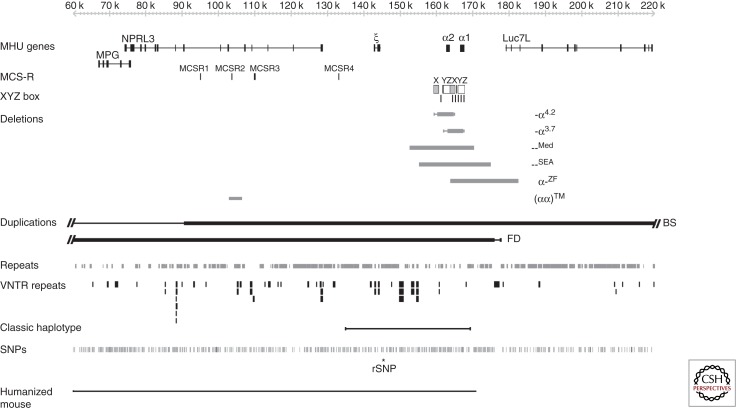
Figure 1.
Figure 1.
The human α-globin cluster (5′-ζ-α2-α1-3′) surrounded by widely expressed genes (MPG, NPRL3, and Luc7L) on chromosome 16 (16p13.3). Below this, the multispecies conserved elements (MCS-Rs) are shown. The X, Y, and Z boxes are the regions of duplication that play a part in the generation of the common α-thalassemias, as discussed in the text. The most common deletions removing one (-α3.7 and -α4.2) or both (--Med and --SEA) α genes and causing thalassemia are shown as horizontal bars, as are the unusual deletions α-ZF and (αα)TM. Duplications of the cluster BS and FD are also indicated. For a full catalog of all deletions that cause α-thalassemia, see Higgs (2009a). At the bottom of the figure the positions of common repeats, variable number random repeats (VNTRs) and single-nucleotide polymorphisms (SNPs) are shown. The region containing all SNPs and VNTRs corresponding to the classic haplotype used in population studies (as discussed in the text) is illustrated as a thin horizontal line. The regulatory SNP (rSNP) that creates new functional GATA1-binding sites seen in the Melanesian nondeletional α-thalassemia is shown with an asterisk. The extent of the α-globin locus present in the humanized mouse is shown as a thin line.
Figure 2.
Figure 2.
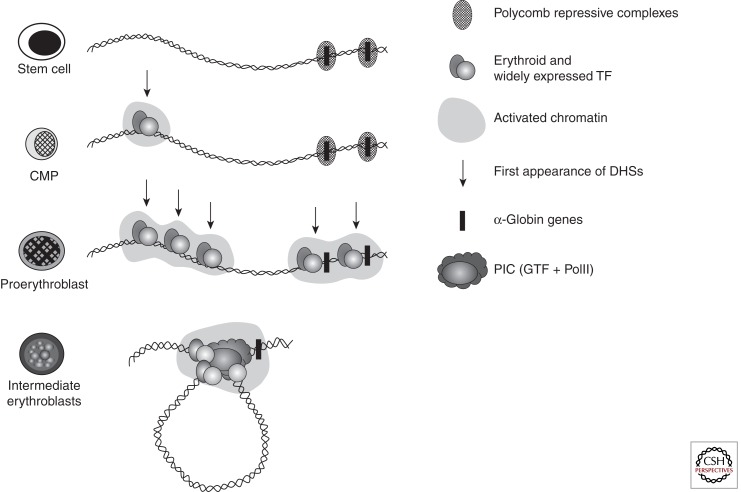
In stem cells and early progenitors, the cluster is silenced by the Polycomb repressive complex. In multipotent cells (CMP), the cluster is primed in the upstream region (MCSR-2) by multiprotein complexes containing SCL and NF-E2 nucleated by GATA-2. In committed erythroid progenitors (U-MEL, proerythroblast stage), additional remote regulatory sequences are bound by multiprotein complexes containing various combinations of SCL, NF-E2, and GATA1 replacing GATA2. At this stage, the α-globin promoter is also occupied by a combination of factors including NF-Y and is poised for expression. In differentiating erythroid cells, the preinitiation complex (PIC), including PolII, is recruited to the enhancers in a cooperative manner but independently of the promoter. Krüppel-like transcription factors are also recruited, independently of the upstream elements and to the promoter. At this final stage, the α-globin promoter is now occupied by a multiprotein complex that represents a docking site for the recruitment of the PIC, which is entirely dependent on the presence of the upstream elements that interact with the promoter, forming a loop.
Figure 3.
Figure 3.
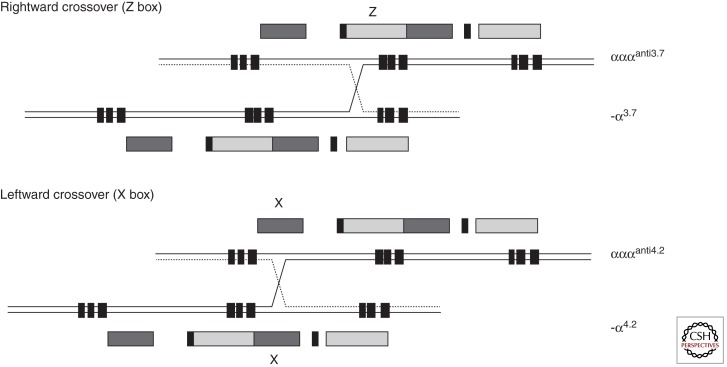
The mechanism by which the common deletions underlying α-thalassemia occur. Crossovers between misaligned Z boxes give rise to the -α3.7 and αααanti3.7 chromosomes. Crossovers between misaligned X boxes give rise to -α4.2 and αααanti4.2 chromosomes.
Figure 4.
Figure 4.
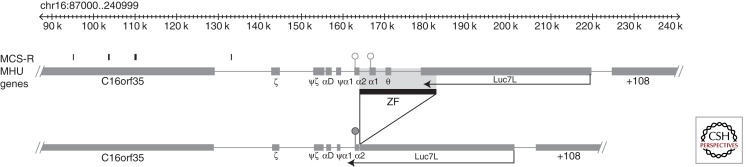
The key features of the α-ZF mutation. In the normal cluster, the promoters of the α-globin genes lie in unmethylated CpG-rich islands. Partial deletion of Luc7L juxtaposes this truncated gene next to the remaining α2-globin gene and RNA transcripts from Luc7L extend through the α2-globin gene. This process is thought to attract de novo DNA methylases early in development, methylating the α2 CpG island and silencing it.
Figure 5.
Figure 5.
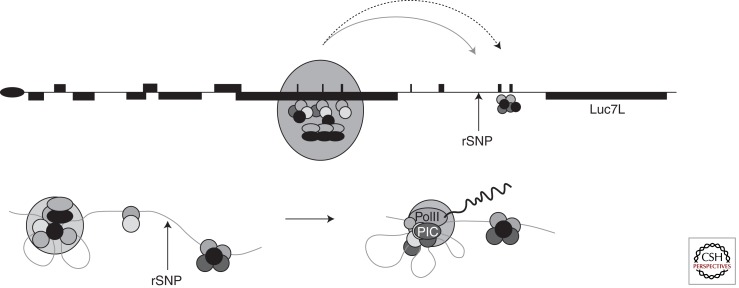
The key features of the Melanesian form of α-thalassemia. A regulatory SNP (rSNP) located between the ζ- and α2-globin genes creates a new GATA1-binding site, which in turn also creates a new promoter. This promoter preferentially interacts with the upstream enhancer elements (gray curved arrow) and steals activity from the α genes (dashed curved arrow). In the hypothetical looping model (below), the upstream element interacts with the new promoter but not the α genes.

References

    1. Anguita E, Hughes J, Heyworth C, Blobel GA, Wood WG, Higgs DR 2004. Globin gene activation during haemopoiesis is driven by protein complexes nucleated by GATA-1 and GATA-2. EMBO J 23: 2841–2852 - PMC - PubMed
    1. Barbour VM, Tufarelli C, Sharpe JA, Smith ZE, Ayyub H, Heinlein CA, Sloane-Stanley J, Indrak K, Wood WG, Higgs DR 2000. α-Thalassemia resulting from a negative chromosomal position effect. Blood 96: 800–807 - PubMed
    1. Bezerra MA, Araujo AS, Phylipsen M, Balak D, Kimura EM, Oliveira DM, Costa FF, Sonati MF, Harteveld CL 2008. The deletion of SOX8 is not associated with ATR-16 in an HbH family from Brazil. Br J Haematol 142: 324–326 - PubMed
    1. Buckle VJ, Higgs DR, Wilkie AO, Super M, Weatherall DJ 1988. Localisation of human α globin to 16p13.3—pter. J Med Genet 25: 847–849 - PMC - PubMed
    1. Carvalho CM, Zhang F, Lupski JR 2010. Evolution in health and medicine Sackler colloquium: Genomic disorders: A window into human gene and genome evolution. Proc Natl Acad Sci 107: 1765–1771 - PMC - PubMed

LinkOut - more resources