


Prevalence of anemia in under five-year-old children in a children's hospital in Recife, Brazil
- PMID: 23284255
- PMCID: PMC3520632
- DOI: 10.5581/1516-8484.20110028
Prevalence of anemia in under five-year-old children in a children's hospital in Recife, Brazil
Abstract
Introduction: Anemia is a nutritional problem of global importance. It is estimated that at least one-third of the population has been at one time anemic.
Objective: To evaluate the prevalence of anemia and associated factors in patients of a children's hospital in Recife.
Methods: A cross-sectional study was developed involving 595 male and female children aged from 6 to 59 months old, who were hospitalized in 2007.
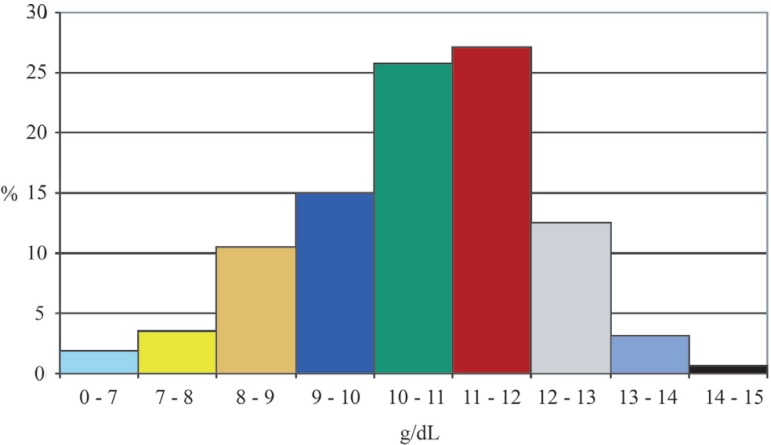
Results: Children with a hemoglobin concentration less than 11 g/dL were considered anemic. The relationship between studied variables and anemia was evaluated by Poisson regression analysis. There was a 56.6% prevalence of anemia (95% CI: 46.6-54.6). Anemia was significantly correlated with low weight (Prevalence ratio - PR = 1.39; 95% CI: 1.18-1.64), young age (PR = 2.01; 95% CI: 1.57-2.56) and a diagnosis of acute lower respiratory disease (PR = 1.57; 95% CI: 1.27-1.96).
Conclusion: The high prevalence of anemia suggests that it may contribute as a causal factor for hospitalization, especially because the period of hospitalization was short and the patient was likely to be anemic at the time of admission. This study stresses the importance of evaluating the overall nutritional status of patients, including their ingestion of microelements. This is especially important in children, because of their greater susceptibility to anemia. Measures directed at the prevention and control of anemia, including increased coverage of supplementation and fortification programs are strongly recommended.
Keywords: Anemia; Nutritional status; Prevalence; Risk factors.
Conflict of interest statement
Conflict-of-interest disclosure: The authors declare no competing financial interest
Figures
References
-
- World Health Organization Iron deficiency anemia assessment, prevention and control. A guide for programme managers. Geneva; WHO; 2001.
-
- Villapando S, Shamah LT, Ramirez-Silva CI, Nejia-Rodrigues F, Rivera JA.Prevalence anemia in children to 12 years of age. Results from a nation wide probabilistic survey in Mexico. Salud Publica Mex. 2003; 45Suppl 4: 490-8 - PubMed
-
- Freire WB, Dirren H, Barclay D.Iron deficiency anemia in Ecuador In: Hercberg S, Galan P, Dupin H.Recent knowledge on iron and folate deficiencies in the world. Paris: Collogue INSEAM; 1990. p. 47-54
-
- Neuman NA, Tanaka OY, Szarfarc SC, Guimarães PR, Victora CG.Prevalência e fatores de risco para anemia no Sul do Brasil. Rev Saúde Pública. 2000; 34(1): 56-63 - PubMed
-
- Osório MM, Lira PIC, Batista-Filho M, Ashworth A.Prevalence of anemia in children 6-59 months old in the state of Pernambuco, Brazil. Rev Panam Salud Publica. 2001; 10(2): 101-7 - PubMed
LinkOut - more resources
Full Text Sources
Research Materials