


Job preferences of nurses and midwives for taking up a rural job in Peru: a discrete choice experiment
- PMID: 23284636
- PMCID: PMC3527463
- DOI: 10.1371/journal.pone.0050315
Job preferences of nurses and midwives for taking up a rural job in Peru: a discrete choice experiment
Abstract
Background: Robust evidence on interventions to improve the shortage of health workers in rural areas is needed. We assessed stated factors that would attract short-term contract nurses and midwives to work in a rural area of Peru.
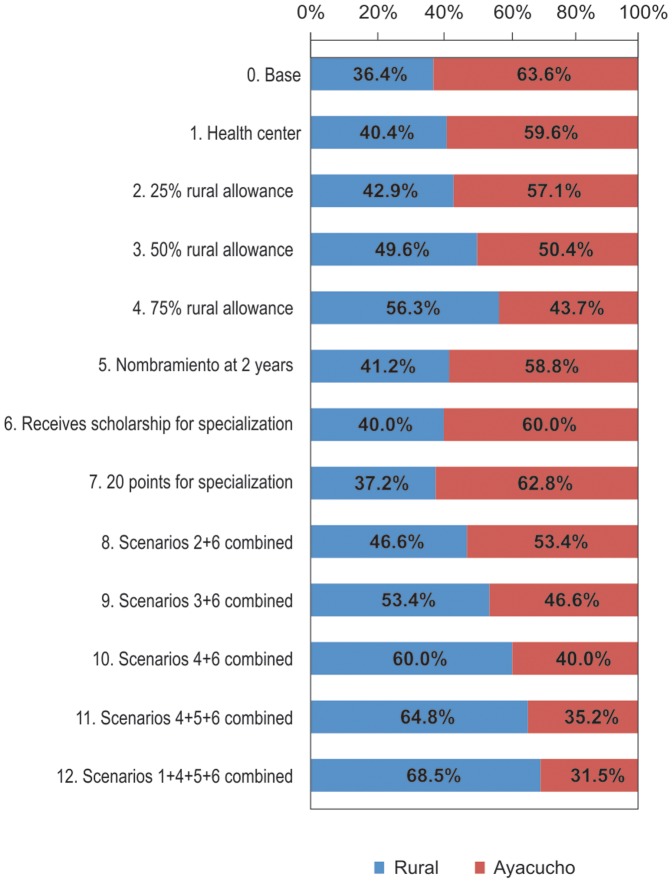
Methods and findings: A discrete choice experiment (DCE) was conducted to evaluate the job preferences of nurses and midwives currently working on a short-term contract in the public sector in Ayacucho, Peru. Job attributes, and their levels, were based on literature review, qualitative interviews and focus groups of local health personnel and policy makers. A labelled design with two choices, rural community or Ayacucho city, was used. Job attributes were tailored to these settings. Multiple conditional logistic regressions were used to assess the determinants of job preferences. Then we used the best-fitting estimated model to predict the impact of potential policy incentives on the probability of choosing a rural job or a job in Ayacucho city. We studied 205 nurses and midwives. The odds of choosing an urban post was 14.74 times than that of choosing a rural one. Salary increase, health center-type of facility and scholarship for specialization were preferred attributes for choosing a rural job. Increased number of years before securing a permanent contract acted as a disincentive for both rural and urban jobs. Policy simulations showed that the most effective attraction package to uptake a rural job included a 75% increase in salary plus scholarship for a specialization, which would increase the proportion of health workers taking a rural job from 36.4% up to 60%.
Conclusions: Urban jobs were more strongly preferred than rural ones. However, combined financial and non-financial incentives could almost double rural job uptake by nurses and midwifes. These packages may provide meaningful attraction strategies to rural areas and should be considered by policy makers for implementation.
Conflict of interest statement
Figures
References
-
- Grobler L, Marais BJ, Mabunda SA, Marindi PN, Reuter H, et al. (2009) Interventions for increasing the proportion of health professionals practising in rural and other underserved areas. Cochrane Database Syst Rev 1: CD005314. - PubMed
-
- Wilson NW, Couper ID, De Vries E, Reid S, Fish T, et al. (2009) A critical review of interventions to redress the inequitable distribution of healthcare professionals to rural and remote areas. Rural Remote Health 9: 1060. - PubMed
Publication types
MeSH terms
Grants and funding
LinkOut - more resources
Full Text Sources
Medical
