


Organic solvents as risk factor for autoimmune diseases: a systematic review and meta-analysis
- PMID: 23284705
- PMCID: PMC3526640
- DOI: 10.1371/journal.pone.0051506
Organic solvents as risk factor for autoimmune diseases: a systematic review and meta-analysis
Abstract
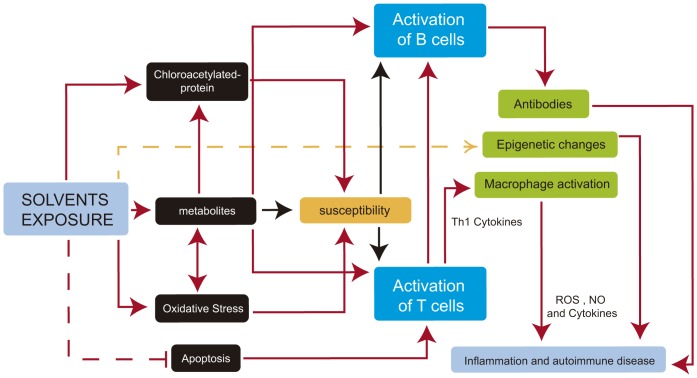
Background: Genetic and epigenetic factors interacting with the environment over time are the main causes of complex diseases such as autoimmune diseases (ADs). Among the environmental factors are organic solvents (OSs), which are chemical compounds used routinely in commercial industries. Since controversy exists over whether ADs are caused by OSs, a systematic review and meta-analysis were performed to assess the association between OSs and ADs.
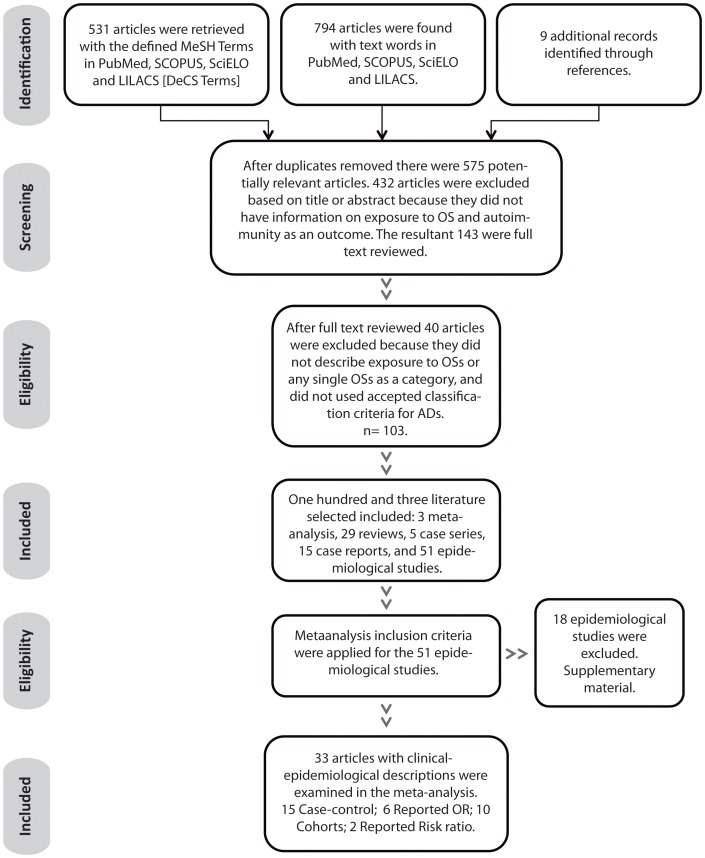
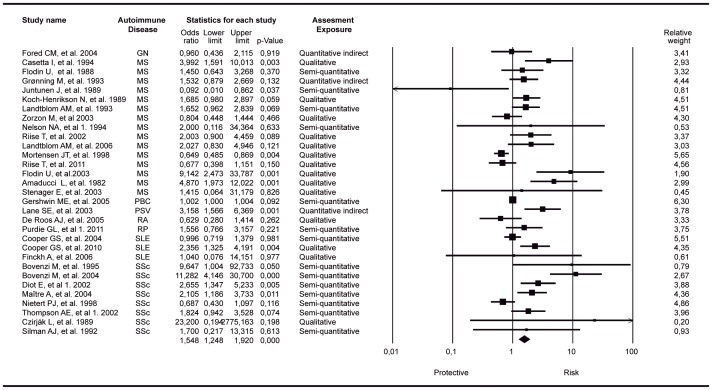
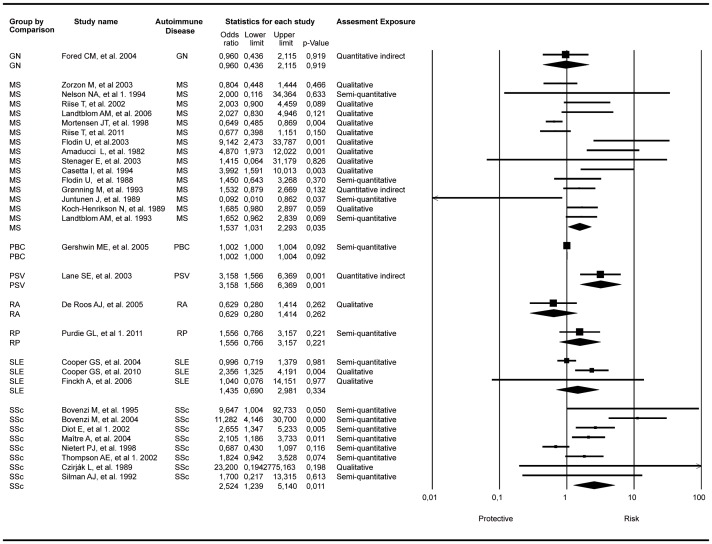
Methods and findings: The systematic search was done in the PubMed, SCOPUS, SciELO and LILACS databases up to February 2012. Any type of study that used accepted classification criteria for ADs and had information about exposure to OSs was selected. Out of a total of 103 articles retrieved, 33 were finally included in the meta-analysis. The final odds ratios (ORs) and 95% confidence intervals (CIs) were obtained by the random effect model. A sensitivity analysis confirmed results were not sensitive to restrictions on the data included. Publication bias was trivial. Exposure to OSs was associated to systemic sclerosis, primary systemic vasculitis and multiple sclerosis individually and also to all the ADs evaluated and taken together as a single trait (OR: 1.54; 95% CI: 1.25-1.92; p-value<0.001).
Conclusion: Exposure to OSs is a risk factor for developing ADs. As a corollary, individuals with non-modifiable risk factors (i.e., familial autoimmunity or carrying genetic factors) should avoid any exposure to OSs in order to avoid increasing their risk of ADs.
Conflict of interest statement
Figures
References
-
- Anaya JM (2010) The autoimmune tautology. Arthritis research & therapy 12: 147 doi:10.1186/ar3175. - DOI - PMC - PubMed
-
- Anaya JM, Corena R, Castiblanco J, Rojas-Villarraga A, Shoenfeld Y (2007) The kaleidoscope of autoimmunity: multiple autoimmune syndromes and familial autoimmunity. Expert review of clinical immunology 3: 623–635 doi:10.1586/1744666X.3.4.623. - DOI - PubMed
-
- Selmi C, Leung PSC, Sherr DH, Diaz M, Nyland JF, et al. (2012) Mechanisms of environmental influence on human autoimmunity: A national institute of environmental health sciences expert panel workshop. Journal of autoimmunity Available: http://www.ncbi.nlm.nih.gov/pubmed/22749494. Accessed 19 October 2012 - PubMed
-
- Rook G (2011) Hygiene Hypothesis and Autoimmune Diseases. Clinical reviews in allergy & immunology: 5–15. doi:10.1007/s12016-011-8285-8. - PubMed
-
- Youinou P, Pers J-O, Gershwin ME, Shoenfeld Y (2010) Geo-epidemiology and autoimmunity. Journal of autoimmunity 34: J163–7. - PubMed
Publication types
MeSH terms
Substances
LinkOut - more resources
Full Text Sources
Medical
