


Source reconstruction accuracy of MEG and EEG Bayesian inversion approaches
- PMID: 23284840
- PMCID: PMC3527408
- DOI: 10.1371/journal.pone.0051985
Source reconstruction accuracy of MEG and EEG Bayesian inversion approaches
Abstract
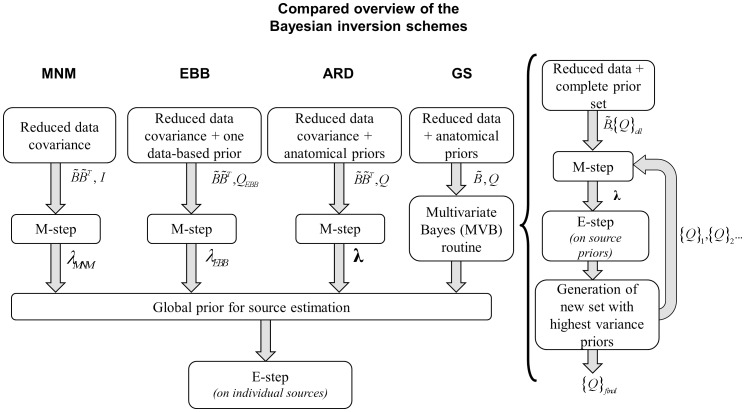
Electro- and magnetoencephalography allow for non-invasive investigation of human brain activation and corresponding networks with high temporal resolution. Still, no correct network detection is possible without reliable source localization. In this paper, we examine four different source localization schemes under a common Variational Bayesian framework. A Bayesian approach to the Minimum Norm Model (MNM), an Empirical Bayesian Beamformer (EBB) and two iterative Bayesian schemes (Automatic Relevance Determination (ARD) and Greedy Search (GS)) are quantitatively compared. While EBB and MNM each use a single empirical prior, ARD and GS employ a library of anatomical priors that define possible source configurations. The localization performance was investigated as a function of (i) the number of sources (one vs. two vs. three), (ii) the signal to noise ratio (SNR; 5 levels) and (iii) the temporal correlation of source time courses (for the cases of two or three sources). We also tested whether the use of additional bilateral priors specifying source covariance for ARD and GS algorithms improved performance. Our results show that MNM proves effective only with single source configurations. EBB shows a spatial accuracy of few millimeters with high SNRs and low correlation between sources. In contrast, ARD and GS are more robust to noise and less affected by temporal correlations between sources. However, the spatial accuracy of ARD and GS is generally limited to the order of one centimeter. We found that the use of correlated covariance priors made no difference to ARD/GS performance.
Conflict of interest statement
Figures




 , top row). The instantaneous source amplitude is obtained by integrating the frequencies and taking the sine of the resulting angle. If the generated time course satisfies the desired correlation threshold (either high or low: middle and lower rows, respectively), it is accepted; otherwise the procedure is repeated. The corresponding frequency histogram and correlation matrices are shown in the right column.


References
-
- Liljeström M, Kujala J, Jensen O, Salmelin R (2005) Neuromagnetic localization of rhythmic activity in the human brain: a comparison of three methods. NeuroImage 25: 734–745. - PubMed
-
- Baillet S, Mosher JC, Leahy RM (2001) Electromagnetic brain mapping. IEEE Signal processing magazine 18: 14–30.
Publication types
MeSH terms
Grants and funding
LinkOut - more resources
Full Text Sources
