. 2012;7(12):e52000.
doi: 10.1371/journal.pone.0052000. Epub 2012 Dec 28.

Quantitative, non-disruptive monitoring of transcription in single cells with a broad-host range GFP-luxCDABE dual reporter system

Affiliations

Quantitative, non-disruptive monitoring of transcription in single cells with a broad-host range GFP-luxCDABE dual reporter system

Ilaria Maria Benedetti et al. PLoS One. 2012.

Abstract

A dual promoter probe system based on a tandem bi-cistronic GFP-luxCDABE reporter cassette is described and implemented. This system is assembled in two synthetic, modular, broad-host range plasmids based on pBBR1 and RK2 origins of replication, allowing its utilization in an extensive number of gram-negative bacteria. We analyze the performance of this dual cassette in two hosts, Escherichia coli and Pseudomonas putida, by examining the induction properties of the lacI(q)-Ptrc expression system in the first host and the Pb promoter of the benzoate degradation pathway in the second host. By quantifying the bioluminescence signal produced through the expression of the lux genes, we explore the dynamic range of induction for the two systems (Ptrc-based and Pb-based) in response to the two inducers. In addition, by quantifying the fluorescence signals produced by GFP expression, we were able to monitor the single-cell expression profile and to explore stochasticity of the same two promoters by flow cytometry. The results provided here demonstrate the power of the dual GFP-luxCDABE cassette as a new, single-step tool to assess promoter properties at both the population and single-cell levels in gram-negative bacteria.


Conflict of interest statement

Competing Interests: The authors have declared that no competing interests exist.

Figures

Figure 1
Figure 1. Structural organization of pGLR1/2 vectors and assayed expression systems.
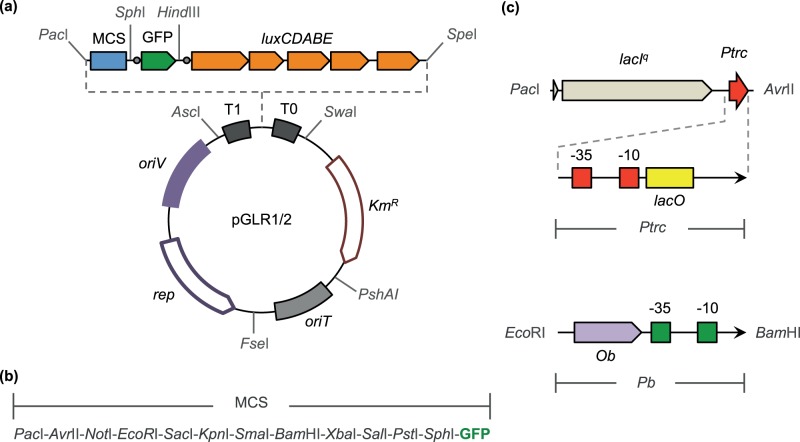
(a) The vectors each harbor a kanamycin resistance (KmR) marker, an oriT for plasmid transfer through conjugation and a broad-host range origin of replication that consists of a vegetative origin (oriV) and a replication protein (rep). Vector pGLR1 is based on a minimal pBBR1 origin , while pGLR2 is based on ori RK2 . The GFP-luxCDABE reporter cassette is cloned between two strong terminators (T0 and T1) and is downstream of a multiple cloning site (MCS). The optimal ribosome-binding site of the TIR element (represented as a grey circle [24]) is placed upstream of the gfp gene and the first gene of the lux operon (luxC). (b) List of enzymes found at the MCS. (c) Architecture of the lacIq-Ptrc expression system (top) and the Pb promoter (bottom). Relevant features such as operators (lacO and Ob) and promoter (−10/−35) regions are represented.
Figure 2
Figure 2. Co-occurrence of lux and gfp activity in a plate assay.
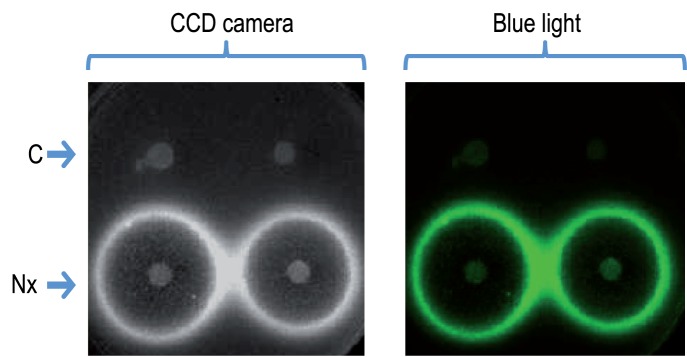
Strain E. coli MG1655 (pGLR1-PlexA) was added to top agar and overlaid onto an LB plate with kanamycin for plasmid retention. Disks containing 25 ng of nalidixic acid (or controls with water) were then deposited onto the surface, and the overnight-grown plates were processed to reveal either bioluminescence with a CCD camera or fluorescence with a blue light as explained in Materials and Methods. Note the coincidence of both images with different reporters.
Figure 3
Figure 3. Validation of the dual GFP-luxCDABE reporter system.
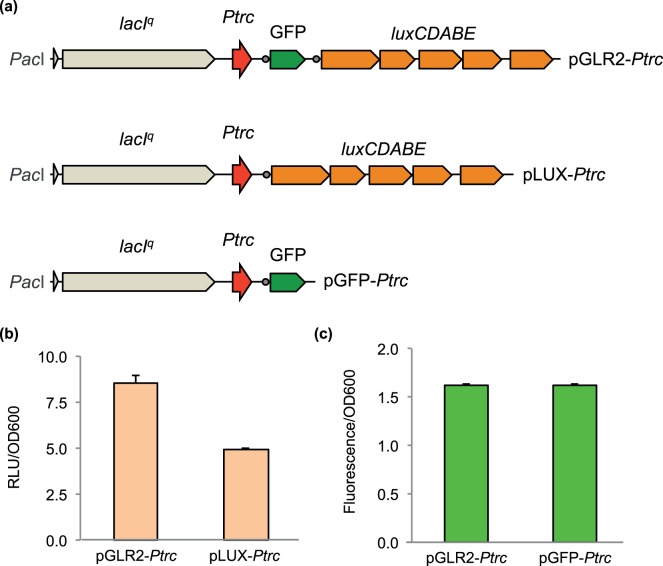
(a) Structure of the reporter systems used. In the three cases, the expression of the different reporters is triggered by a lacIq-Ptrc expression system . Plasmid pGLR2-Ptrc has the dual reporter system, while in pLUX-Ptrc, only the luxCDABE operon is present. Additionally, in the pGFP-Ptrc plasmid, GFP alone is placed under the control of the lacIq-Ptrc system. (b) and (c) Comparison of reporter performances in response to IPTG. Overnight-grown cells were diluted 1∶20 in fresh M9 minimal media with 1 mM of IPTG. After 4 h of induction, promoter activities were calculated by normalizing the reporter signal (RLU or fluorescence) to the OD600. In this sense, promoter activity represents RLU/OD600 in (b) and fluorescence/OD600 in (c). Vertical bars represent the standard deviation calculated from four technical replicates.
Figure 4
Figure 4. Expression landscape using bioluminescence signal in E. coli and P. putida hosts.
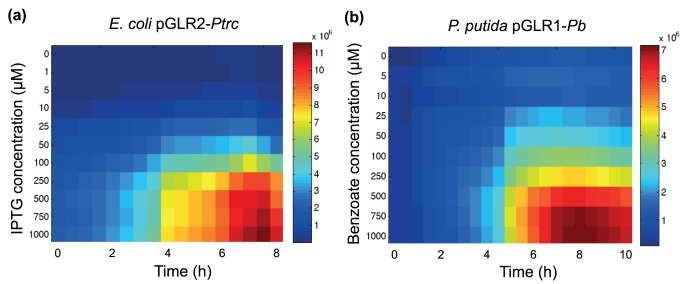
Overnight-grown strains were diluted 1:20 in fresh media containing different concentrations of IPTG or benzoate, as indicated. At 30 min intervals, bioluminescence and OD600 signals were recorded. Figures represent the level of promoter activities for each strain relative to time. E. coli CC118 harboring pGLR1-Ptrc (a) was induced with IPTG, while P. putida KT2440 with pGLR2-Pb was induced with benzoate (b). Color bars at left represent the scale for promoter activity.
Figure 5
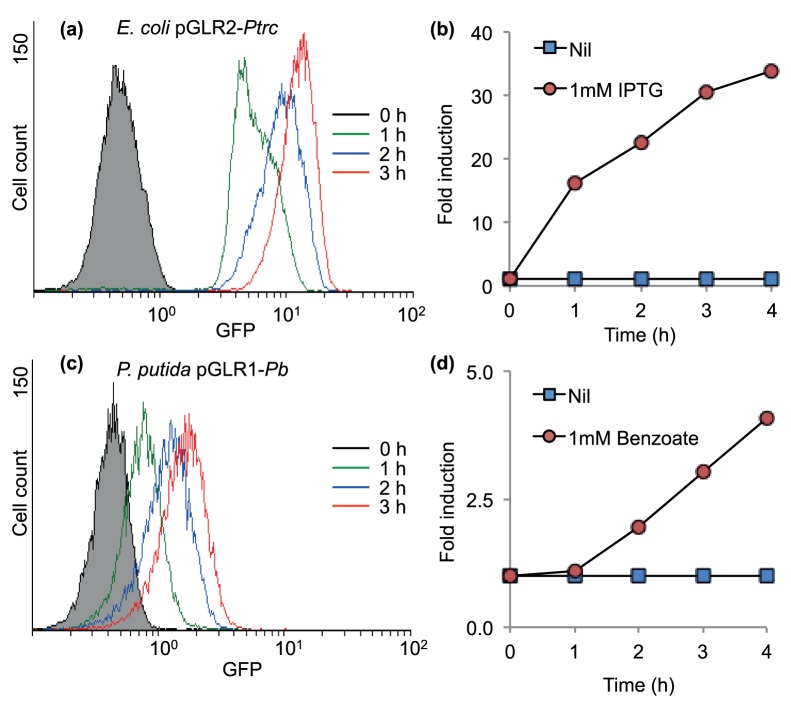
Figure 5. Single-cell analysis of Ptrc- and Pb-based systems.
Overnight-grown strains were diluted 1∶20 in fresh media and allowed to grown to mid-exponential phase. At this point, 1 mM of IPTG for E. coli harboring the Ptrc::GFP-luxCDABE system (a) or 1 mM of benzoate for P. putida with Pb::GFP-luxCDABE (b) were added to the culture. At time intervals of 1 hour, samples were collected and stored on ice until analysis by flow cytometry. Untreated cells were used as controls. For each assay, 15,000 cells were analyzed. (c) Induction profile of E. coli Ptrc::GFP-luxCDABE strain in response to 1 mM of IPTG. (d) Induction profile of P. putida Pb::GFP-luxCDABE strain in response to 1 mM of benzoate. Profiles in (c) and (d) were calculated by normalizing the average fluorescence levels of induced populations by fluorescence levels of the control samples with no treatments.
Figure 6
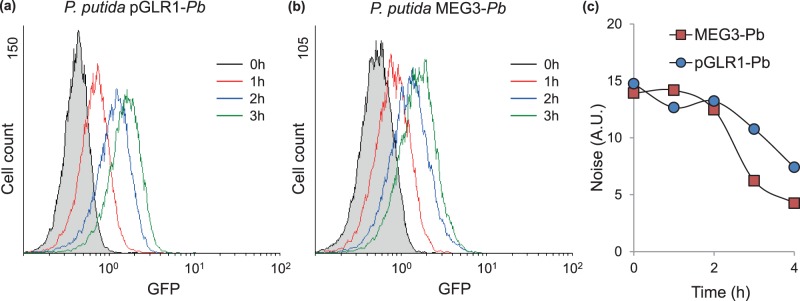
Figure 6. Comparison of mono-copy vs. multi-copy reporter systems.
Briefly, overnight-grown strains were diluted 1∶20 in fresh media and allowed to grown to mid-exponential phase. At this point, 1 mM of benzoate was added to P. putida MEG3-Pb (a) or P. putida with Pb::GFP-luxCDABE (b). At time intervals of 1 hour, samples were collected and stored on ice until analysis by flow cytometry. Untreated cells were used as controls. For each assay, 15,000 cells were analyzed. (c) Noise quantification in mono-copy and multi-copy reporter system. Squares represent the data from experiments shown in (a), while circles are for experiments in (b).

References

    1. Cases I, de Lorenzo V, Ouzounis CA (2003) Transcription regulation and environmental adaptation in bacteria. Trends Microbiol 11: 248–253. - PubMed
    1. Browning DF, Busby SJ (2004) The regulation of bacterial transcription initiation. Nat Rev Microbiol 2: 57–65. - PubMed
    1. Hermsen R, Tans S, ten Wolde PR (2006) Transcriptional regulation by competing transcription factor modules. PLoS Comput Biol 2: e164. - PMC - PubMed
    1. Kinkhabwala A, Guet CC (2008) Uncovering cis regulatory codes using synthetic promoter shuffling. PLoS ONE 3: e2030. - PMC - PubMed
    1. Elowitz MB, Levine AJ, Siggia ED, Swain PS (2002) Stochastic gene expression in a single cell. Science 297: 1183–1186. - PubMed

Publication types

Substances