


A meta-analysis of core stability exercise versus general exercise for chronic low back pain
- PMID: 23284879
- PMCID: PMC3524111
- DOI: 10.1371/journal.pone.0052082
A meta-analysis of core stability exercise versus general exercise for chronic low back pain
Abstract
Objective: To review the effects of core stability exercise or general exercise for patients with chronic low back pain (LBP).
Summary of background data: Exercise therapy appears to be effective at decreasing pain and improving function for patients with chronic LBP in practice guidelines. Core stability exercise is becoming increasingly popular for LBP. However, it is currently unknown whether core stability exercise produces more beneficial effects than general exercise in patients with chronic LBP.
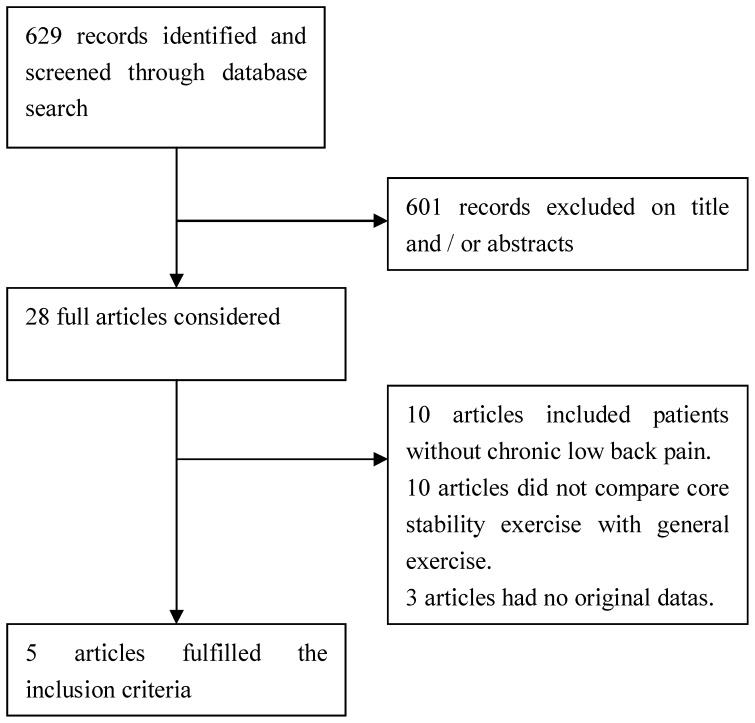
Methods: Published articles from 1970 to October 2011 were identified using electronic searches. For this meta-analysis, two reviewers independently selected relevant randomized controlled trials (RCTs) investigating core stability exercise versus general exercise for the treatment of patients with chronic LBP. Data were extracted independently by the same two individuals who selected the studies.
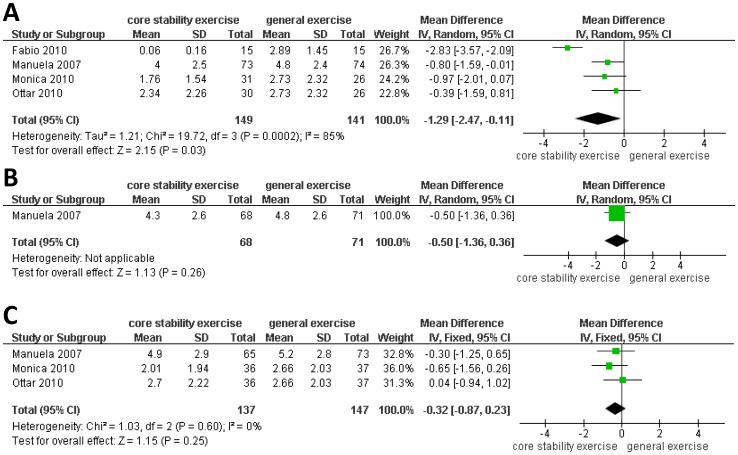
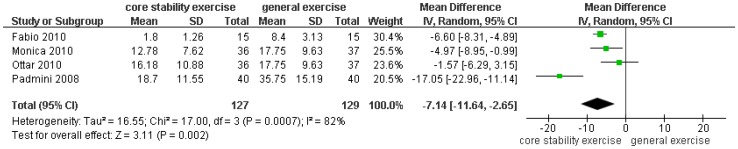
Results: From the 28 potentially relevant trials, a total of 5 trials involving 414 participants were included in the current analysis. The pooling revealed that core stability exercise was better than general exercise for reducing pain [mean difference (-1.29); 95% confidence interval (-2.47, -0.11); P = 0.003] and disability [mean difference (-7.14); 95% confidence interval (-11.64, -2.65); P = 0.002] at the time of the short-term follow-up. However, no significant differences were observed between core stability exercise and general exercise in reducing pain at 6 months [mean difference (-0.50); 95% confidence interval (-1.36, 0.36); P = 0.26] and 12 months [mean difference (-0.32); 95% confidence interval (-0.87, 0.23); P = 0.25].
Conclusions: Compared to general exercise, core stability exercise is more effective in decreasing pain and may improve physical function in patients with chronic LBP in the short term. However, no significant long-term differences in pain severity were observed between patients who engaged in core stability exercise versus those who engaged in general exercise.
Systematic review registration: http://www.crd.york.ac.uk/PROSPERO PROSPERO registration number: CRD42011001717.
Conflict of interest statement
Figures
References
-
- Katz RT (2001) Impairment and disability rating in low back pain. Phys Med Rehabil Clin N Am 12: 681–94. - PubMed
-
- Beith ID, Kemp A, Kenyon J, Prout M, Chestnut TJ (2011) Identifying neuropathic back and leg pain: a cross-sectional study. Pain 152: 1511–6. - PubMed
-
- Andersson GB (1999) Epidemiological features of chronic low-back pain. Lancet 354: 581–5. - PubMed
-
- Fabunmi AA, Aba SO, Odunaiya NA (2005) Prevalence of low back pain among peasant farmers in a rural community in South West Nigeria. Afr J Med Med Sci 34: 259–62. - PubMed
-
- Barrero LH, Hsu YH, Terwedow H, Perry MJ, Dennerlein JT, et al. (2006) Prevalence and physical determinants of low back pain in a rural Chinese population. Spine (Phila Pa 1976) 31: 2728–34. - PubMed
Publication types
MeSH terms
LinkOut - more resources
Full Text Sources
Other Literature Sources
Medical
Research Materials
Miscellaneous
