. 2012;7(12):e52150.
doi: 10.1371/journal.pone.0052150. Epub 2012 Dec 20.

Dissection of quorum-sensing genes in Burkholderia glumae reveals non-canonical regulation and the new regulatory gene tofM for toxoflavin production

Affiliations

Dissection of quorum-sensing genes in Burkholderia glumae reveals non-canonical regulation and the new regulatory gene tofM for toxoflavin production

Ruoxi Chen et al. PLoS One. 2012.

Abstract

Burkholderia glumae causes bacterial panicle blight of rice and produces major virulence factors, including toxoflavin, under the control of the quorum-sensing (QS) system mediated by the luxI homolog, tofI, and the luxR homolog, tofR. In this study, a series of markerless deletion mutants of B. glumae for tofI and tofR were generated using the suicide vector system, pKKSacB, for comprehensive characterization of the QS system of this pathogen. Consistent with the previous studies by other research groups, ΔtofI and ΔtofR strains of B. glumae did not produce toxoflavin in Luria-Bertani (LB) broth. However, these mutants produced high levels of toxoflavin when grown in a highly dense bacterial inoculum (∼ 10(11) CFU/ml) on solid media, including LB agar and King's B (KB) agar media. The ΔtofI/ΔtofR strain of B. glumae, LSUPB201, also produced toxoflavin on LB agar medium. These results indicate the presence of previously unknown regulatory pathways for the production of toxoflavin that are independent of tofI and/or tofR. Notably, the conserved open reading frame (locus tag: bglu_2g14480) located in the intergenic region between tofI and tofR was found to be essential for the production of toxoflavin by tofI and tofR mutants on solid media. This novel regulatory factor of B. glumae was named tofM after its homolog, rsaM, which was recently identified as a novel negative regulatory gene for the QS system of another rice pathogenic bacterium, Pseudomonas fuscovaginae. The ΔtofM strain of B. glumae, LSUPB286, produced a less amount of toxoflavin and showed attenuated virulence when compared with its wild type parental strain, 336gr-1, suggesting that tofM plays a positive role in toxoflavin production and virulence. In addition, the observed growth defect of the ΔtofI strain, LSUPB145, was restored by 1 µM N-octanoyl homoserine lactone (C8-HSL).


Conflict of interest statement

Competing Interests: The authors have declared that no competing interests exist.

Figures

Figure 1
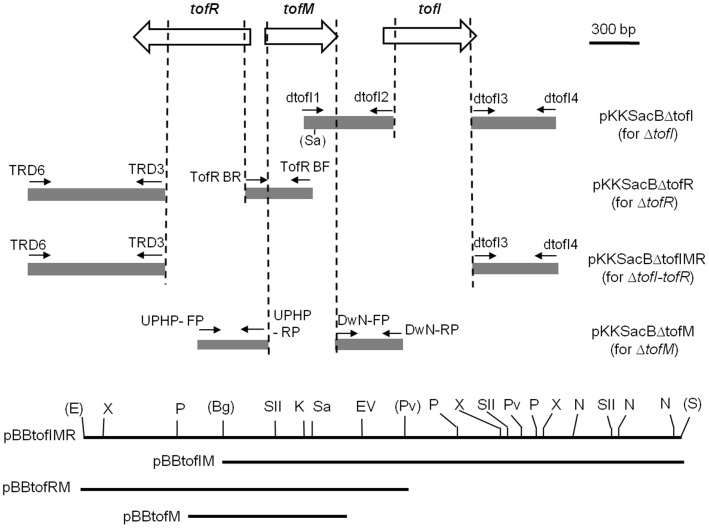
Figure 1. A schematic view of the tofI, tofM, and tofR loci and the DNA constructs used for deletion mutation and genetic complementation.
The grey areas indicate the flanking regions cloned in pKKSacB for individual or combined deletions of tofI, tofM, and tofR. The genomic regions to be deleted with the DNA constructs in pKKSacB are indicated with vertical hatched lines, while those cloned in a broad host vector, pBBR1MCS-2 or pBBR1MCS-5, for complementation tests are indicated with horizontal solid lines. Small arrows indicate the primers (Table 2) used for the amplification of each flanking region. Abbreviation for restriction sites are as follows: Bg, BglII; E, EcoRI; EV, EcoRV; K, KpnI; N, NotI; P, PstI; Pv, PvuII; S, SacI; Sa, SalI; SII, SacII; X, XhoI. Restriction sites used for generating pBBtofIMR, pBBtofIM, and pBBtofRM are denoted with parentheses.
Figure 2
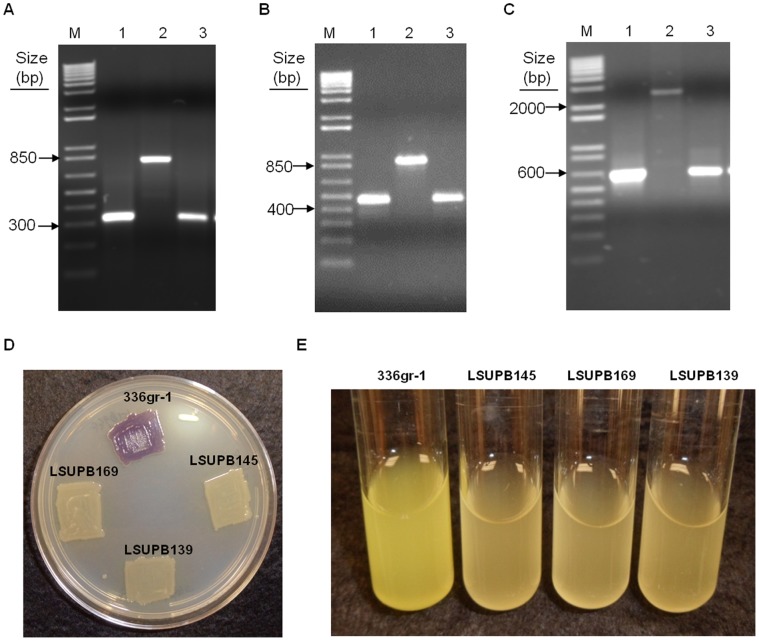
Figure 2. PCR products from diagnostic PCRs used to confirm deletion mutations in Burkholderia glumae and N-acyl homoserine lactone (AHL) signal production and toxoflavin production of deletion mutants.
(A) PCR products amplified from primers, TofI(H)F and TofI(H)R, to confirm the tofI deletion in LSUPB145. Template DNA for each lane is as follows: 1, pKKSacBΔtofI; 2, genomic DNA of B. glumae 336gr-1; and 3, genomic DNA of B. glumae LSUPB145. (B) PCR products amplified with primers, TofR(H)F and TofR(H)R, to confirm the tofR deletion in LSUPB169. Template DNA for each lane is as follows: 1, pKKSacBΔtofR; 2, genomic DNA of B. glumae 336gr-1; and 3, genomic DNA of B. glumae LSUPB169. (C) PCR products amplified with primers, TofI(H)F and TofR(H)R, to confirm the tofI-tofR deletion in LSUPB139. Template DNA for each lane is as follows: 1, pKKSacBΔtofIMR; 2, genomic DNA of B. glumae 336gr-1; and 3, genomic DNA of B. glumae LSUPB139. M indicates the 1 kb Plus DNA ladder (Invitrogen, Santa Clara, CA, USA) used as a marker. (D) Violacein production, shown as a purple pigment, by the biosensor, Chromobacterium violaceum CV026, in the presence of the culture extracts of the B. glumae strains, 336gr-1, LSUPB145, LSUPB169, and LSUPB139. Photo was taken 48 h after application of bacterial culture extracts on C. violaceum CV026 inoculated onto a LB agar plate. (E) Toxoflavin production, shown as a yellow pigment, in the LB broth by B. glumae strains, 336gr-1, LSUPB145, LSUPB169, and LSUPB139. Photo was taken after 24 h incubation at 37°C.
Figure 3
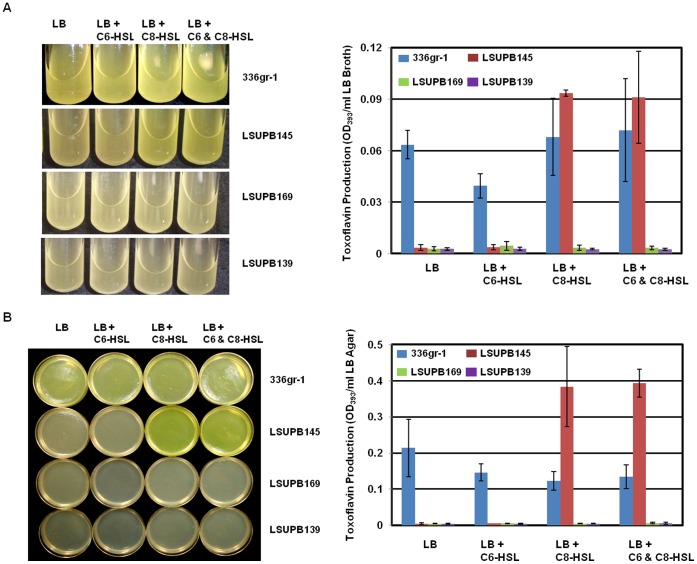
Figure 3. Toxoflavin production by Burkholderia glumae strains, 336gr-1 (wild type), LSUPB145 (ΔtofI), LSUPB169 (ΔtofR) and LSUPB139 (ΔtofI-tofR) in the presence or absence of 1
µM N- hexanoyl homoserine lactone (C6-HSL) and N- octanoyl homoserine lactone (C8-HSL) in LB broth (A) and on LB agar (B). LB broth and LB agar were inoculated with equal amounts of bacterial cells (∼106 CFU) per ml of media. Bacteria were spread uniformly on LB agar plates with a spreader. Photos were taken and toxoflavin were quantified after 24 h incubation at 37°C. LB agar plates were photographed after removal of bacterial culture from the medium. Error bars indicate the standard deviation from three replications.
Figure 4
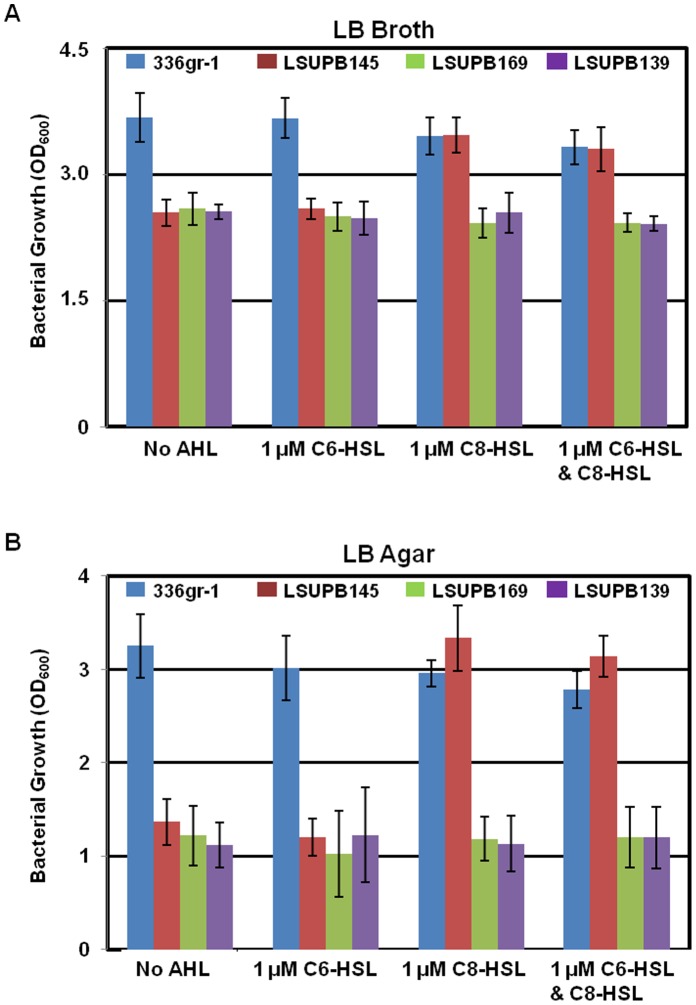
Figure 4. Bacterial growth of Burkholderia glumae strains, 336gr-1 (wild type), LSUPB145 (ΔtofI), LSUPB169 (ΔtofR) and LSUPB139 (ΔtofI-tofR) in the presence or absence of 1 µM N-hexanoyl homoserine lactone (C6-HSL) and N-octanoyl homoserine lactone (C8-HSL) in LB broth (A) and on LB agar (B).
LB broth and LB agar were inoculated with equal amounts of bacterial cells (∼106 CFU) per ml of media. Absorbance of each bacterial culture was measured after 24 h incubation at 37°C. Error bars indicate the standard deviation from three replications.
Figure 5
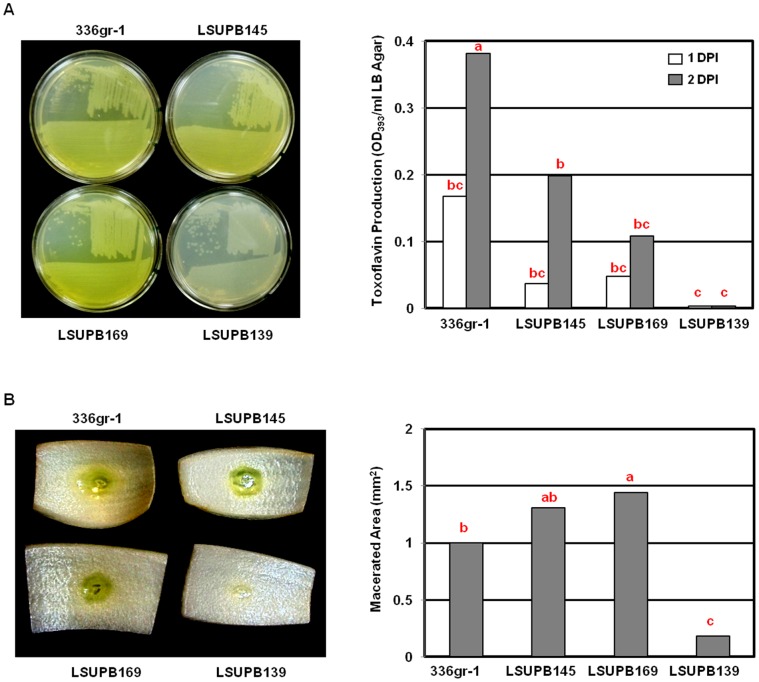
Figure 5. Toxoflavin production (A) and virulence phenotypes (B) by Burkholderia glumae strains, 336gr-1 (wild type), LSUPB145 (ΔtofI), LSUPB169 (ΔtofR) and LSUPB139 (ΔtofI-tofR).
(A) LB agar plates inoculated with the streaking method with inoculums from fresh bacterial colonies of B. glumae strains. Photos were taken and quantification procedures were performed 48 h after incubation at 37°C. (B) Virulence phenotypes on onion bulb scales. Photos were taken and maceration was measured 72 h after incubation in a wet chamber at 30°C. Columns for toxoflavin production (A) and area of maceration (B) represent the mean values from three replications and five replications, respectively. The letters above columns indicate significant differences among B. glumae strains (P<0.01). DPI: days post inoculation.
Figure 6
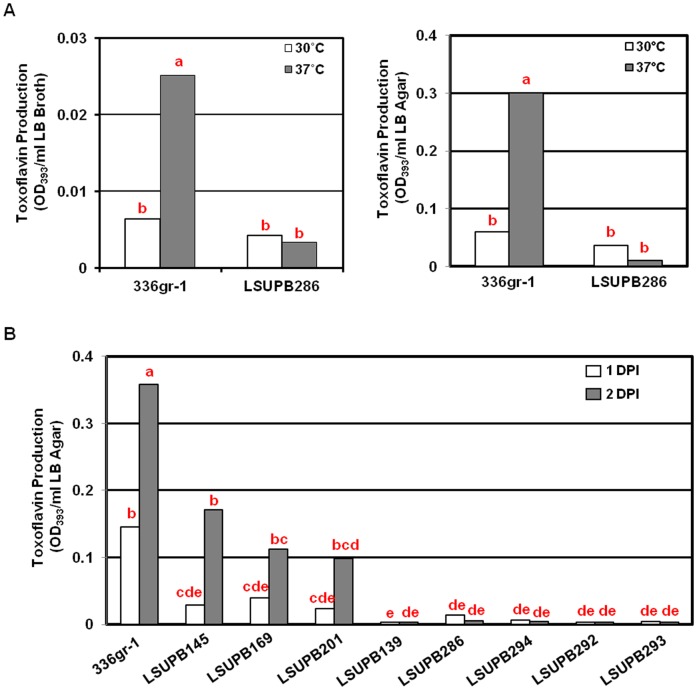
Figure 6. Toxoflavin production of Burkholderia glumae tofM deletion mutants in various genetic backgrounds.
(A) Toxoflavin production by 336gr-1 (wild type) and LSUPB286 (ΔtofM) in LB broth (left) and on LB agar (right). Equal amounts of bacterial cells (∼106 CFU/ml medium) were inoculated in both LB broth and LB agar media. For inoculation on LB agar plates, bacterial suspensions were uniformly spread with a spreader. Toxoflavin production was determined 24 h after incubation at 30°C or 37°C. (B) Toxoflavin production on LB agar plated by B. glumae strains, 336gr-1 (wild type), LSUPB145 (ΔtofI), LSUPB169 (ΔtofR), LSUPB201 (ΔtofI/ΔtofR), LSUPB139 (ΔtofI-tofR), LSUPB286 (ΔtofM), LSUPB294 (ΔtofI/ΔtofM), LSUPB292 (ΔtofR/ΔtofM) and LSUPB293 (ΔtofI/ΔtofM/ΔtofR). Bacteria were inoculated with the streaking method from fresh bacterial colonies. Toxoflavin production was determined 24 and 48 h after incubation at 37°C. Each column for A indicates a mean values from three replications, while that for B represents a mean value from six replications conducted in two independent experiments. The letters above columns indicate significant differences among B. glumae strains (P<0.01).
Figure 7
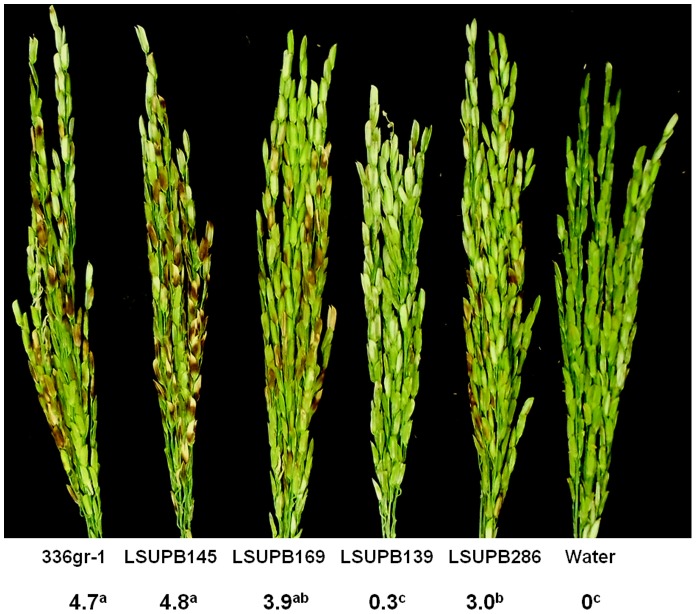
Figure 7. The virulence of Burkholderia glumae strains in rice.
The numbers indicate the disease severities caused by each strain of B. glumae or water. Disease severity was determined with a 0–9 scale (0 - no symptom, 9– more than 80% discolored panicles) at 10 days after bacterial inoculation and each number indicates a mean value from at least five replications. The superscript letters of the disease severity values indicate significant differences among B. glumae strains (P<0.01).

References

    1. Ham JH, Melanson RA, Rush MC (2011) Burkholderia glumae: next major pathogen of rice? Mol Plant Pathol 12: 329–339. - PMC - PubMed
    1. Nandakumar R, Shahjahan AKM, Yuan XL, Dickstein ER, Groth DE, et al. (2009) Burkholderia glumae and B. gladioli cause bacterial panicle blight in rice in the southern United States. Plant Dis 93: 896–905. - PubMed
    1. Iiyama K, Furuya N, Takanami Y, Matsuyama N (1995) A role of phytotoxin in virulence of Pseudomonas glumae . Ann Phytopathol Soc Jpn 61: 470–476.
    1. Kim J, Kim JG, Kang Y, Jang JY, Jog GJ, et al. (2004) Quorum sensing and the LysR-type transcriptional activator ToxR regulate toxoflavin biosynthesis and transport in Burkholderia glumae . Mol Microbiol 54: 921–934. - PubMed
    1. Nagamatsu T (2002) Syntheses, transformation, and biological activities of 7-azapteridine antibiotics: Toxoflavin, fervenulin, reumycin and their analogues. Chem Inform 33: 261.

Publication types

MeSH terms