


Multiple origins of kdr-type resistance in the house fly, Musca domestica
- PMID: 23285178
- PMCID: PMC3532202
- DOI: 10.1371/journal.pone.0052761
Multiple origins of kdr-type resistance in the house fly, Musca domestica
Abstract
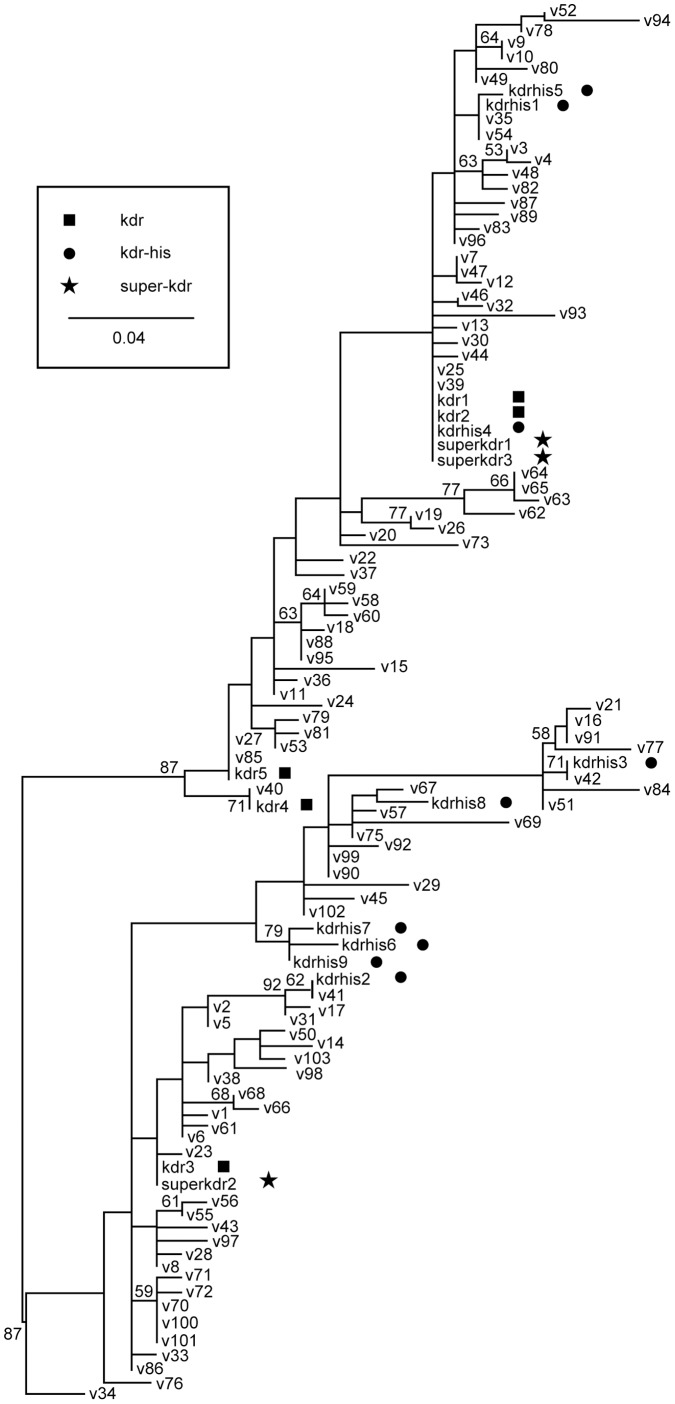
Insecticide resistance is a model phenotype that can be used to investigate evolutionary processes underlying the spread of alleles across a global landscape, while offering valuable insights into solving the problems that resistant pests present to human health and agriculture. Pyrethroids are one of the most widely used classes of insecticides world-wide and they exert their toxic effects through interactions with the voltage-sensitive sodium channel (Vssc). Specific mutations in Vssc (kdr, kdr-his and super-kdr) are known to cause resistance to pyrethroid insecticides in house flies. In order to determine the number of evolutionary origins of kdr, kdr-his and super-kdr, we sequenced a region of Vssc from house flies collected in the USA, Turkey and China. Our phylogenetic analysis of Vssc unequivocally supports the hypothesis of multiple independent origins of kdr, super-kdr and kdr-his on an unprecedented geographic scale. The implications of these evolutionary processes on pest management are discussed.
Conflict of interest statement
Figures
References
-
- Georghiou GP, Taylor CE (1977) Genetic and biological influences in the evolution of insecticide resistance. J Econ Entomol 70: 319–323. - PubMed
-
- Whitten MJ, McKenzie JA (1981) The Genetic Basis for Pesticide Resistance. Proc 3rd Aust Conf Grassland Invert Ecol Adelaide, South Aust Gov Print 1–16.
-
- ffrench-Constant RH, Daborn PJ, Le Goff G (2004) The genetics and genomics of insecticide resistance. Trends in Genetics 20: 165–170. - PubMed
-
- Caprio MA, Tabashnik BE (1992) Gene flow accelerates location adaptation among finite populations: simulating the evolution of insecticide resistance. J Econ Entomol 85: 611–620.
-
- Rinkevich FD, Zhang L, Hamm RL, Brady SG, Lazzaro BP, et al. (2006) Frequencies of the pyrethroid resistance alleles of Vssc1 and CYP6D1 in house flies from the eastern United States. Insect Mol Biol 15: 157–167. - PubMed
Publication types
MeSH terms
Substances
LinkOut - more resources
Full Text Sources
