


Positive attitudes to pediatric HIV testing: findings from a nationally representative survey from Zimbabwe
- PMID: 23285268
- PMCID: PMC3532106
- DOI: 10.1371/journal.pone.0053213
Positive attitudes to pediatric HIV testing: findings from a nationally representative survey from Zimbabwe
Abstract
Objective: Early HIV testing and diagnosis are paramount for increasing treatment initiation among children, necessary for their survival and improved health. However, uptake of pediatric HIV testing is low in high-prevalence areas. We present data on attitudes towards pediatric testing from a nationally representative survey in Zimbabwe.
Methods: All 18-24 year olds and a proportion of 25-49 year olds living in randomly selected enumeration areas from all ten Zimbabwe provinces were invited to self-complete an anonymous questionnaire on a personal digital assistant, and 16,719 people agreed to participate (75% of eligibles).
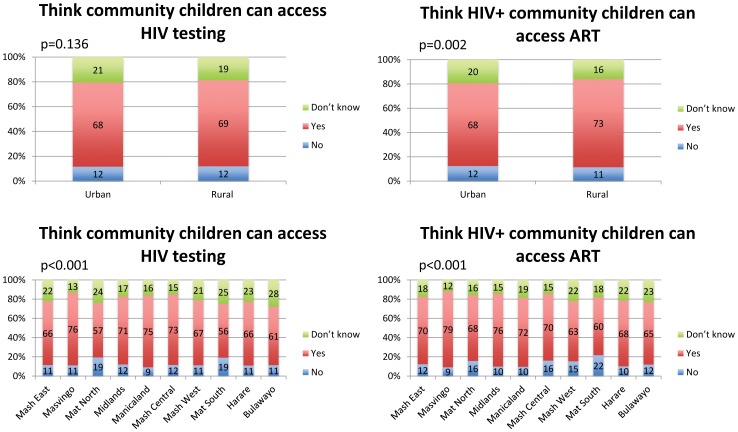
Results: Most people think children can benefit from HIV testing (91%), 81% of people who looked after children know how to access testing for their children and 92% would feel happier if their children were tested. Notably, 42% fear that, if tested, children may be discriminated against by some community members and 28% fear their children are HIV positive. People who fear discrimination against children who have tested for HIV are more likely than their counterparts to perceive their community as stigmatizing against HIV positive people (43% vs. 29%). They are also less likely to report positive attitudes to HIV themselves (49% vs. 74%). Only 28% think it is possible for children HIV-infected at birth to live into adolescence without treatment. Approximately 70% of people (irrespective of whether they are themselves parents) think HIV-infected children in their communities can access testing and treatment.
Conclusions: Pediatric HIV testing is the essential gateway to prevention and care services. Our data indicate positive attitudes to testing children, suggesting a conducive environment for increasing uptake of pediatric testing in Zimbabwe. However, there is a need to better understand the barriers to pediatric testing, such as stigma and discrimination, and address the gaps in knowledge regarding HIV/AIDS in children.
Conflict of interest statement
Figures
References
-
- WHO UNICEF, UNAIDS (2011) Global HIV/AIDS Response. Epidemic update and health sector progress towards Universal Access. Progress report 2011. Geneva, Switzerland.
-
- Zimbabwe Country Report (2012) Global AIDS Response Progress Report 2012.
-
- Joint United Nations Programme on HIV/AIDS (2012) Together we will end AIDS.
-
- Newell M-L, Brahmbhatt H, Ghys PD (2004) Child mortality and HIV infection in Africa: a review. AIDS 18: S27–34 doi:10.1097/01.aids.0000125981.71657.0d. - DOI - PubMed
-
- Violari A, Cotton MF, Gibb DM, Babiker AG, Steyn J, et al. (2008) Early antiretroviral therapy and mortality among HIV-infected infants. The New England Journal of Medicine 359: 2233–2244 Available: http://www.pubmedcentral.nih.gov/articlerender.fcgi?artid=2950021&tool=p... - PMC - PubMed
Publication types
MeSH terms
LinkOut - more resources
Full Text Sources
Medical
