


Wild vegetable mixes sold in the markets of Dalmatia (southern Croatia)
- PMID: 23286393
- PMCID: PMC3554486
- DOI: 10.1186/1746-4269-9-2
Wild vegetable mixes sold in the markets of Dalmatia (southern Croatia)
Abstract
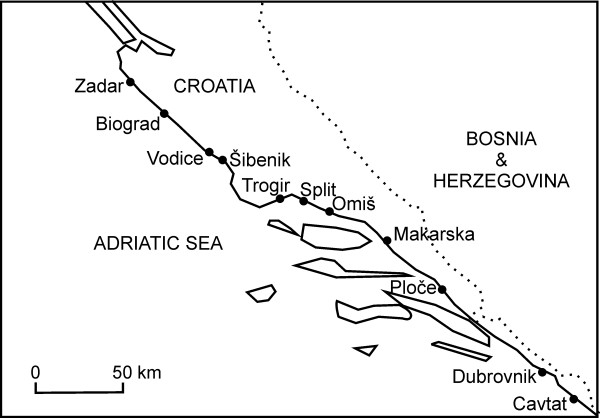
Background: Dalmatia is an interesting place to study the use of wild greens as it lies at the intersection of influence of Slavs, who do not usually use many species of wild greens, and Mediterranean culinary culture, where the use of multiple wild greens is common. The aim of the study was to document the mixtures of wild green vegetables which are sold in all the vegetable markets of Dalmatia.
Methods: All vendors (68) in all 11 major markets of the Dalmatian coast were interviewed. The piles of wild vegetables they sold were searched and herbarium specimens taken from them.
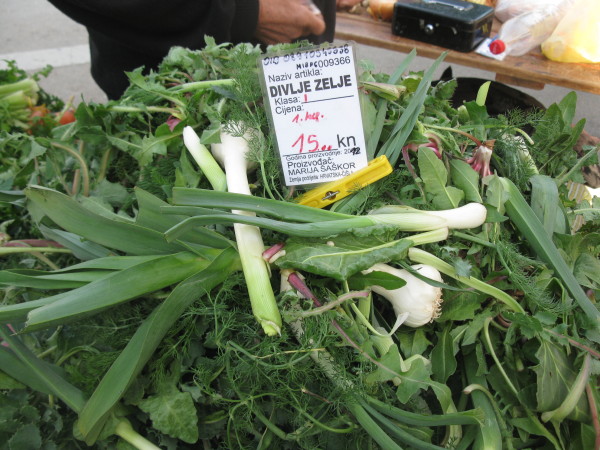
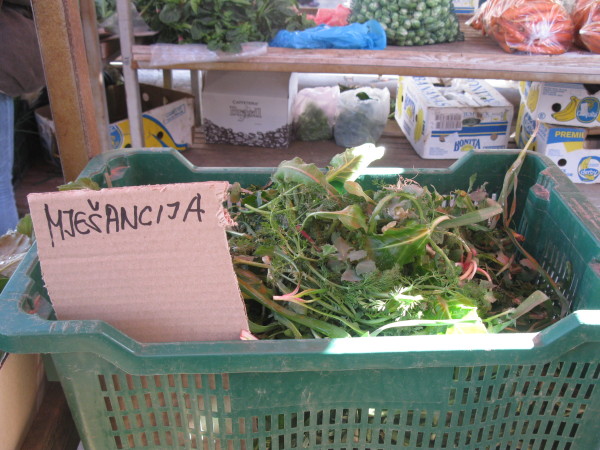
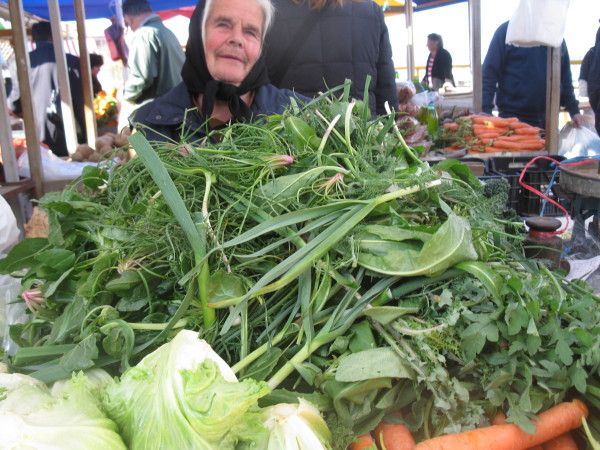
Results: The mean number of species in the mix was 5.7. The most commonly sold wild plants are: Sonchus oleraceus L., Allium ampeloprasum L., Foeniculum vulgare Mill., Urospermum picroides F.W.Schmidt, Papaver rhoeas L., Daucus carota L., Taraxacum sp., Picris echioides L., Silene latifolia Poir. and Crepis spp. Also the cultivated beet (Beta vulgaris L.) and a few cultivated Brassicaceae varieties are frequent components. Wild vegetables from the mix are usually boiled for 20-30 minutes and dressed with olive oil and salt. Altogether at least 37 wild taxa and 13 cultivated taxa were recorded.Apart from the mixes, Asparagus acutifolius L. and Tamus communis L. shoots are sold in separate bunches (they are usually eaten with eggs), as well as some Asteraceae species, the latter are eaten raw or briefly boiled.
Conclusions: The rich tradition of eating many wild greens may result both from strong Venetian and Greek influences and the necessity of using all food resources available in the barren, infertile land in the past. Although the number of wild-collected green vegetables is impressive we hypothesize that it may have decreased over the years, and that further in-depth local ethnobotanical studies are needed in Dalmatia to record the disappearing knowledge of edible plants.
Figures
References
-
- Rivera D, Obón C, Inocencio C, Heinrich M, Verde A, Fajardo J, Llorach R. The ethnobotanical study of local Mediterranean food plants as medicinal resources in Southern Spain. J Physiol Pharmacol. 2005;56(Suppl):97–114. - PubMed
-
- Hadjichambis A, Paraskeva-Hadjichambi D, Della A, Giusti ME, De Pasquale C, Lenzarini C, Censorii E, Gonzales-Tejero MR, Sanchez-Rojas CP, Ramiro-Gutierrez JM. et al. Wild and semi-domesticated food plant consumption in seven circum-Mediterranean areas. Int J Food Sci Nutr. 2008;59(5):383–414. doi: 10.1080/09637480701566495. - DOI - PubMed
-
- Paoletti MG, Dreon AL, Lorenzoni GG. Pistic, traditional food from Western Friuli, N.E. Italy. Econ Bot. 1995;49(1):26–30. doi: 10.1007/BF02862273. - DOI
-
- Pieroni A. Gathered wild food plants in the upper valley of the Serchio River (Garfagnana), Central Italy. Econ Bot. 1999;53(3):327–341. doi: 10.1007/BF02866645. - DOI
Publication types
MeSH terms
LinkOut - more resources
Full Text Sources
Other Literature Sources
Miscellaneous
