


Effects of flecainide on exercise-induced ventricular arrhythmias and recurrences in genotype-negative patients with catecholaminergic polymorphic ventricular tachycardia
- PMID: 23286974
- PMCID: PMC3809106
- DOI: 10.1016/j.hrthm.2012.12.035
Effects of flecainide on exercise-induced ventricular arrhythmias and recurrences in genotype-negative patients with catecholaminergic polymorphic ventricular tachycardia
Abstract
Background: Conventional therapy with beta-blockers is incompletely effective in preventing arrhythmic events in patients with catecholaminergic polymorphic ventricular tachycardia (CPVT). We have previously discovered that flecainide in addition to conventional drug therapy prevents ventricular arrhythmias in patients with genotype-positive CPVT.
Objective: To study the efficacy of flecainide in patients with genotype-negative CPVT.
Methods: We studied the efficacy of flecainide for reducing ventricular arrhythmias during exercise testing and preventing arrhythmia events during long-term follow-up.
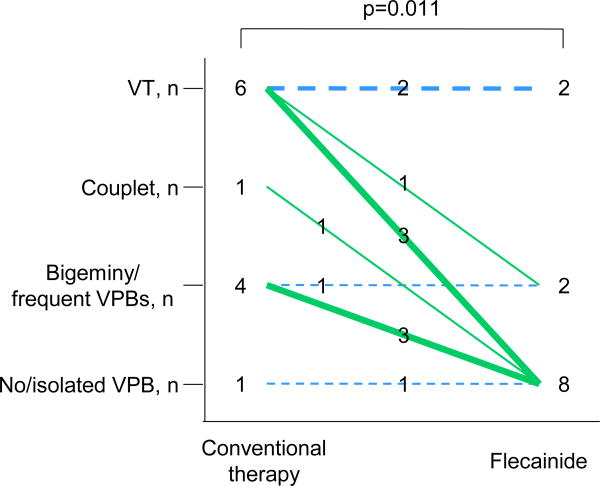
Results: Twelve patients with genotype-negative CPVT were treated with flecainide. Conventional therapy failed to control ventricular arrhythmias in all patients. Flecainide was initiated because of significant ventricular arrhythmias (n = 8), syncope (n = 3), or cardiac arrest (n = 1). At the baseline exercise test before flecainide, 6 patients had ventricular tachycardia and 5 patients had bigeminal or frequent ventricular premature beats. Flecainide reduced ventricular arrhythmias at the exercise test in 8 patients compared to conventional therapy, similar to that in patients with genotype-positive CPVT in our previous report. Notably, flecainide completely prevented ventricular arrhythmias in 7 patients. Flecainide was continued in all patients except for one who had ventricular tachycardia at the exercise test on flecainide. During a follow-up of 48±94 months, arrhythmia events (sudden cardiac death and aborted cardiac arrest) associated with noncompliance occurred in 2 patients. Flecainide was not discontinued owing to side effects in any of the patients.
Conclusions: Flecainide was effective in patients with genotype-negative CPVT, suggesting that spontaneous Ca(2+) release from ryanodine channels plays a role in arrhythmia susceptibility, similar to that in patients with genotype-positive CPVT.
Copyright © 2013. Published by Elsevier Inc.
Figures
References
-
- Leenhardt A, Lucet V, Denjoy I, Grau F, Ngoc DD, Coumel P. Catecholaminergic polymorphic ventricular tachycardia in children. A 7-year follow-up of 21 patients. Circulation. 1995 Mar 1;91:1512–1519. - PubMed
-
- Hayashi M, Denjoy I, Extramiana F, et al. Incidence and risk factors of arrhythmic events in catecholaminergic polymorphic ventricular tachycardia. Circulation. 2009 May 12;119:2426–2434. - PubMed
-
- van der Werf C, Zwinderman AH, Wilde AA. Therapeutic approach for patients with catecholaminergic polymorphic ventricular tachycardia: state of the art and future developments. Europace. 2011 Sep 4;14:175–183. - PubMed
-
- Laitinen PJ, Brown KM, Piippo K, et al. Mutations of the cardiac ryanodine receptor (RyR2) gene in familial polymorphic ventricular tachycardia. Circulation. 2001 Jan 30;103:485–490. - PubMed
-
- Priori SG, Napolitano C, Memmi M, et al. Clinical and molecular characterization of patients with catecholaminergic polymorphic ventricular tachycardia. Circulation. 2002 Jul 2;106:69–74. - PubMed
Publication types
MeSH terms
Substances
Grants and funding
LinkOut - more resources
Full Text Sources
Other Literature Sources
Miscellaneous
