. 2013 Mar;193(3):739-49.
doi: 10.1534/genetics.112.147645. Epub 2013 Jan 3.

Efficient targeted mutagenesis in medaka using custom-designed transcription activator-like effector nucleases

Affiliations

Efficient targeted mutagenesis in medaka using custom-designed transcription activator-like effector nucleases

Satoshi Ansai et al. Genetics. 2013 Mar.

Abstract

Transcription activator-like effector nucleases (TALENs) have become powerful tools for targeted genome editing. Here we demonstrate efficient targeted mutagenesis in medaka (Oryzias latipes), which serves as an excellent vertebrate model for genetics and genomics. We designed and constructed a pair of TALENs targeting the medaka DJ-1 gene, a homolog of human DJ-1 (PARK7). These TALENs induced a number of insertions and deletions in the injected embryos with extremely high efficiency. This induction of mutations occurred in a dose-dependent manner. All screened G0 fish injected with the TALENs transmitted the TALEN-induced mutations to the next generation with high efficiency (44-100%). We also confirmed that these TALENs induced site-specific mutations because none of the mutations were found at potential off-target sites. In addition, the DJ-1 protein was lost in DJ-1(Δ7/Δ7) fish that carried a TALEN-induced frameshift mutation in both alleles. We also investigated the effect of the N- and C-terminal regions of the transcription activator-like (TAL) effector domain on the gene-disrupting activity of DJ1-TALENs and found that 287 amino acids at the N terminus and 63 amino acids at the C terminus of the TAL domain exhibited the highest disrupting activity in the injected embryos. Our results suggest that TALENs enable us to rapidly and efficiently establish knockout medaka strains. This is the first report of targeted mutagenesis in medaka using TALENs. The TALEN technology will expand the potential of medaka as a model system for genetics and genomics.


Figures

Figure 1
Figure 1
Genomic structure of the medaka DJ-1 gene (Ensembl gene no. ENSORLG0000004285) and design of DJ1-TALENs. DJ-1 gene has six exons that code 189 amino acids of the DJ-1 protein. DJ1-TALENs were designed to target the second exon of the gene. Red and blue boxes indicate the left and right recognition sequences of the TALENs, respectively. The RVDs of the TAL effector domain for each binding site are shown with the recognition sequences. The large green box in the center of the sequence indicates a cleavage site with HaeIII for mutation analysis.
Figure 2
Figure 2
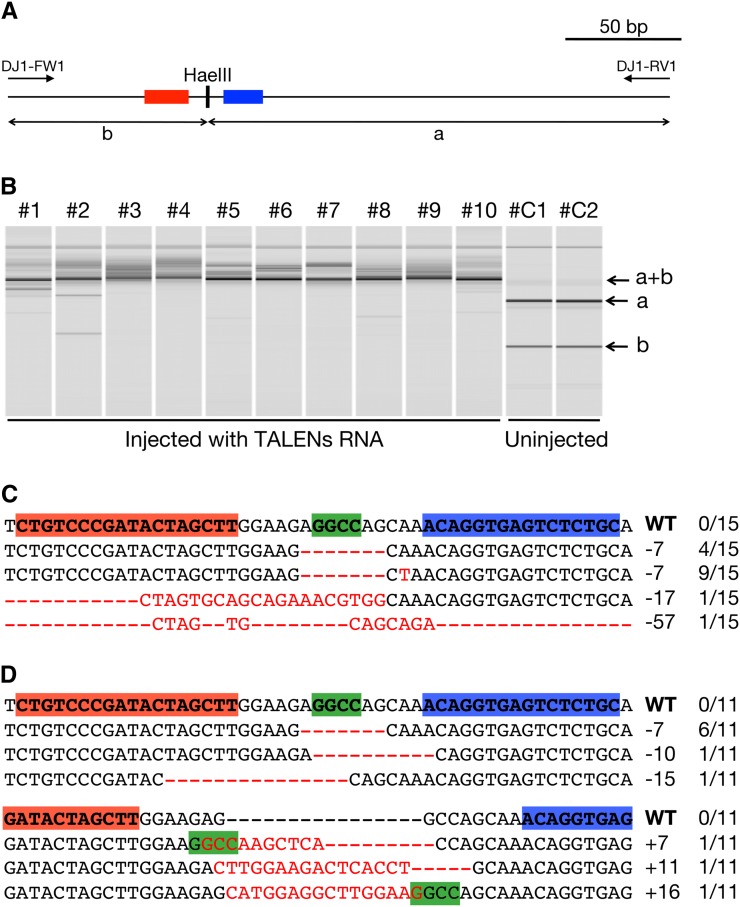
Somatic mutations in embryos injected with 300 ng/µl RNA for DJ1-TALENs. (A) In the wild type, a 285-bp amplified fragment obtained using primers DJ1-FW2 and DJ1-RV1 is digested into 199-bp (a) and 86-bp (b) fragments by HaeIII. Red or blue boxes indicate the left or right recognition sites of the TALENs, respectively. (B) Gel images of HaeIII-digested fragments analyzed in MultiNA. The TALEN-injected embryos (#1–#10) showed an undigested fragment (a+b), while control embryos that were not injected with TALEN (#C1 and #C2) showed that the intact fragment (a+b) was completely digested into two fragments (a and b). (C and D) Subcloned sequences observed in TALEN-injected embryos #1 and #2, respectively. Red letters or dashes indicate the identified mutations. Red and blue boxes in wild-type (WT) sequences indicate the left and right recognition sites of the TALENs, respectively. Green boxes indicate the HaeIII cleavage site. The sizes of the insertions and deletions are shown to the right of each mutated sequence (−, deletions; +, insertions). Numbers on the right edge indicate the numbers of mutated clones identified from all analyzed clones from each embryo.
Figure 3
Figure 3
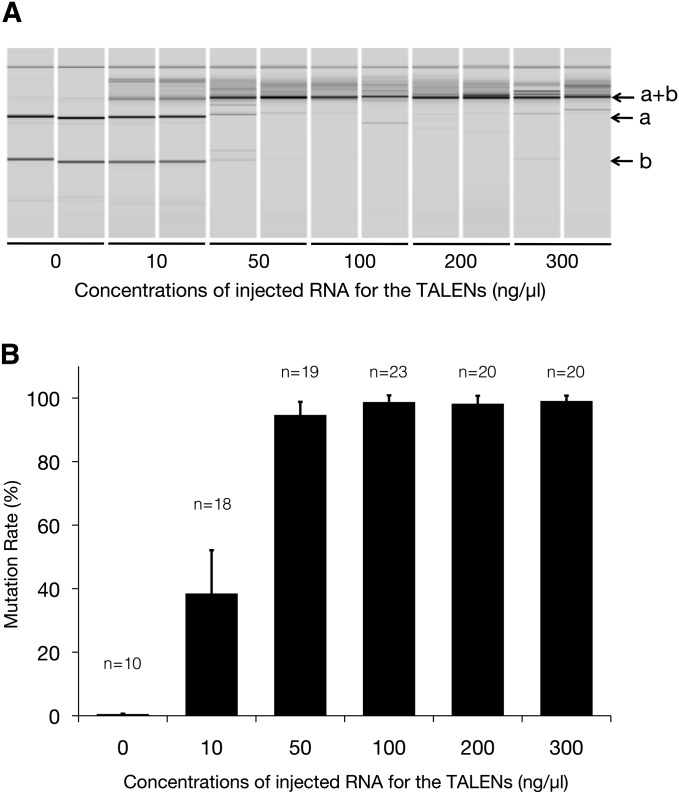
Dose-dependent mutagenesis by DJ1-TALENs. (A) MultiNA gel images of HaeIII digestion. A PCR fragment containing the TALEN target site was digested with HaeIII. Gel images from two representative embryos injected with 0–300 ng/µl RNA for the TALENs are shown. (B) Mutation rates at each injected TALEN RNA concentration. The mutation rate was calculated as the molar concentration of the undigested fragment (a+b) with HaeIII as a percentage of the sum of molar concentrations of the undigested fragment (a+b) and the larger digested fragment (a). The molar concentration of each fragment was quantified using the MultiNA Viewer software. Columns and error bars represent mean ± SEM. “n” indicates the numbers of embryos analyzed.
Figure 4
Figure 4
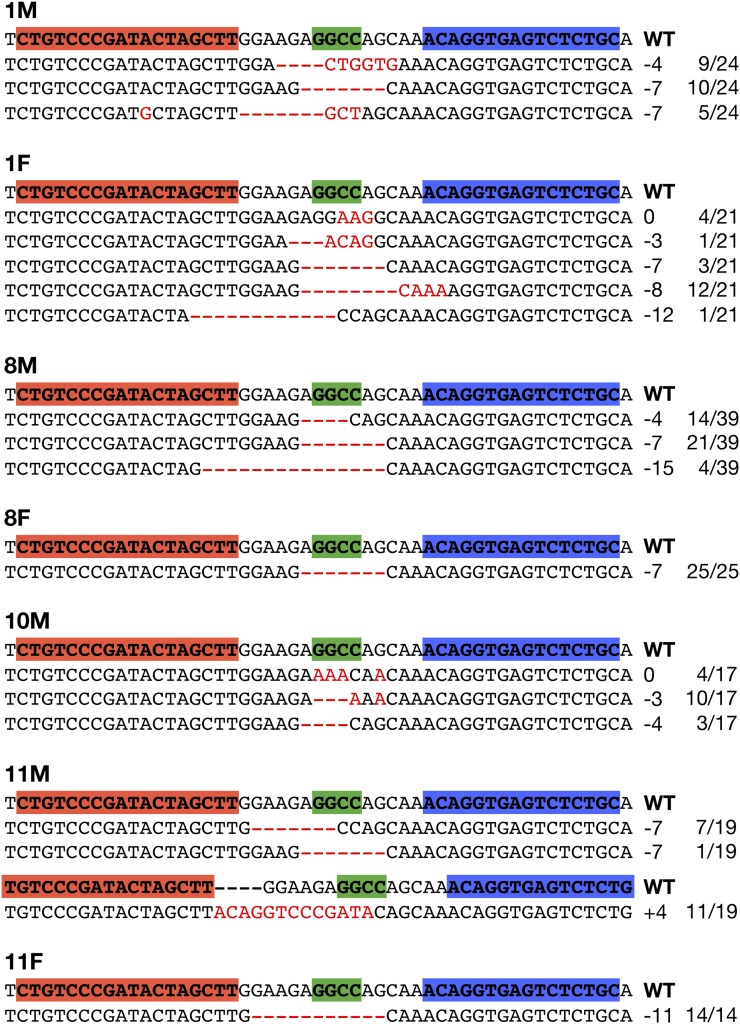
TALEN-induced mutations observed in F1 larvae from seven G0 founders. Red letters or dashes indicate the identified mutations. Red and blue boxes in the wild-type (WT) sequences indicate the left and right recognition sites of the TALENs, respectively. Green boxes indicate the HaeIII cleavage site. The sizes of the insertions and deletions are shown to the right of each mutated sequence (−, deletions; +, insertions). The numbers on the right edge indicate the numbers of larvae carrying each mutated sequence among all sequenced larvae.
Figure 5
Figure 5
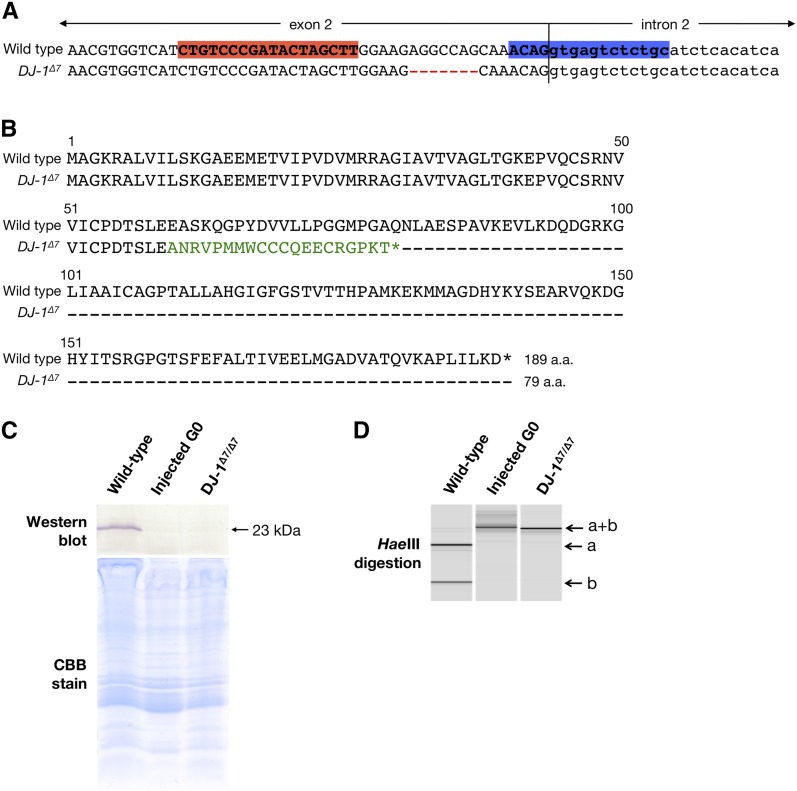
Expression of the DJ-1 protein in homozygous mutant fish. (A) Nucleotide sequences from the wild-type and mutant DJ-1Δ7 alleles. Red dashes indicate the TALEN-induced deletion. Red and blue boxes indicate the left and right recognition sites of DJ1-TALENs, respectively. Uppercase and lowercase letters in the sequences indicate the second exon and second intron sequences of the DJ-1 gene, respectively. (B) Alignment of the amino acid sequences of wild-type (accession no. AB193829) and truncated medaka DJ-1 proteins led by the DJ-1Δ7 frameshifted mutation. The DJ-1Δ7 product has an additional region of altered translation, which is indicated by green letters. (C) Western blot analysis using anti-medaka DJ-1 antibody. Homogenates prepared using the head regions of each fish were used (see Materials and Methods for details). The predicted signal (23 kDa) was detected in the wild-type lysate. No signals were detected in both injected G0 and DJ-1Δ7/Δ7 lysates, although the Coomassie Brilliant Blue (CBB)-stained gel showed evenly extracted protein bands among the three samples (bottom). (D) MultiNA gel images of HaeIII digestion. Genomic DNA was extracted from the posterior part of each fish whose head region was analyzed with Western blot in C. PCR fragments containing the target site of DJ1-TALENs were digested with HaeIII. In the wild type, the intact band (a+b) was completely digested into two fragments (a and b), whereas both the injected G0 fish and the DJ-1Δ7/Δ7 mutant exhibited an undigested fragment (a+b). (C and D) “Wild-type”: without TALEN-injection; “injected G0 fish”: injected with 200 ng/µl RNA for the TALENs; “DJ-1Δ7/Δ7”: F1 fish harboring a 7-bp deletion (DJ-1Δ7) in both alleles.
Figure 6
Figure 6
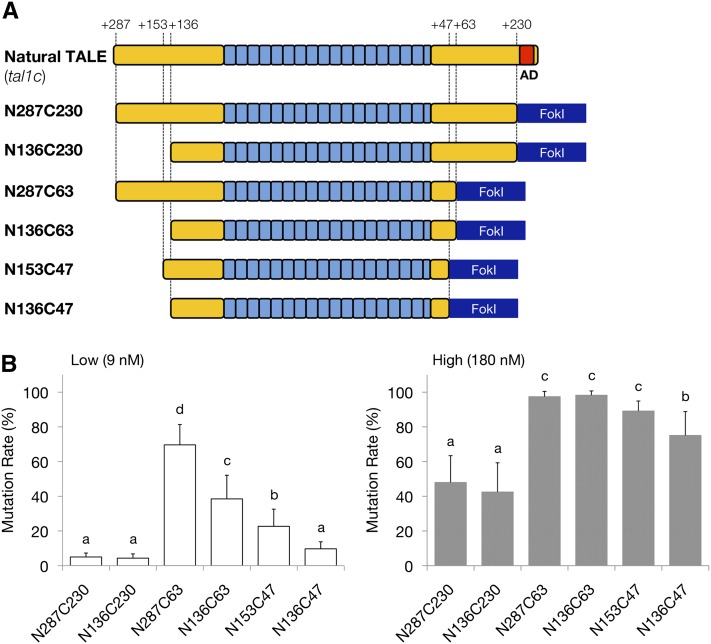
Effects of the N and C termini of the TAL effector domain on the gene-disrupting activities of deletion variants of DJ1-TALENs. (A) Schematic of deletion variants in the TAL effector domain. A natural TALE (tal1c) has 287 and 278 amino acids in the N- and C-terminal regions of the TAL effector domain, respectively. The transcriptional activation domain (AD) in the C-terminal region is highlighted in red. The names of the deletion variants generated by PCR amplification are indicated on the left side. The numbers of remaining amino acids of the N- and C-terminal regions relative to the position of the repeat modules are shown above. (B) Disruption activities of the truncated TALENs, shown as the mutation rate in the injected embryos. (Left) Mutation rates in the embryos injected with “low” concentrations of RNAs (9 nM) containing a mole ratio equal to 10 ng/µl of RNA for the N136C63 scaffold of the TALENs. (Right) Mutation rates in the embryos injected with “high” concentrations of RNAs (180 nM) containing a mole ratio equal to 200 ng/µl of the N136C63 scaffold. Mutation rate was calculated as the molar concentration of the undigested fragment with HaeIII as a percentage of the sum of the molar concentrations of the undigested fragment and the larger digested fragment. The molar concentration of each fragment was quantified using the MultiNA Viewer software. Columns and error bars represent mean ± SEM (n = 12). The differnt letters at the top of the columns indicate significant differences (P < 0.05; one-way ANOVA and Tukey’s HSD test).

References

    1. Aida T., 1921. On the inheritance of color in a fresh-water fish, Aplocheilus latipes Temmick and Schlegel, with special reference to sex-linked inheritance. Genetics 6: 554–573. - PMC - PubMed
    1. Ansai S., Ochiai H., Kanie Y., Kamei Y., Gou Y., et al. , 2012. Targeted disruption of exogenous EGFP gene in medaka using zinc-finger nucleases. Dev. Growth Differ. 54: 546–556. - PubMed
    1. Bedell V. M., Wang Y., Campbell J. M., Poshusta T. L., Starker C. G., et al. , 2012. In vivo genome editing using a high-efficiency TALEN system. Nature 491: 114–118. - PMC - PubMed
    1. Boch J., Scholze H., Schornack S., Landgraf A., Hahn S., et al. , 2009. Breaking the code of DNA binding specificity of TAL-type III effectors. Science 326: 1509–1512. - PubMed
    1. Bogdanove A. J., Voytas D. F., 2011. TAL effectors: customizable proteins for DNA targeting. Science 333: 1843–1846. - PubMed

MeSH terms

Substances