


Do sleep problems mediate the relationship between traumatic brain injury and development of mental health symptoms after deployment?
- PMID: 23288974
- PMCID: PMC3524546
- DOI: 10.5665/sleep.2306
Do sleep problems mediate the relationship between traumatic brain injury and development of mental health symptoms after deployment?
Abstract
Study objectives: Military members screening positive for blast-related traumatic brain injury (TBI) may subsequently screen positive for posttraumatic stress disorder (PTSD) or depression. The role of sleep as a mediating factor in the development of mental health symptoms was explored.
Design: Prospective study with symptoms evaluated at two time points.
Setting: Postdeployment service in Iraq, Afghanistan, or Kuwait during 2008 and 2009.
Participants: There were 29,640 US Navy and Marine Corps men (29,019 who did not screen positive for PTSD at baseline, 27,702 who did not screen positive for depression at baseline, and 27,320 who did not screen positive at baseline for either condition).
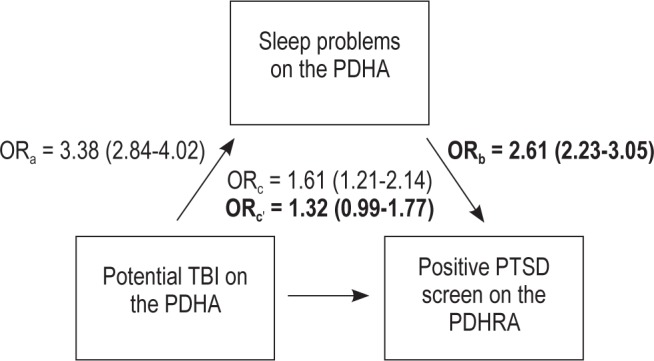
Measurements and results: After controlling for sleep problems, the adjusted odds of receiving a positive PTSD screening at follow-up decreased from 1.61 (95% confidence interval [CI] 1.21-2.14) to 1.32 (95% CI 0.99-1.77) for a subject screening positive for TBI relative to a subject screening negative, suggesting that sleep problems mediated 26% of TBI's effect on development of PTSD. Likewise, after controlling for sleep problems, the adjusted odds of receiving a positive depression screening decreased from 1.41 (95% CI 1.11-1.80) to 1.15 (95% CI 0.90-1.47), suggesting that sleep problems mediated 41% of TBI's effect on development of depression. Results were similar for those with either PTSD or depression (37% mediated).
Conclusions: These results suggest that sleep problems mediate the effect of a positive TBI screening on the development of mental health disorders, and sleep problems may be an early indicator of risk for PTSD or depression.
Figures


Comment in
-
Sound sleep, a crucial component of military medicine's armamentarium?Sleep. 2013 Jan 1;36(1):7-8. doi: 10.5665/sleep.2284. Sleep. 2013. PMID: 23288963 Free PMC article. No abstract available.
References
-
- Peterson AL, Goodie JL, Satterfield WA, Brim WL. Sleep disturbance during military deployment. Mil Med. 2008;173:230–35. - PubMed
-
- Rao V, Bergey A, Hill H, Efron D, McCann U. Sleep disturbance after mild traumatic brain injury: indicator of injury? J Neuropsychiatry Clin Neurosci. 2011;23:201–5. - PubMed
-
- Schreiber S, Barkai G, Gur-Hartman T, et al. Long-lasting sleep patterns of adult patients with minor traumatic brain injury (mTBI) and non-mTBI subjects. Sleep Med. 2008;9:481–7. - PubMed
-
- Orff HJ, Ayalon L, Drummon SP. Traumatic brain injury and sleep disturbance: a review of current research. J Head Trauma Rehabil. 2009;24:155–65. - PubMed
Publication types
MeSH terms
LinkOut - more resources
Full Text Sources
Other Literature Sources
Medical
Research Materials
