Comparative Study
. 2013 Feb;13(2):115-31.
doi: 10.1089/ast.2011.0811. Epub 2013 Jan 5.

Growth of Serratia liquefaciens under 7 mbar, 0°C, and CO2-enriched anoxic atmospheres

Affiliations
Comparative Study

Growth of Serratia liquefaciens under 7 mbar, 0°C, and CO2-enriched anoxic atmospheres

Andrew C Schuerger et al. Astrobiology. 2013 Feb.

Abstract

Twenty-six strains of 22 bacterial species were tested for growth on trypticase soy agar (TSA) or sea-salt agar (SSA) under hypobaric, psychrophilic, and anoxic conditions applied singly or in combination. As each factor was added to multi-parameter assays, the interactive stresses decreased the numbers of strains capable of growth and, in general, reduced the vigor of the strains observed to grow. Only Serratia liquefaciens strain ATCC 27592 exhibited growth at 7 mbar, 0°C, and CO2-enriched anoxic atmospheres. To discriminate between the effects of desiccation and hypobaria, vegetative cells of Bacillus subtilis strain 168 and Escherichia coli strain K12 were grown on TSA surfaces and simultaneously in liquid Luria-Bertani (LB) broth media. Inhibition of growth under hypobaria for 168 and K12 decreased in similar ways for both TSA and LB assays as pressures were reduced from 100 to 25 mbar. Results for 168 and K12 on TSA and LB are interpreted to indicate a direct low-pressure effect on microbial growth with both species and do not support the hypothesis that desiccation alone on TSA was the cause of reduced growth at low pressures. The growth of S. liquefaciens at 7 mbar, 0°C, and CO2-enriched anoxic atmospheres was surprising since S. liquefaciens is ecologically a generalist that occurs in terrestrial plant, fish, animal, and food niches. In contrast, two extremophiles tested in the assays, Deinococcus radiodurans strain R1 and Psychrobacter cryohalolentis strain K5, failed to grow under hypobaric (25 mbar; R1 only), psychrophilic (0°C; R1 only), or anoxic (< 0.1% ppO2; both species) conditions.


Figures
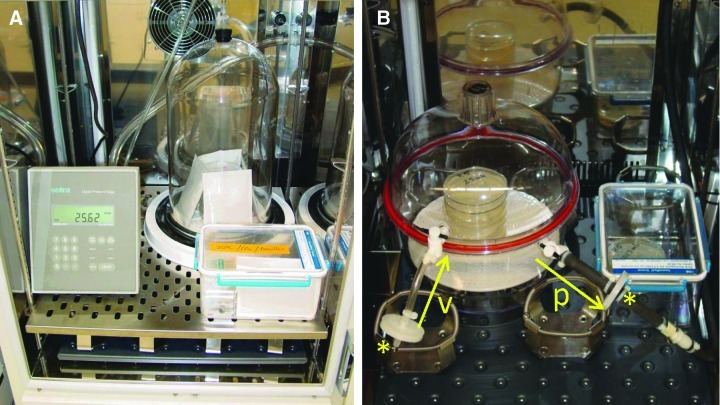
FIG. 1.
FIG. 1.
Hypobaric chambers used for creating low-pressure conditions reported in Tables 2, 3, and 6, and Figs. 2, 3, and 4. (A) One system was composed of a single glass bell jar attached to a high-density polyethylene stage through which vent holes permitted the connection to external pumps and controllers (model PU-842, KNF, Neuberger, Trenton NJ, USA). For anoxic conditions, AnaeroPack (Remel, Thermo Fisher Scientific, Chicago, IL, USA) sachets were placed around each stack of up to six Petri dishes of TSA or SSA media. (B) A second hypobaric system was developed to replace the single glass bell jar system in which two separate hypobaric chambers were maintained in separate microbial incubators. The newer hypobaric chambers were composed of clear polycarbonate desiccators (model #08-642-7, Thermo-Fisher Scientific, Rochester, NY, USA) connected to two separate KNF pump/controllers placed on the outsides of the microbial incubators. For each unit, in-line 0.22 μm filters (*) were used on the vent line (v) and the pump line (p) to prevent the introduction of room air into the hypobaric chamber during normal operations. Arrows designate the airflow into and out of the hypobaric desiccator system. Color images available online at www.liebertonline.com/ast
FIG. 2.
FIG. 2.
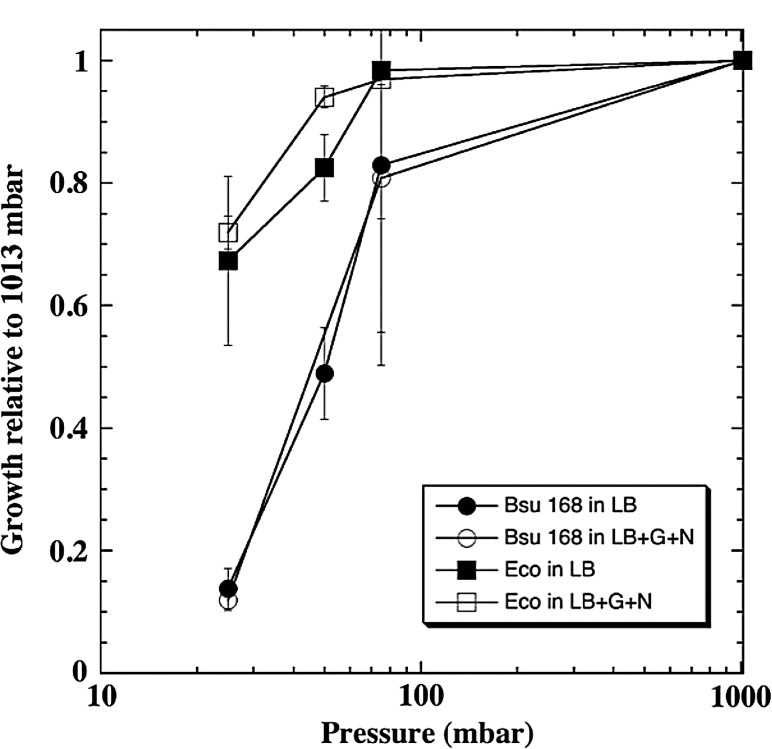
Growth of Bacillus subtilis 168 (Bsu) and Escherichia coli K12 (Eco) in liquid culture under hypobaric conditions. Vegetative cells of both species were grown for 24 h at 30°C in Luria-Bertani (LB) liquid media with and without added glucose (0.25%) and nitrate (0.1%) (LB+G+N). Bacteria were grown at pressures of 1013, 75, 50, or 25 mbar. Data were normalized to growth rates at an Earth-normal sea-level pressure of 1013 mbar (n=3; P≤0.05; bars=standard deviations).
FIG. 3.
FIG. 3.
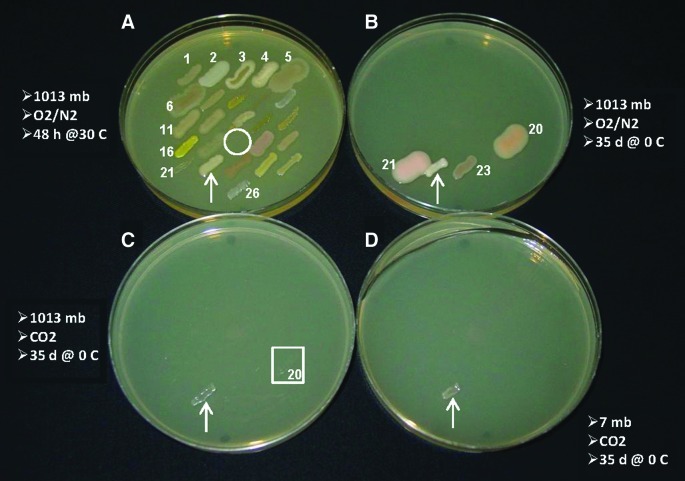
Growth of 26 strains of 22 bacterial species under hypobaric, psychrophilic, and anoxic conditions. Spot-plate assays with bacterial strains were laid out in 5×5 grids with strain 26 placed below the grids; numbers (#s) coincide with bacterial strains listed in Table 1. Arrows indicate locations of Serratia liquefaciens (strain #22). (A) Lab controls were incubated for 48 h at 1013 mbar, 30°C, in a standard 21%/78% O2/N2 atmosphere. The circle denotes the location where Proteus mirabilis was omitted from the lab conditions because the bacterium would normally overgrow the TSA plates in 48 h when incubated at 30°C. Proteus mirabilis was included in the spot-plate assays maintained 35 d at 0°C under nonstandard conditions (B), (C), and (D). Environmental conditions for assays are given adjacent to the TSA plates. Only S. liquefaciens exhibited obvious growth in 7 mbar, 0°C, and CO2-enriched anoxic atmospheres (D). The box labeled #20 (C) includes subtle but observable growth of Pseudomonas fluorescens. Results presented here, and Fig. 4, confirm the results presented in Tables 4, 5, and 6. Color images available online at www.liebertonline.com/ast
FIG. 4.
FIG. 4.
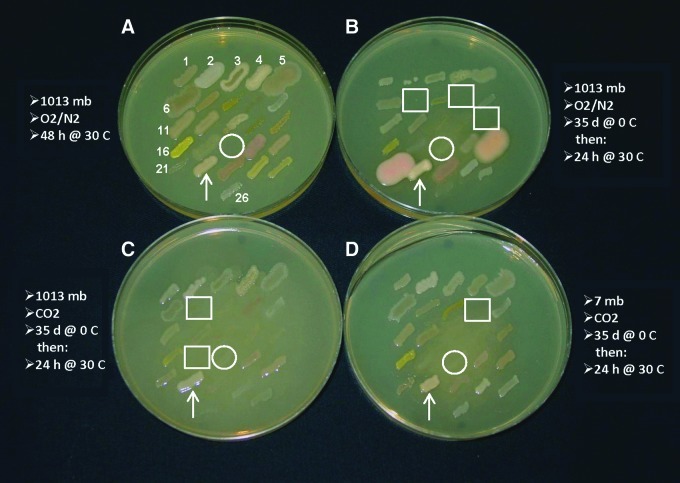
Growth of 26 strains of 22 bacterial species previously exposed to hypobaric, psychrophilic, and anoxic conditions (Fig. 3) were transferred to lab conditions and incubated an additional 48 h at 1013 mbar, 30°C, and an Earth-normal O2/N2 atmosphere. Arrows indicate the location of Serratia liquefaciens. Circles indicate the locations of the omitted Proteus mirabilis for the 30°C (A), and the included P. mirabilis for the 0°C assay plates (i.e., B, C, and D). Note how P. mirabilis overgrows the other bacterial strains when spot-plates were transferred from 0°C to 30°C for only 24 h (current image). Boxes indicate bacterial strains in which growth was not observed after 24 h incubation at 30°C, but in all cases bacterial growth was observed for the box-marked strains when the TSA plates were incubated an additional 24 h (data not shown). The spot-plates shown here are the exact same plates presented in Fig. 3. Results presented here, and Fig. 3, confirm the results presented in Tables 4, 5, and 6. Color images available online at www.liebertonline.com/ast
FIG. 5.
FIG. 5.
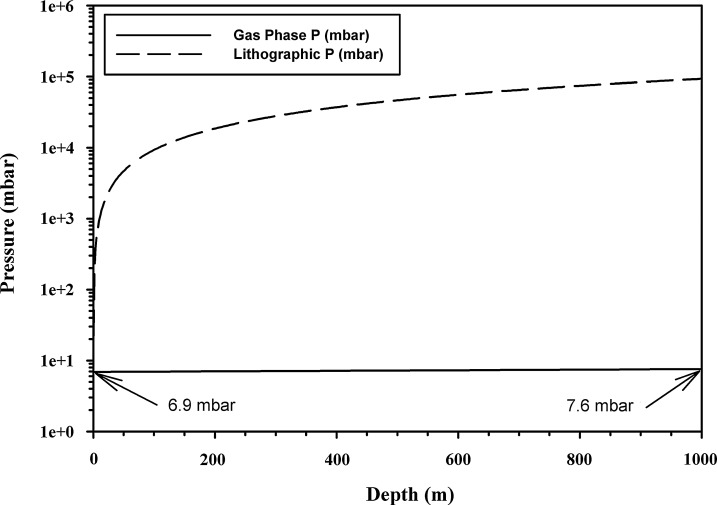
Atmospheric gas-phase (i.e., for void spaces) and lithographic (i.e., for salt, or ice inclusions) pressure lapse rates for Mars. The atmospheric gas-phase pressure increases very slowly with increasing depth in the martian lithosphere and reaches 25 mbar at a depth of 13.8 km below the martian datum. In contrast, the lithographic pressure for salt or ice inclusions in the lithosphere can achieve 25 mbar at 19.5 cm of overburden depth. The lithographic pressure is entirely dependent upon the microbial niche being completely (i.e., 100%) sealed from outgassing; otherwise, the niche would equilibrate to the atmospheric pressure predicted by the gas-phase lapse rate.

References

    1. Ashelford K.E. Fry J.C. Bailey M.J. Jeffries A.R. Day M.J. Characterization of six bacteriophages of Serratia liquefaciens CP6 isolated from the sugar beet phytosphere. Appl Surf Sci. 1999;65:1959–1965. - PMC - PubMed
    1. Aydin S. Erman Z. Bilgin O.C. Investigation of Serratia liquefaciens infection in rainbow trout (Oncorhynchus mykiss Walbaum) Turkish Journal of Veterinary and Animal Sciences. 2001;25:643–650.
    1. Beaty D.W. Buxbaum K. Meyer M. Boynton W.V. Clark B.C. Deming J.W. Doran P.T. Edgett K.S. Hecht M.H. Hipkin V. Kieft T. McDonald E. McKay C.P. Mellon M.T. Newsom H.E. Ori G. Paige D. Schuerger A.C. Sogin M. Spry A. Steele A. Tanaka K.L. Voytek M.A. Findings of the Mars Special Regions Science Analysis Group. Astrobiology. 2006;6:677–732. - PubMed
    1. Berry B.J. Jenkins D.G. Schuerger A.C. Inhibition of Escherichia coli and Serratia liquefaciens under high-salt, low-pressure, and low-temperature environments that approach surface conditions on Mars. Appl Environ Microbiol. 2010;76:2377–2386. - PMC - PubMed
    1. Clark B.C. Morris R.V. McLennan S.M. Gellert R. Jolliff B. Knoll A.H. Squyres S.W. Lowerstein T.K. Ming D.W. Tosca N.J. Yen A. Christensen P.R. Gorevan S. Brückner J. Calvin W. Dreibus G. Farrand W. Klingelhoefer G. Waenke H. Zipfel J. Bell J.F., III Grotzinger J. McSween H.Y. Rieder R. Chemistry and mineralogy of outcrops at Meridiani Planum. Earth Planet Sci Lett. 2005;240:73–94.

Publication types

MeSH terms