. 2013 Jan 5;11(1):1.
doi: 10.1186/1478-811X-11-1.

Structural and functional characteristics of cGMP-dependent methionine oxidation in Arabidopsis thaliana proteins

Affiliations

Structural and functional characteristics of cGMP-dependent methionine oxidation in Arabidopsis thaliana proteins

Claudius Marondedze et al. Cell Commun Signal. .

Abstract

Background: Increasing structural and biochemical evidence suggests that post-translational methionine oxidation of proteins is not just a result of cellular damage but may provide the cell with information on the cellular oxidative status. In addition, oxidation of methionine residues in key regulatory proteins, such as calmodulin, does influence cellular homeostasis. Previous findings also indicate that oxidation of methionine residues in signaling molecules may have a role in stress responses since these specific structural modifications can in turn change biological activities of proteins.

Findings: Here we use tandem mass spectrometry-based proteomics to show that treatment of Arabidopsis thaliana cells with a non-oxidative signaling molecule, the cell-permeant second messenger analogue, 8-bromo-3,5-cyclic guanosine monophosphate (8-Br-cGMP), results in a time-dependent increase in the content of oxidised methionine residues. Interestingly, the group of proteins affected by cGMP-dependent methionine oxidation is functionally enriched for stress response proteins. Furthermore, we also noted distinct signatures in the frequency of amino acids flanking oxidised and un-oxidised methionine residues on both the C- and N-terminus.

Conclusions: Given both a structural and functional bias in methionine oxidation events in response to a signaling molecule, we propose that these are indicative of a specific role of such post-translational modifications in the direct or indirect regulation of cellular responses. The mechanisms that determine the specificity of the modifications remain to be elucidated.


Figures
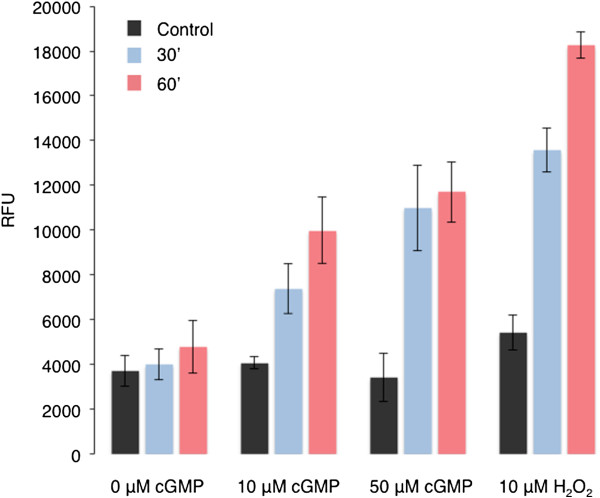
Figure 1
Figure 1
Protein oxidation assay. OxiSelect™ Intracellular ROS assay kit (Cell Biolabs, Inc. San Diego, CA) was used in the in vivo oxidation experiments according to the assay protocol provided by the manufacturer. Cultured Arabidopsis (Col-0) cells were placed in a black bottom 96-well cell culture plate for 2 h in a shaking incubator. The 2,7-dichlorofluorescein diacetate/media solution was added to the cells prior to incubation at 37°C for 1 h. The dye-loaded cells were then treated with 10 μM or 50 μM of cGMP or H2O2. Fluorescence in the cells was measured at 30 and 60 min post-treatment at 480/530 nm using a PHERAstar FS microplate reader (BMG Labtech GmbH, Germany) and the values plotted. Each bar represents data from 3 biological replicates (n = 3), the bars are the standard errors. Treatment with 8-Br-cGMP at the final concentration of 50 μM induces statistically significant differences of the means at p = 0.05 using a two-sample t-test.
Figure 2
Figure 2
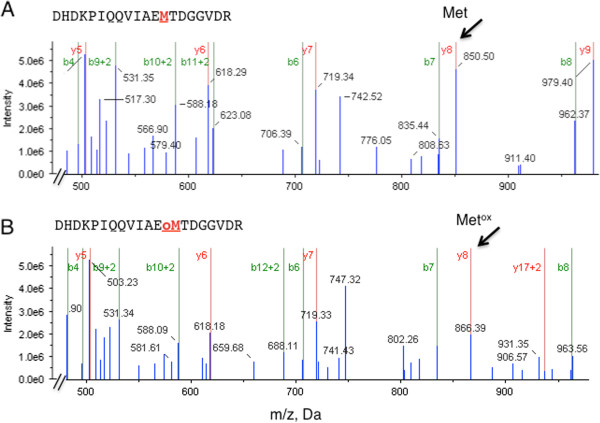
MS/MS spectra of ADH1 containing non-oxidised (A) and oxidised (B) methionine residues. Three biological replicates of 10 μM 8-Br-cGMP-treated cells and H2O mock treated controls were collected at 0, 30 and 60 min. Proteins were precipitated using 10% (w/v) trichloroacetic acid in acetone, re-solubilised in 7 M urea, 2 M thiourea and 4% (w/v) CHAPS, reduced, alkylated and trypsin digested. Peptides were fractionated by cation exchange chromatography. Methionine oxidised peptides were enriched using TiO2 beads and re-suspended in 5% (v/v) acetonitrile and 0.1% (v/v) formic acid prior to identification and quantitation by LTQ Orbitrap coupled with a nanoelectrospray ion source. Peptides (5 μL) were injected onto a 50 mm × 0.3 mm Magic C18AQ column. The top 10 precursor ions were selected with a resolution of 60,000 for fragmentation using normalized collision-induced dissociation set at 35.0. Spectra were searched against TAIR using MASCOT, with a precursor mass tolerance of 10 ppm, a fragment ion mass tolerance of 0.3 Da, one missed cleavage, carbamidomethyl cysteine residues as fixed modification and oxidation and dioxidation of methionine residues as variable modifications. Proteins with a score > 95% were considered positively identified (corresponding score ≤ 31). Spectra were further processed with the Scaffold software using the “Trans-Proteomic Pipeline” algorithm (threshold 95%). Oxidised Met residues showed an increase in mass/charge ratio (m/z) of 15.9994. Arrows show Met residues at position 13 in the fragment DHDKPIQQVIAEMTDGGVDR of AT1G77120 before oxidation (m/z ratio 850.3723) (A) and after oxidation (m/z ratio 866.3673) (B).
Figure 3
Figure 3
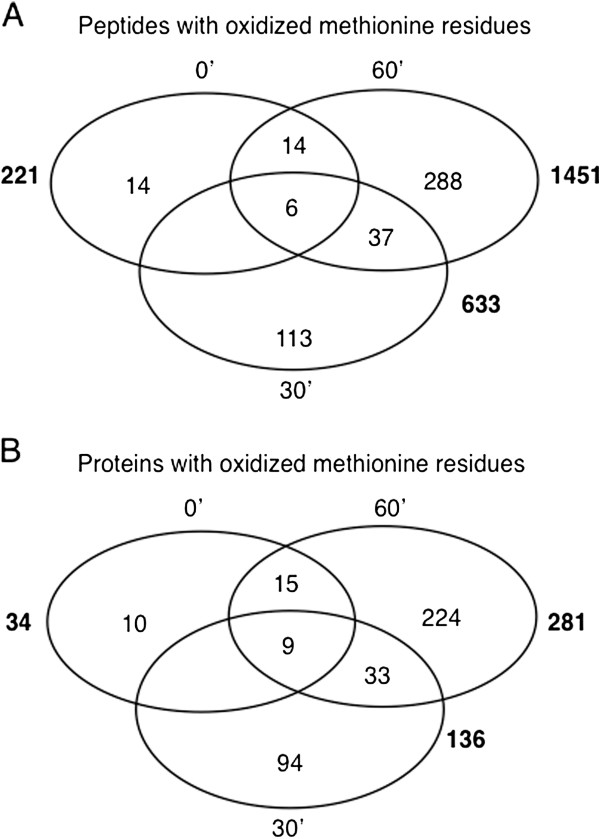
Quantitative representation of peptides (A) and proteins (B) containing oxidised Met residues identified by mass spectrometry. The total numbers of peptides and proteins containing at least one oxidised Met residue identified by LC-MS/MS in protein samples extracted from A. thaliana cells treated with 10 μM 8-Br-cGMP and collected at 0, 30 and 60 min post-treatment were analysed. Proteins matching the peptides were identified by searching against TAIR10 database using MASCOT and TPP algorithm, and only proteins within a 95% confidence threshold were considered. The total number of peptides (A) or proteins (B) are indicated outside the Venn diagram (in bold), the numbers inside are the unique peptides or proteins identified at each time point. Fourteen, 113 and 288 peptide fragments containing at least one oxidised Met appear only at either 0, 30 or 60 min. This corresponds to an increase in the total number of time point specific Met oxidised proteins from 10 to 94 and then to 224 (B).
Figure 4
Figure 4
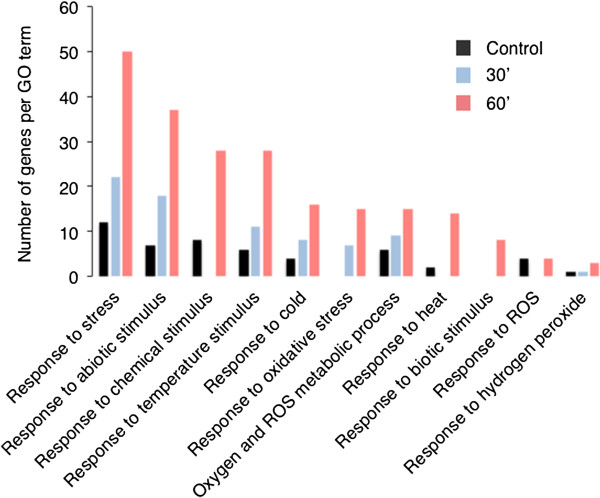
Enriched gene ontology (GO) terms (adjusted p-value < 1.00e-02). Unique proteins containing oxidised Met identified in cGMP-treated samples were used to search for GO term enrichment using Fatigo+ ( http://babelomics3.bioinfo.cipf.es/) and selected significantly enriched terms are represented. A significant increase in the enrichment of GO terms over time was observed as well as an increase in the number of genes in these GO categories.

References

    1. Hoshi T, Heinemann S. Regulation of cell function by methionine oxidation and reduction. J Physiol. 2001;531:1–11. doi: 10.1111/j.1469-7793.2001.0001j.x. - DOI - PMC - PubMed
    1. Stadtman ER, Moskovitz J, Levine RL. Oxidation of methionine residues of proteins: biological consequences. Antiox Redox Sign. 2003;5:577–582. doi: 10.1089/152308603770310239. - DOI - PubMed
    1. Hardin SC, Larue CT, Oh MH, Jain V, Huber SC. Coupling oxidative signals to protein phosphorylation via methionine oxidation in Arabidopsis. Biochem J. 2009;422:305–312. doi: 10.1042/BJ20090764. - DOI - PMC - PubMed
    1. Neuhaus G, Bowler C, Hiratsuka K, Yamagata H, Chua NH. Phytochrome-regulated repression of gene expression requires calcium and cGMP. EMBO J. 1997;16:2554–2564. doi: 10.1093/emboj/16.10.2554. - DOI - PMC - PubMed
    1. Pharmawati M, Billington T, Gehring CA. Stomatal guard cell responses to kinetin and natriuretic peptides are cGMP-dependent. Cell Mol Life Sci. 1998;54:272–276. doi: 10.1007/s000180050149. - DOI - PMC - PubMed

LinkOut - more resources