


Identification of prognostic factors in canine mammary malignant tumours: a multivariable survival study
- PMID: 23289974
- PMCID: PMC3542312
- DOI: 10.1186/1746-6148-9-1
Identification of prognostic factors in canine mammary malignant tumours: a multivariable survival study
Abstract
Background: Although several histopathological and clinical features of canine mammary gland tumours have been widely studied from a prognostic standpoint, considerable variations in tumour individual biologic behaviour difficult the definition of accurate prognostic factors. It has been suggested that the malignant behaviour of tumours is the end result of several alterations in cellular physiology that culminate in tumour growth and spread. Accordingly, the aim of this study was to determine, using a multivariable model, the independent prognostic value of several immunohistochemically detected tumour-associated molecules, such as MMP-9 and uPA in stromal cells and Ki-67, TIMP-2 and VEGF in cancer cells.
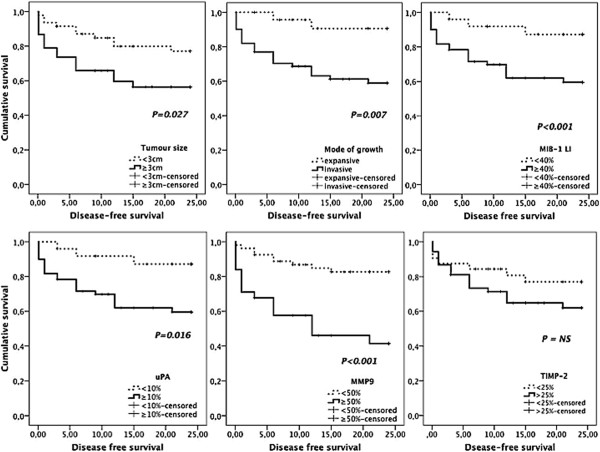
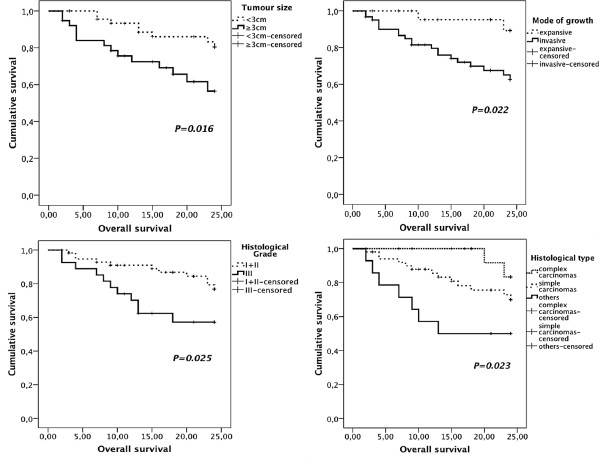
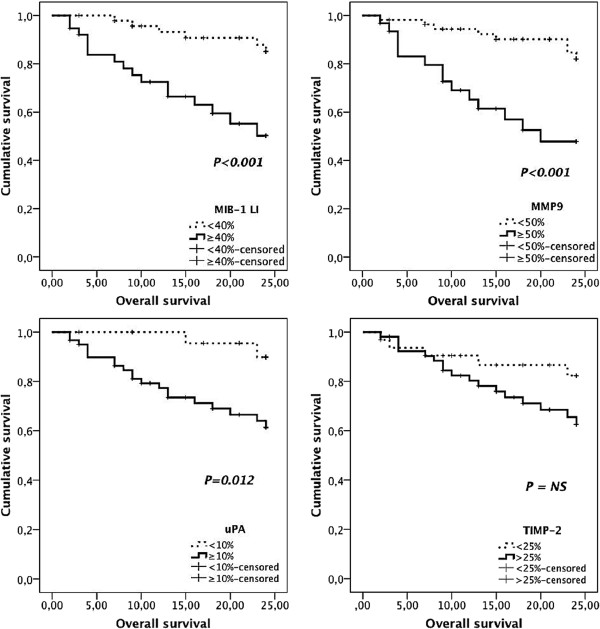
Results: Eighty-five female dogs affected by spontaneous malignant mammary neoplasias were followed up for a 2-year post-operative period. In univariate analysis, tumour characteristics such as size, mode of growth, regional lymph node metastases, tumour cell MIB-1 LI and MMP-9 and uPA expressions in tumour-adjacent fibroblasts, were associated with both survival and disease-free intervals. Histological type and grade were related with overall survival while VEGF and TIMP-2 were not significantly associated with none of the outcome parameters. In multivariable analysis, only a MIB-1 labelling index higher than 40% and a stromal expression of MMP-9 higher than 50% retained significant relationships with poor overall and disease-free survival.
Conclusions: The results of this study indicate that MMP-9 and Ki-67 are independent prognostic markers of canine malignant mammary tumours. Furthermore, the high stromal expressions of uPA and MMP-9 in aggressive tumours suggest that these molecules are potential therapeutic targets in the post-operative treatment of canine mammary cancer.
Figures
References
-
- Lana SE, Rutteman GR, Withrow SJ. In: Small Animal Clinical Oncology. 4th. Withrow SJ, MacEwen EG, editor. St. Louis: Saunders Elsevier; 2007. Tumors of the mammary gland; pp. 619–636.
-
- Misdorp W, Else RW, Helmén E, Lipscomb TP. In: World Health Organization International Histological Classification of Tumours of Domestic Animals. 2nd. Shulman FL, editor. Washington DC: Armed Forces Institute of Pathology; 1999. Histological classification of the mammary tumours of the dog and the cat; pp. 16–29.
-
- De Las Mulas J, Millán Y, Dios R. A prospective analysis of immunohistochemically determined estrogen receptor α and progesterone receptor expression and host and tumor factors as predictors of disease-free period in mammary tumors of the Dog. Vet Pathol. 2005;42:200–212. doi: 10.1354/vp.42-2-200. - DOI - PubMed
Publication types
MeSH terms
Substances
LinkOut - more resources
Full Text Sources
Other Literature Sources
Medical
Research Materials
Miscellaneous
