


Artificial selection on relative brain size in the guppy reveals costs and benefits of evolving a larger brain
- PMID: 23290552
- PMCID: PMC3566478
- DOI: 10.1016/j.cub.2012.11.058
Artificial selection on relative brain size in the guppy reveals costs and benefits of evolving a larger brain
Abstract
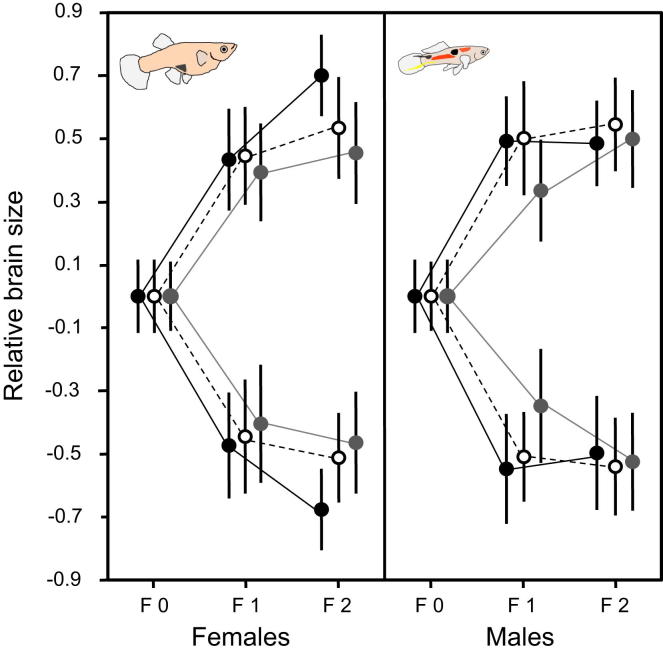
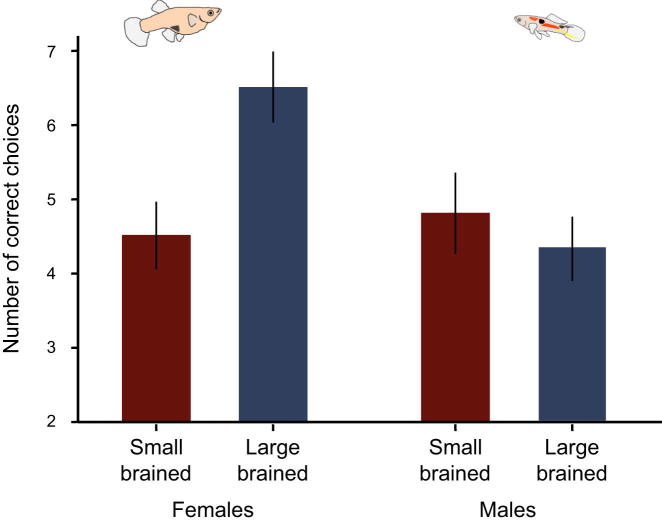
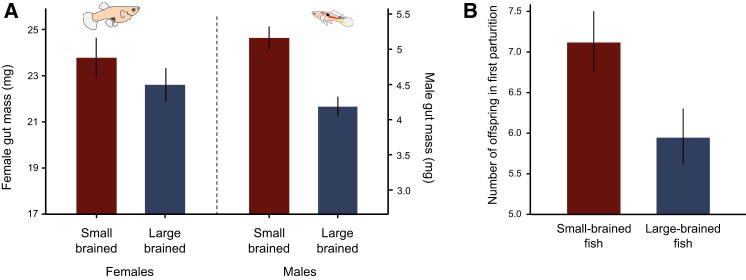
The large variation in brain size that exists in the animal kingdom has been suggested to have evolved through the balance between selective advantages of greater cognitive ability and the prohibitively high energy demands of a larger brain (the "expensive-tissue hypothesis"). Despite over a century of research on the evolution of brain size, empirical support for the trade-off between cognitive ability and energetic costs is based exclusively on correlative evidence, and the theory remains controversial. Here we provide experimental evidence for costs and benefits of increased brain size. We used artificial selection for large and small brain size relative to body size in a live-bearing fish, the guppy (Poecilia reticulata), and found that relative brain size evolved rapidly in response to divergent selection in both sexes. Large-brained females outperformed small-brained females in a numerical learning assay designed to test cognitive ability. Moreover, large-brained lines, especially males, developed smaller guts, as predicted by the expensive-tissue hypothesis, and produced fewer offspring. We propose that the evolution of brain size is mediated by a functional trade-off between increased cognitive ability and reproductive performance and discuss the implications of these findings for vertebrate brain evolution.
Copyright © 2013 Elsevier Ltd. All rights reserved.
Figures
Comment in
-
Brain size evolution: how fish pay for being smart.Curr Biol. 2013 Jan 21;23(2):R63-5. doi: 10.1016/j.cub.2012.11.042. Curr Biol. 2013. PMID: 23347939
References
-
- Aiello L.C., Wheeler P. The expensive-tissue hypothesis: the brain and the digestive system in human and primate evolution. Curr. Anthropol. 1995;36:199–221.
-
- Navarrete A., van Schaik C.P., Isler K. Energetics and the evolution of human brain size. Nature. 2011;480:91–93. - PubMed
-
- Darwin C. John Murray; London: 1871. The Descent of Man, and Selection in Relation to Sex.
Publication types
MeSH terms
Grants and funding
LinkOut - more resources
Full Text Sources
Other Literature Sources
