


Comorbid cardiovascular disease and major depression among ethnic and racial groups in the United States
- PMID: 23290766
- PMCID: PMC5714272
- DOI: 10.1017/S1041610212002062
Comorbid cardiovascular disease and major depression among ethnic and racial groups in the United States
Abstract
Background: To describe and examine the distribution, disability, and treatment associated with comorbid cardiovascular disease and major depressive disorder (CVD/MDD) among middle-aged and older ethnic/racial groups in the United States.
Methods: Cross-sectional data from a national probability sample of household resident adults (18 years and older; N = 16,423) living in the 48 coterminous United States were analyzed. We defined comorbid CVD/MDD as the presence of CVD (e.g. diabetes, hypertension, heart disease, and stroke) among adults who met MDD criteria at or after age 50 years.
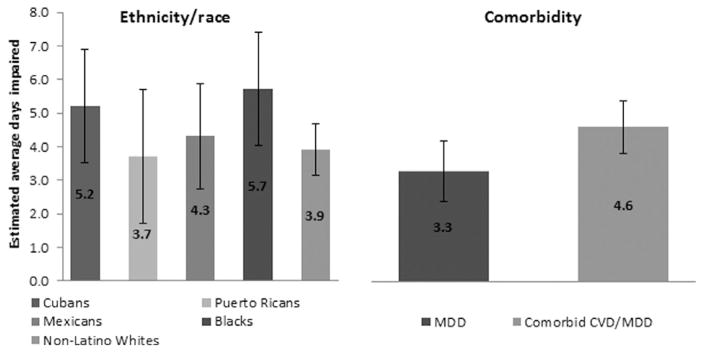
Results: Two-thirds of middle-aged and older American adults meeting criteria major depression at or after age 50 years also reported a diagnosis of comorbid CVD. Blacks were most likely to meet our comorbid CVD/MDD (74.4%) criteria. The disease burden of depression was also highest among Black respondents. Differences in treatment due to race/ethnicity and comorbidity were not statistically significant.
Conclusions: Our findings indicate that among middle-aged and older US adults meeting MDD criteria more than half would also report a comorbid CVD. Comorbid CVD/MDD rates varied between the considered ethnic/race groups. Functional impairment associated with comorbid CVD/MDD was higher than MDD alone; however, depression care rates did not differ remarkably. Among middle-aged and older adults meeting MDD criteria, comorbid CVD may be the rule rather than the exception.
Conflict of interest statement
None.
Figures
References
-
- Alexopoulos GS. The vascular depression hypothesis: 10 years later. Biological Psychiatry. 2006;60:1304–1305. - PubMed
-
- American Psychiatric Association (APA) Diagnostic and Statistical Manual of Mental Disorders. 4. Washington, DC: American Psychiatric Association; 2000. revised.
-
- Cameron CA, Trivedi PK. Microeconometrics Using Stata (Revised Edition) College Station, Texas, USA: Stata Press; 2010.
-
- Cutler JA, Sorlie PD, Wolz L, Thom T, Fields LE, Roccella EJ. Trends in hypertension prevalence, awareness, treatment, and control rates in United States adults between 1988–1994 and 1999–2004. Hypertension. 2008;52:818–827. - PubMed
-
- Flegal KM, Carroll MD, Kit BK, Ogden CL. Prevalence of obesity and trends in the distribution of body mass index among US adults, 1999–2010. JAMA. 2012;307:491–497. - PubMed
Publication types
MeSH terms
Grants and funding
LinkOut - more resources
Full Text Sources
Other Literature Sources
Miscellaneous
