Meta-Analysis
. 2013 Feb;45(2):155-63.
doi: 10.1038/ng.2506. Epub 2013 Jan 6.

Genome-wide association analyses identify multiple loci associated with central corneal thickness and keratoconus

Yi Lu  1 Veronique VitartKathryn P BurdonChiea Chuen KhorYelena BykhovskayaAlireza MirshahiAlex W HewittDemelza KoehnPirro G HysiWishal D RamdasTanja ZellerEranga N VithanaBelinda K CornesWan-Ting TayE Shyong TaiChing-Yu ChengJianjun LiuJia-Nee FooSeang Mei SawGudmar ThorleifssonKari StefanssonDavid P DimasiRichard A MillsJenny MountainWei AngRené HoehnVirginie J M VerhoevenFranz GrusRoger WolfsRaphaële CastagneKarl J LacknerHenriët SpringelkampJian YangFridbert JonassonDexter Y L LeungLi J ChenClement C Y ThamIgor RudanZoran VatavukCaroline HaywardJane GibsonAngela J CreeAlex MacLeodSarah EnnisOzren PolasekHarry CampbellJames F WilsonAnanth C ViswanathanBrian FleckXiaohui LiDavid SiscovickKent D TaylorJerome I RotterSeyhan YazarMegan UlmerJun LiBrian L YaspanAyse B OzelJulia E RichardsSayoko E MoroiJonathan L HainesJae H KangLouis R PasqualeR Rand AllinghamAllison Ashley-KochNEIGHBOR ConsortiumPaul MitchellJie Jin WangAlan F WrightCraig PennellTimothy D SpectorTerri L YoungCaroline C W KlaverNicholas G MartinGrant W MontgomeryMichael G AndersonTin AungColin E WilloughbyJaney L WiggsChi P PangUnnur ThorsteinsdottirAndrew J LoteryChristopher J HammondCornelia M van DuijnMichael A HauserYaron S RabinowitzNorbert PfeifferDavid A MackeyJamie E CraigStuart MacgregorTien Y Wong
Affiliations
Meta-Analysis

Genome-wide association analyses identify multiple loci associated with central corneal thickness and keratoconus

Yi Lu et al. Nat Genet. 2013 Feb.

Abstract

Central corneal thickness (CCT) is associated with eye conditions including keratoconus and glaucoma. We performed a meta-analysis on >20,000 individuals in European and Asian populations that identified 16 new loci associated with CCT at genome-wide significance (P < 5 × 10(-8)). We further showed that 2 CCT-associated loci, FOXO1 and FNDC3B, conferred relatively large risks for keratoconus in 2 cohorts with 874 cases and 6,085 controls (rs2721051 near FOXO1 had odds ratio (OR) = 1.62, 95% confidence interval (CI) = 1.4-1.88, P = 2.7 × 10(-10), and rs4894535 in FNDC3B had OR = 1.47, 95% CI = 1.29-1.68, P = 4.9 × 10(-9)). FNDC3B was also associated with primary open-angle glaucoma (P = 5.6 × 10(-4); tested in 3 cohorts with 2,979 cases and 7,399 controls). Further analyses implicate the collagen and extracellular matrix pathways in the regulation of CCT.


Conflict of interest statement

COMPETING FINANCIAL INTERESTS

The authors declare no competing financial interests.

Figures
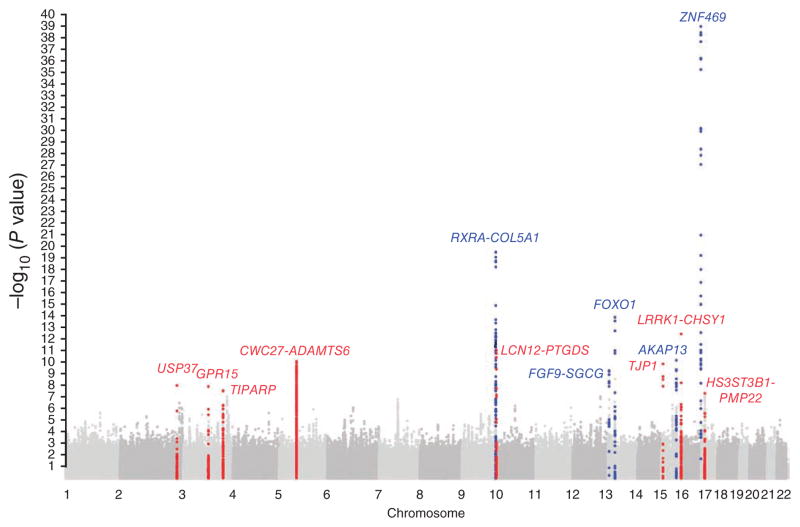
Figure 1
Figure 1
Manhattan plot of set 1 meta-analysis results. Association results (–log10 P values) are plotted for each chromosome. A blue dot and the corresponding gene name indicate that the locus is known in European populations. The red dot and the corresponding gene name indicate that the locus has not previously been reported as associated with CCT in European populations.
Figure 2
Figure 2
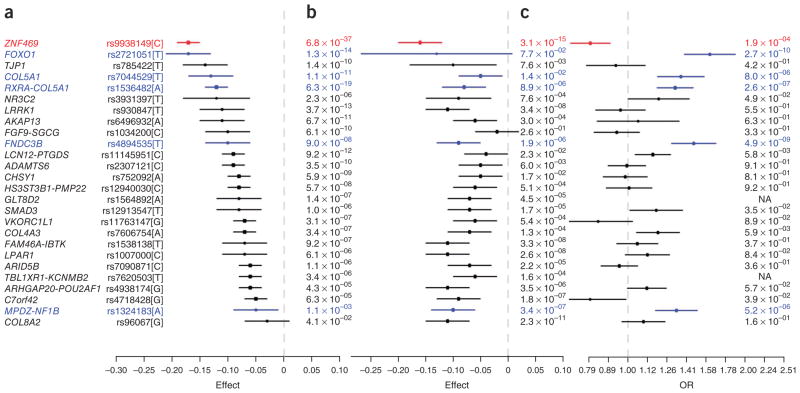
Association with CCT in European and Asian populations, and with keratoconus risk in European populations. (a) Association with CCT in European populations (set 1). (b) Association with CCT in Asian populations (set 2). (c) Association with keratoconus risk in European populations. This plot is a standard forest plot, but, instead of showing study-specific effects, it shows the association effects in the three panels for each locus. The allele is chosen as the CCT-reducing allele (boxes that represent the point estimates in a and b are on the left side of the dashed line, effect on CCT < 0). Effect on CCT is in standardized units. Given the association between reduced CCT and elevated keratoconus risk, for the effect directions to be consistent, the CCT-reducing allele would be the keratoconus risk allele (boxes that represent the OR of keratoconus in c on the right side of the dashed line, OR > 1). Five loci in blue, FOXO1, two SNPs at COL5A1, FNDC3B and MPDZ-NF1B, are the CCT-associated loci that are significantly associated with keratoconus risk after correction for multiple testing and also show consistent effect directions. The ZNF469 locus is marked in red because the CCT-reducing allele is significantly associated with a lower risk of keratoconus. rs1564892 and rs7620503 were not genotyped in the keratoconus case-control studies and are therefore presented as missing values (NA).

References

    1. Dimasi DP, Burdon KP, Craig JE. The genetics of central corneal thickness. Br J Ophthalmol. 2010;94:971–976. - PubMed
    1. Pedersen U, Bramsen T. Central corneal thickness in osteogenesis imperfecta and otosclerosis. ORL J Otorhinolaryngol Relat Spec. 1984;46:38–41. - PubMed
    1. Evereklioglu C, et al. Central corneal thickness is lower in osteogenesis imperfecta and negatively correlates-vith the presence of blue sclera. Ophthalmic Physiol Opt. 2002;22:511–515. - PubMed
    1. Cohen EJ. Keratoconus and normal-tension glaucoma: a study of the possible association with abnormal biomechanical properties as measured by corneal hysteresis (An AOS Thesis) Trans Am Ophthalmol Soc. 2009;107:282–99. - PMC - PubMed
    1. Gordon MO, et al. The Ocular Hypertension Treatment Study: baseline factors that predict the onset of primary open-angle glaucoma. Arch Ophthalmol. 2002;120:714–720. discussion 829–830. - PubMed

Publication types

Supplementary concepts