. 2013 Jan;10(1):149-56.
doi: 10.4161/rna.23475. Epub 2013 Jan 1.

Characterization of the kinetics of RNA annealing and strand displacement activities of the E. coli DEAD-box helicase CsdA

Affiliations

Characterization of the kinetics of RNA annealing and strand displacement activities of the E. coli DEAD-box helicase CsdA

Sabine Stampfl et al. RNA Biol. 2013 Jan.

Abstract

CsdA is one of five E. coli DEAD-box helicases and as a cold-shock protein assists RNA structural remodeling at low temperatures. The helicase has been shown to catalyze duplex unwinding in an ATP-dependent way and accelerate annealing of complementary RNAs, but detailed kinetic analyses are missing. Therefore, we performed kinetic measurements using a coupled annealing and strand displacement assay with high temporal resolution to analyze how CsdA balances the two converse activities. We furthermore tested the hypothesis that the unwinding activity of DEAD-box helicases is largely determined by the substrate's thermodynamic stability using full-length CsdA and a set of RNAs with constant length, but increasing GC content. The rate constants for strand displacement did indeed decrease with increasing duplex stability, with a calculated free energy between -31.3 and -40 kcal/mol being the limit for helix unwinding. Thus, our data generally support the above hypothesis, showing that for CsdA substrate thermal stability is an important rate limiting factor.

Keywords: CsdA; DEAD-box helicase; DeaD; FRET; RNA annealing; RNA chaperone; StpA; kinetics; strand displacement.


Figures
None
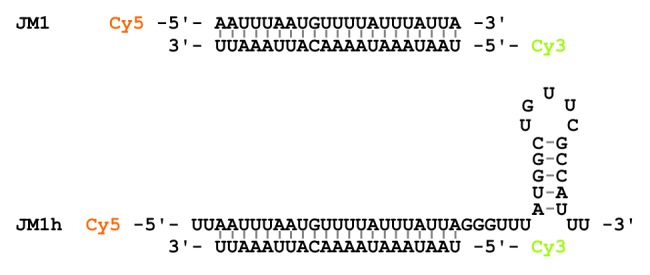
Figure 1. RNAs with a helicase binding platform. RNA substrates JM1 and JM1h were chosen exemplarily to illustrate secondary structure formation in RNAs with the helicase binding platform.
None
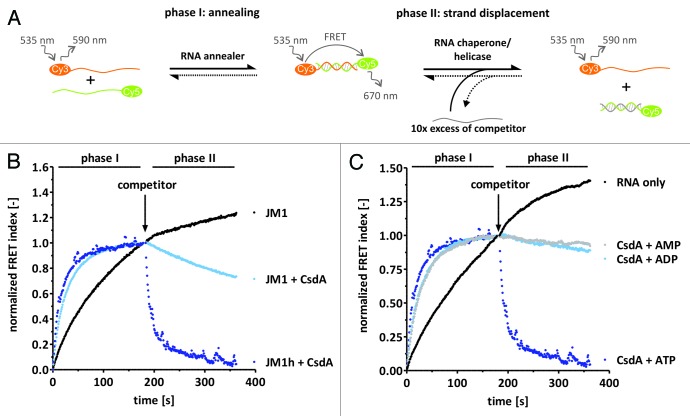
Figure 2. Kinetics of CsdA’s RNA annealing and helicase activities. (A) Scheme of the FRET-based annealing and strand displacement assay used to determine RNA annealing, helicase and chaperone activity. Briefly, two complementary 21mers that are 5′-labeled with Cy5 and Cy3, respectively, are annealed with each other which results in a FRET signal (phase I). Proteins that accelerate this reaction are referred to as RNA annealer proteins. Phase II is started through the addition of a 10-molar excess of an unlabeled competitor RNA which will replace one strand if an RNA helicase or chaperone is present to catalyze the reaction, resulting in a decrease of the FRET signal. In the absence of such a protein the FRET index either remains constant or increases further, indicating annealing of the residual single-strands. (B) CsdA-dependent annealing and strand displacement of a blunt-ended RNA (JM1) and a substrate with a helicase binding platform (JM1h). The JM1h ‘RNA only’ curves were identical with the JM1 ‘RNA only’ curves and are thus not shown. (C) Annealing and strand displacement activities of CsdA were tested in the presence of 2 mM AMP, ADP, or ATP and using the JM1h substrate. Observed annealing reaction rates were as follows: kobs, ann (CsdA+ATP) = (0.067 ± 0.026) s−1; kobs, ann (CsdA+ADP) = (0.042 ± 0.006) s−1; kobs, ann (CsdA+AMP) = (0.045 ± 0.026) s−1; kobs, ann (CsdA) = (0.030 ± 0.004) s−1.
None
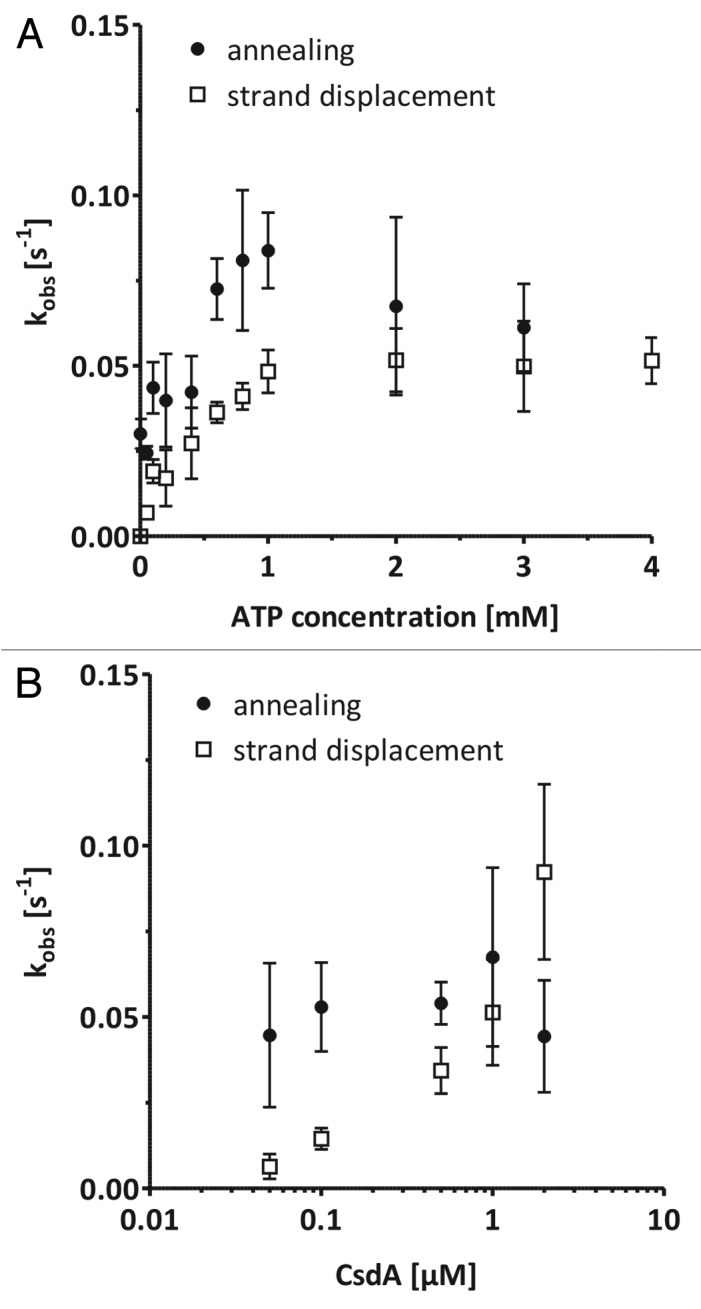
Figure 3. Balancing of annealing and helicase activities. (A) FRET-based annealing and strand displacement assays were performed using the JM1h substrate and different ATP concentrations. (B) Dependence of the observed rate constants kobs, ann and kobs, SD on CsdA concentrations determined with the FRET-based annealing and strand displacement assay. Measurements were performed using the JM1h substrate. Values are means ± standard deviation of at least three measurements.
None
Figure 4. Strand displacement activities of CsdA and StpA depending on the thermodynamic stability of the RNA duplex. (A) CsdA-catalyzed annealing and strand displacement rates were measured with our combined FRET-based chaperone assay and the substrates JM1h-JM4h and JM6h. (B) Comparison of StpA- and CsdA-catalyzed strand displacement rates kobs, SD depending on the substrate’s GC content. Values are means ± standard deviation of at least three measurements.

References

    1. Iost I, Dreyfus M. DEAD-box RNA helicases in Escherichia coli. Nucleic Acids Res. 2006;34:4189–97. doi: 10.1093/nar/gkl500. - DOI - PMC - PubMed
    1. Kossen K, Karginov FV, Uhlenbeck OC. The carboxy-terminal domain of the DExDH protein YxiN is sufficient to confer specificity for 23S rRNA. J Mol Biol. 2002;324:625–36. doi: 10.1016/S0022-2836(02)01140-3. - DOI - PubMed
    1. Klostermeier D, Rudolph MG. A novel dimerization motif in the C-terminal domain of the Thermus thermophilus DEAD box helicase Hera confers substantial flexibility. Nucleic Acids Res. 2009;37:421–30. doi: 10.1093/nar/gkn947. - DOI - PMC - PubMed
    1. Mallam AL, Jarmoskaite I, Tijerina P, Del Campo M, Seifert S, Guo L, et al. Solution structures of DEAD-box RNA chaperones reveal conformational changes and nucleic acid tethering by a basic tail. Proc Natl Acad Sci U S A. 2011;108:12254–9. doi: 10.1073/pnas.1109566108. - DOI - PMC - PubMed
    1. Karginov FV, Caruthers JM, Hu Y, McKay DB, Uhlenbeck OC. YxiN is a modular protein combining a DEx(D/H) core and a specific RNA-binding domain. J Biol Chem. 2005;280:35499–505. doi: 10.1074/jbc.M506815200. - DOI - PubMed

Publication types

LinkOut - more resources