Review
. 2013 Mar;14(1):59-68.
doi: 10.1007/s11154-012-9235-3.

Lipotoxicity contributes to endothelial dysfunction: a focus on the contribution from ceramide

Affiliations
Review

Lipotoxicity contributes to endothelial dysfunction: a focus on the contribution from ceramide

J David Symons et al. Rev Endocr Metab Disord. 2013 Mar.

Abstract

Cardiovascular complications are the leading causes of morbidity and mortality in individuals with obesity, type 2 diabetes mellitus (T2DM), and insulin resistance. Complications include pathologies specific to large (atherosclerosis, cardiomyopathy) and small (retinopathy, nephropathy, neuropathy) vessels. Common among all of these pathologies is an altered endothelial cell phenotype i.e., endothelial dysfunction. A crucial aspect of endothelial dysfunction is reduced nitric oxide (NO) bioavailability. Hyperglycemia, oxidative stress, activation of the renin-angiotensin system, and increased pro-inflammatory cytokines are systemic disturbances in individuals with obesity, T2DM, and insulin resistance and each of these contribute independently and synergistically to decreasing NO bioavailability. This review will examine the contribution from elevated circulating fatty acids in these subjects that lead to lipotoxicity. Particular focus will be placed on the fatty acid metabolite ceramide.


Figures
Figure
Figure
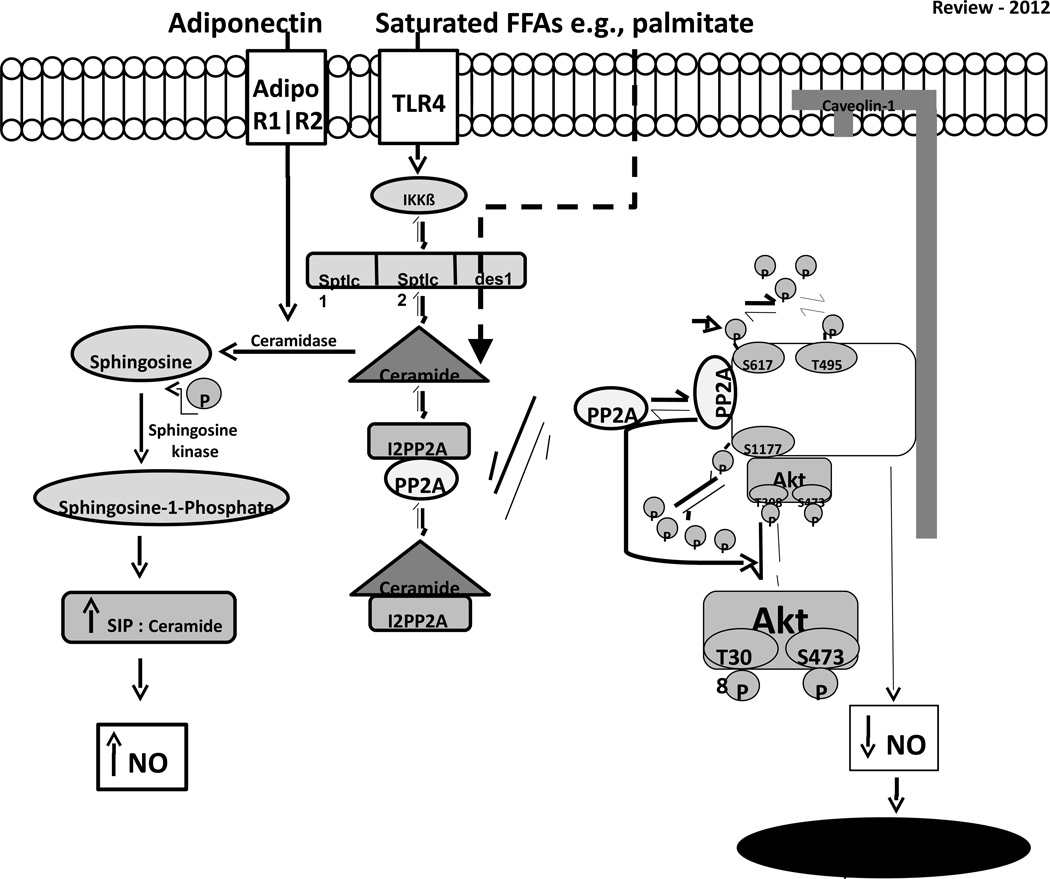
Saturated free fatty acids (FFAs) such as palmitate not only represent the substrate for de novo ceramide biosynthesis, but also signal via the toll-like receptor 4 (TLR4) to activate inhibitor of kB-kinase (IKKβ) which stimulates transcript levels of enzymes involved in ceramide biosynthesis e.g., serine palmitoyl transferase long chain base 1 (Sptlc1) and 2 (Sptlc2) and dihydroceramide desaturase (des1). The dashed line indicates that ceramide disrupts the association between inhibitor 2 of protein phosphatase 2A (I2PP2A) and protein phosphatase 2A (PP2A) by binding to I2PP2A. PP2A translocates to the cell membrane and associates with endothelial nitric oxide synthase (eNOS). PP2A association with eNOS decreases the association between eNOS and protein kinase B (Akt) and between eNOS and heat shock protein 90 (Hsp90). PP2A promotes the dephosphorylation of Akt that colocalizes with eNOS and /or decreases eNOS phosphorylation at serine (S) 1177 and S617 directly. This impairs NO bioavailability and leads to vascular dysfunction. Adiponectin might modify the effects of ceramide accumulation by binding to adiponectin (Adipo) R1 and Adipo R2 receptors and increasing ceramidase activity. Ceramidases hydrolyze ceramide to form sphingosine leading to an increase sphingosine-1-phosphate (SIP) to ceramide ratio. Evidence exists that signaling via this pathway increases NO production. Neither this pathway, nor the potential metabolism of ceramide via adiponectin, have been evaluated in vivo in the context of obesity and endothelial dysfunction. P; phosphorylation; T; threonine.

References

    1. Boyle JP, Thompson TJ, Gregg EW, Barker LE, Williamson DF. Projection of the year 2050 burden of diabetes in the US adult population: dynamic modeling of incidence, mortality, and prediabetes prevalence. Popul Health Metr. 2010;8:29. - PMC - PubMed
    1. Triggle CR, Ding H. A review of endothelial dysfunction in diabetes: a focus on the contribution of a dysfunctional eNOS. J Am Soc Hypertens. 2010;4:102–115. - PubMed
    1. Alderton WK, Cooper CE, Knowles RG. Nitric oxide synthases: structure, function and inhibition. Biochem J. 2001;357:593–615. - PMC - PubMed
    1. Shaul PW. Regulation of endothelial nitric oxide: location, location, location. Annu Rev Physiol. 2002;64:749–774. - PubMed
    1. Sessa WC. eNOS at a glance. J Cell Sci. 2004;117:2427–2429. - PubMed

Publication types

LinkOut - more resources
