


doi: 10.1038/nchembio.1159.
Epub 2013 Jan 6.
A conserved asparagine has a structural role in ubiquitin-conjugating enzymes
Affiliations
- PMID: 23292652
- PMCID: PMC3578109
- DOI: 10.1038/nchembio.1159
Item in Clipboard
A conserved asparagine has a structural role in ubiquitin-conjugating enzymes
Nat Chem Biol.
2013 Mar.
Abstract
It is widely accepted that ubiquitin-conjugating enzymes contain an active site asparagine that serves as an oxyanion hole, thereby stabilizing a negatively charged transition state intermediate and promoting ubiquitin transfer. Using structural and biochemical approaches to study the role of the conserved asparagine to ubiquitin conjugation by Ubc13-Mms2, we conclude that the importance of this residue stems primarily from its structural role in stabilizing an active site loop.
Conflict of interest statement
The Authors declare no competing financial interests.
Figures
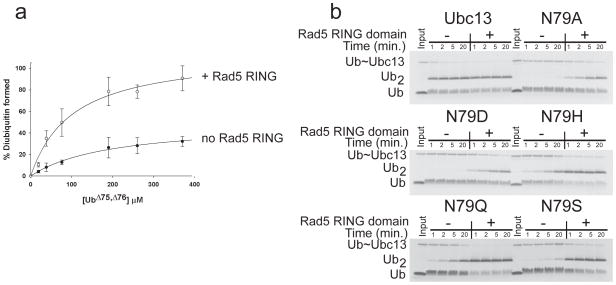
(a) Substrate partitioning experiments showing active fraction of Ubc13~Ub thioester as a function of acceptor ubiquitin concentration. Plot of percentage diubiquitin formed versus concentration of ubiquitin (Ub)Δ 75,Δ76 for Ubc13N79Q-Mms2 (filled circles) or Ubc13N79Q-Mms2 with the Rad5 RING domain (open circles). Points represent the average of 3 to 4 separate measurements with the standard deviation shown by the error bars. (b) Single discharge assays of diubiquitin formation by Ubc13-Mms2 containing wild-type Ubc13 or mutants with substitutions at N79, performed in the presence and absence of the Rad5 RING fragment. Full gels in Supplementary Figure 4.
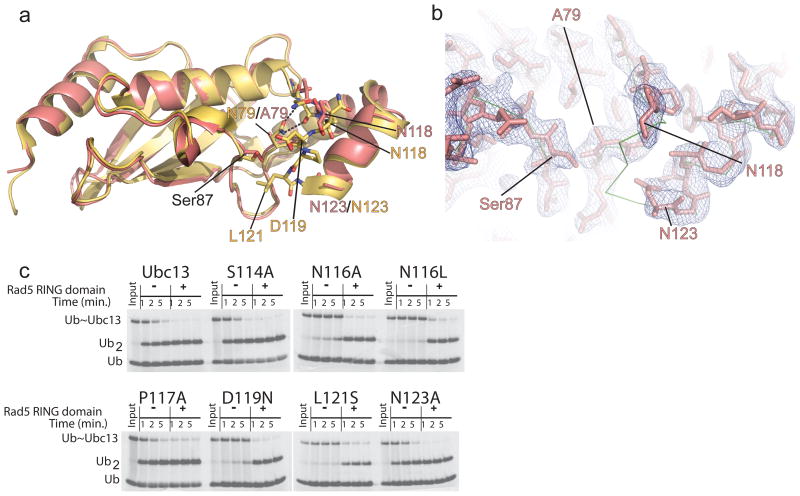
(a) Alignment of the structure of Ubc13N79A (salmon) with wild-type Ubc13 from 2GMI (yellow). Residue names are colored to match the coloring of the N79A or wild-type structures. (b) Electron density 2F0-Fc map contoured at 1.0σ showing the density for the active site loop in Ubc13N79A. The backbone Cα trace of wild-type Ubc13 from 2GMI is shown in green. (c) Single discharge assay for the Ubc13 active site loop mutants using ubiquitinΔ75,Δ76 (Ub) as the ubiquitin acceptor.
References
-
- Pickart CM, Eddins MJ. Ubiquitin: structures, functions, mechanisms. Biochim Biophys Acta. 2004;1695:55–72. - PubMed
-
- Kerscher O, Felberbaum R, Hochstrasser M. Modification of proteins by ubiquitin and ubiquitin-like proteins. Annu Rev Cell Dev Biol. 2006;22:159–80. - PubMed
-
- Yunus AA, Lima CD. Lysine activation and functional analysis of E2-mediated conjugation in the SUMO pathway. Nat Struct Mol Biol. 2006;13:491–9. - PubMed
Publication types
MeSH terms
Substances
Associated data
- Actions
Grants and funding
LinkOut - more resources
Full Text Sources
Other Literature Sources
Molecular Biology Databases
