. 2013 Mar;63(2):125-32.
doi: 10.1007/s12576-012-0247-2. Epub 2013 Jan 6.

The effect of a physiological concentration of caffeine on the endurance of maximally and submaximally stimulated mouse soleus muscle

Affiliations

The effect of a physiological concentration of caffeine on the endurance of maximally and submaximally stimulated mouse soleus muscle

Jason Tallis et al. J Physiol Sci. 2013 Mar.

Abstract

The use of caffeine as an ergogenic aid to promote endurance has been widely studied, with human literature showing the greatest benefit during submaximal muscle activities. Recent evidence suggests that the acute treatment of skeletal muscle with physiological concentrations of caffeine (70 μM maximum) will directly potentiate force production. The aims of the present study are: firstly, to assess the effects of a physiological concentration (70 μM) of caffeine on endurance in maximally activated mouse soleus (relatively slow) muscle; and secondly, to examine whether endurance changes when muscle is activated submaximally during caffeine treatment. Maximally stimulated soleus muscle treated with 70 μM caffeine resulted in a significant (17.6 %) decrease in endurance. In contrast, at a submaximal stimulation frequency, caffeine treatment significantly prolonged endurance (by 19.2 %). Findings are activation-dependent such that, during high frequency stimulation, caffeine accelerates fatigue, whereas, during low frequency stimulation, caffeine delays fatigue.


Figures
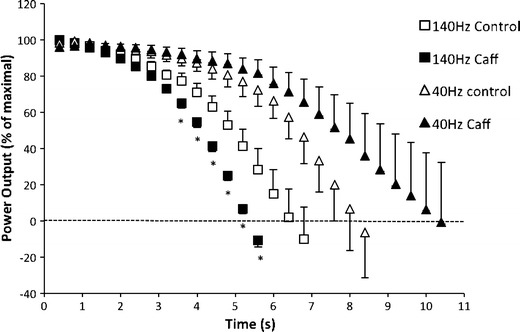
Fig. 1
Fig. 1
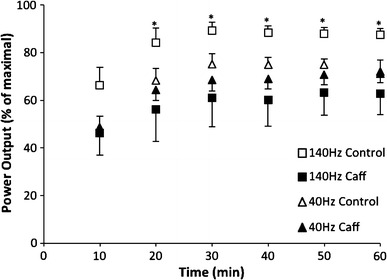
The effects of 70 μM caffeine treatment and stimulation frequency on soleus muscle power output following continues work loop stimulation. Values are displayed as a percentage of maximal work loop power output [data represented as mean and SE; n = 8 in each case; significant differences (*p < 0.05) in power output at each individual time point between 140 Hz control and 140 Hz caffeine treated]
Fig. 2
Fig. 2
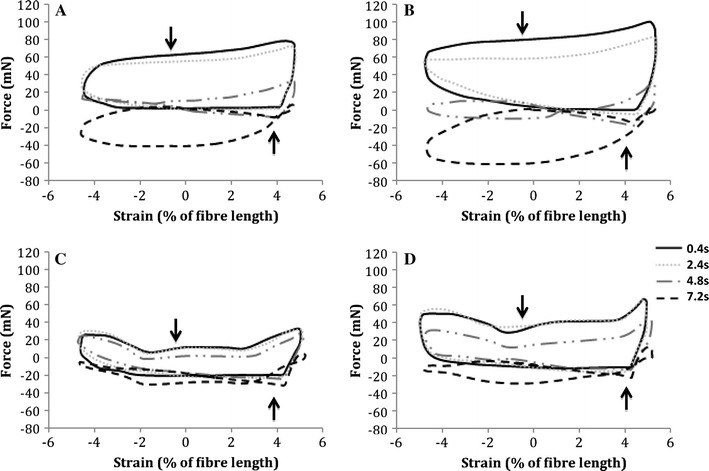
Typical effects of fatigue on work loop shape for control soleus stimulated at 140 and 40 Hz (a and c, respectively) compared with those treated with 70 μM caffeine (b 140 Hz caffeine, d 40 Hz caffeine) (arrows indicate where stimulation typically started, towards the end of lengthening, and finished, during shortening; 0.4s, 2.4s, 4.8s and 7.2s represent time since the start of the fatigue protocol)
Fig. 3
Fig. 3
Effect of 70 μM caffeine treatment and stimulation frequency on recovery of soleus muscle following fatigue (data represented as mean and SE; n = 8 in each case; asterisks represent significant differences in power output at each individual time point between 140 Hz control and 140 Hz caffeine treated)

References

    1. Graham TE. Caffeine and exercise. Metabolism, endurance and performance. J Sports Med. 2001;31:785–807. doi: 10.2165/00007256-200131110-00002. - DOI - PubMed
    1. Davis JK, Green JM. Caffeine and anaerobic performance: ergogenic value and mechanisms of action. J Sports Med. 2009;39:813–832. doi: 10.2165/11317770-000000000-00000. - DOI - PubMed
    1. James RS, Wilson RS, Askew GN. Effects of caffeine on mouse skeletal muscle power output during recovery from fatigue. J Appl Physiol. 2004;96:545–552. doi: 10.1152/japplphysiol.00696.2003. - DOI - PubMed
    1. James RS, Kohlsdorf T, Cox VM, Navas CA. 70 μM caffeine treatments enhances in vitro force and power output during cyclic activities in mouse extensor digitorum longus muscle. Eur J Appl Physiol. 2005;95:74–82. doi: 10.1007/s00421-005-1396-2. - DOI - PubMed
    1. Tallis JA, James RS, Cox VM, Duncan MJ. The effect of physiological concentrations of caffeine on the power output of maximally and submaximally stimulated mouse EDL (fast) and soleus (slow) muscle. J Appl Physiol. 2012;112:64–71. doi: 10.1152/japplphysiol.00801.2011. - DOI - PubMed