


Genetic and evolutionary characterization of RABVs from China using the phosphoprotein gene
- PMID: 23294868
- PMCID: PMC3548735
- DOI: 10.1186/1743-422X-10-14
Genetic and evolutionary characterization of RABVs from China using the phosphoprotein gene
Abstract
Background: While the function of the phosphoprotein (P) gene of the rabies virus (RABV) has been well studied in laboratory adapted RABVs, the genetic diversity and evolution characteristics of the P gene of street RABVs remain unclear. The objective of the present study was to investigate the mutation and evolution of P genes in Chinese street RABVs.
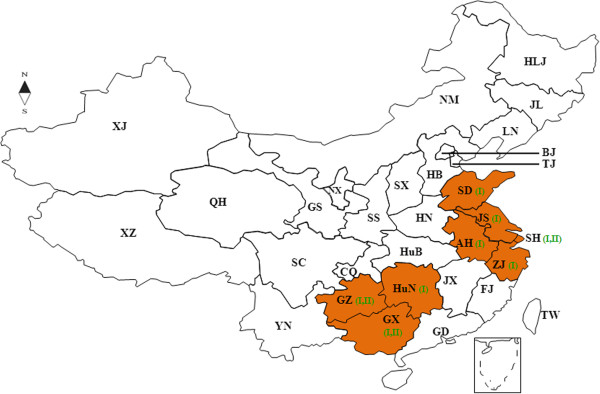
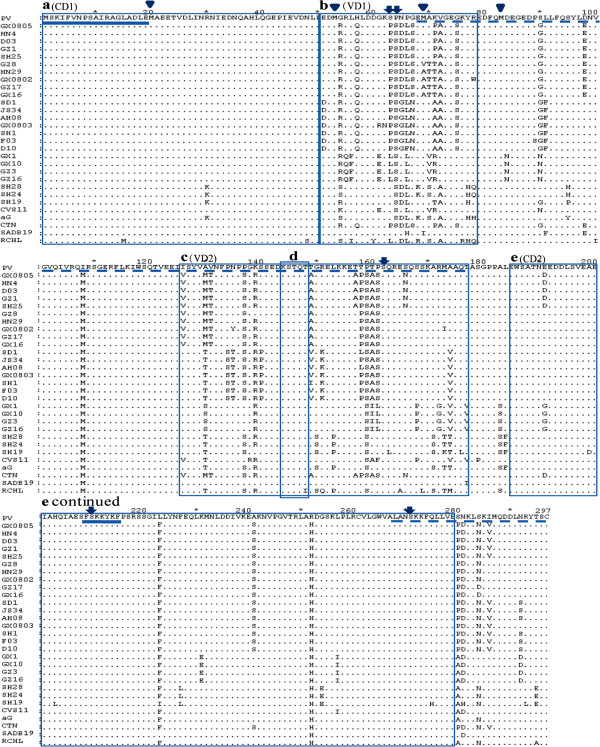
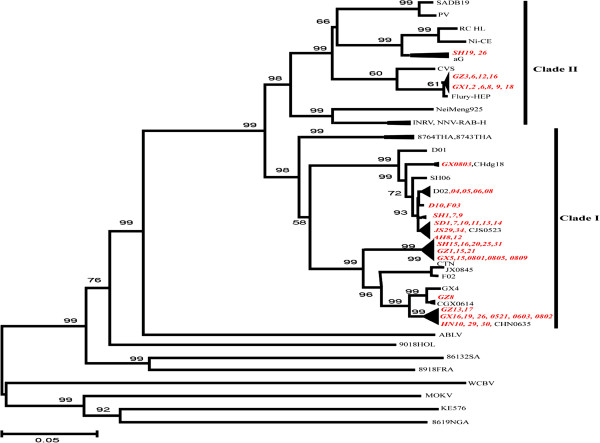
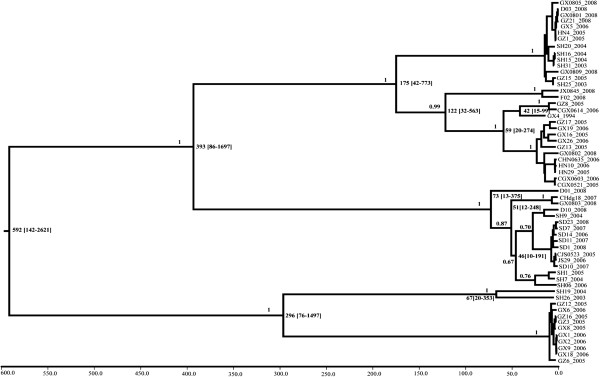
Results: The P gene of 77 RABVs from brain samples of dogs and wild animals collected in eight Chinese provinces through 2003 to 2008 were sequenced. The open reading frame (ORF) of the P genes was 894 nucleotides (nt) in length, with 85-99% (80-89%) amino acid (nucleotide) identity compared with the laboratory RABVs and vaccine strains. Phylogenetic analysis based on the P gene revealed that Chinese RABVs strains could be divided into two distinct clades, and several RABV variants were found to co circulating in the same province. Two conserved (CD1, 2) and two variable (VD1, 2) domains were identified by comparing the deduced primary sequences of the encoded P proteins. Two sequence motifs, one believed to confer binding to the cytoplasmic dynein light chain LC8 and a lysine-rich sequence were conserved throughout the Chinese RABVs. In contrast, the isolates exhibited lower conservation of one phosphate acceptor and one internal translation initiation site identified in the P protein of the rabies challenge virus standard (CVS) strain. Bayesian coalescent analysis showed that the P gene in Chinese RABVs have a substitution rate (3.305x10(-4) substitutions per site per year) and evolution history (592 years ago) similar to values for the glycoprotein (G) and nucleoprotein (N) reported previously.
Conclusion: Several substitutions were found in the P gene of Chinese RABVs strains compared to the laboratory adapted and vaccine strains, whether these variations could affect the biological characteristics of Chinese RABVs need to be further investigated. The substitution rate and evolution history of P gene is similar to G and N gene, combine the topology of phylogenetic tree based on the P gene is similar to the G and N gene trees, indicate that the P, G and N genes are equally valid for examining the phylogenetics of RABVs.
Figures
References
-
- International Committee on Taxonomy of Viruses. ICTV files and discussions. ICTV master species list. 2009. Version 4. http://talk.ictvonline.org/files/ictvdocuments/m/msl/1231.aspx (accessed 02.06.10)
-
- Le MP, Jacob Y, Tordo N. The complete Mokola virus genome sequence: structure of the RNA-dependent RNA polymerase. J Gen Virol. 1997;78:1571–1576. - PubMed
Publication types
MeSH terms
Substances
LinkOut - more resources
Full Text Sources
Other Literature Sources
Medical
Research Materials
