


Screening for impulse control symptoms in patients with de novo Parkinson disease: a case-control study
- PMID: 23296128
- PMCID: PMC3589192
- DOI: 10.1212/WNL.0b013e31827b915c
Screening for impulse control symptoms in patients with de novo Parkinson disease: a case-control study
Abstract
Objective: To determine the frequency and correlates of impulse control and related behavior symptoms in patients with de novo, untreated Parkinson disease (PD) and healthy controls (HCs).
Methods: The Parkinson's Progression Markers Initiative is an international, multisite, case-control clinical study conducted at 21 academic movement disorders centers. Participants were recently diagnosed, untreated PD patients (n = 168) and HCs (n = 143). The outcome measures were presence of current impulse control and related behavior symptoms based on recommended cutoff points for the Questionnaire for Impulsive-Compulsive Disorders in Parkinson's Disease (QUIP)-Short Form.
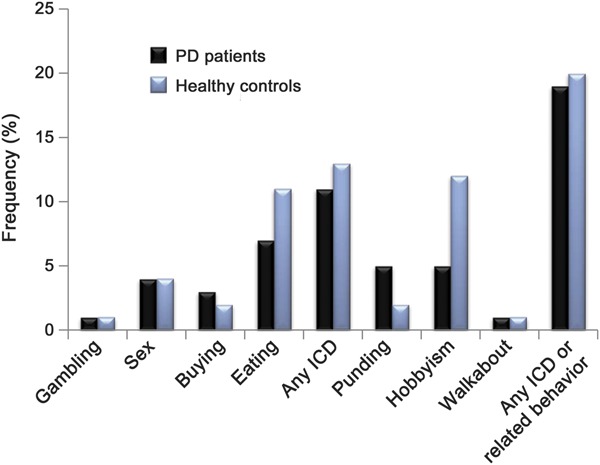
Results: There were 311 participants with complete QUIP data. Frequencies of impulse control and related behavior symptoms for patients with PD vs HCs were as follows: gambling (1.2% vs. 0.7%), buying (3.0% vs. 2.1%), sexual behavior (4.2% vs. 3.5%), eating (7.1% vs. 10.5%), punding (4.8% vs. 2.1%), hobbyism (5.4% vs. 11.9%), walkabout (0.6% vs. 0.7%), and any impulse control or related behavior (18.5% vs. 20.3%). In multivariable models, a diagnosis of PD was not associated with symptoms of any impulse control or related behavior (p ≥ 0.10 in all cases).
Conclusions: PD itself does not seem to confer an increased risk for development of impulse control or related behavior symptoms, which further reinforces the reported association between PD medications and impulse control disorders in PD. Given that approximately 20% of patients with newly diagnosed PD report some impulse control or related behavior symptoms, long-term follow-up is needed to determine whether such patients are at increased risk for impulse control disorder development once PD medications are initiated.
Figures
Comment in
-
Screening for impulse control symptoms in patients with de novo Parkinson disease: a case-control study.Neurology. 2013 Aug 13;81(7):694-5. doi: 10.1212/WNL.0b013e3182a2935a. Neurology. 2013. PMID: 23940022 No abstract available.
References
-
- Voon V, Fox SH. Medication-related impulse control and repetitive behaviors in Parkinson disease. Arch Neurol 2007;64:1089–1096 - PubMed
-
- Weintraub D, Koester J, Potenza MN, et al. Impulse control disorders in Parkinson disease: a cross-sectional study of 3090 patients. Arch Neurol 2010;67:589–595 - PubMed
-
- Evans AH, Katzenschlager R, Paviour D, et al. Punding in Parkinson's disease: its relation to the dopamine dysregulation syndrome. Mov Disord 2004;19:397–405 - PubMed
Publication types
MeSH terms
Substances
LinkOut - more resources
Full Text Sources
Other Literature Sources
Medical
