. 2013 Mar;81(3):876-83.
doi: 10.1128/IAI.01406-12. Epub 2013 Jan 7.

Helicobacter pylori-induced disruption of monolayer permeability and proinflammatory cytokine secretion in polarized human gastric epithelial cells

Affiliations

Helicobacter pylori-induced disruption of monolayer permeability and proinflammatory cytokine secretion in polarized human gastric epithelial cells

Maria Fiorentino et al. Infect Immun. 2013 Mar.

Abstract

Helicobacter pylori infection of the stomach is related to the development of diverse gastric pathologies. The ability of H. pylori to compromise epithelial junctional complexes and to induce proinflammatory cytokines is believed to contribute to pathogenesis. The purpose of this study was to use an in vitro human gastric epithelial model to investigate the ability of H. pylori to affect permeability and the extent and polarity of the host inflammatory response. NCI-N87 monolayers were cocultured with live or heat-killed H. pylori or culture supernatants. Epithelial barrier function was measured by transepithelial electric resistance (TEER) analysis, diffusion of fluorescein isothiocyanate (FITC)-labeled markers, and immunostaining for tight junction proteins. Supernatants from both apical and basolateral chambers were tested for cytokine production by multiplex analysis. H. pylori caused a significant decrease in TEER, an increased passage of markers through the infected monolayer, and severe disruption and mislocalization of ZO-1 and claudin-1 proteins. Cell viability was not altered by H. pylori, indicating that loss of barrier function could be attributed to a breakdown of tight junction integrity. Significantly high levels of cytokine secretion were induced by either viable or heat-killed H. pylori. H. pylori affects monolayer permeability of polarized human gastric epithelial cells. Proinflammatory cytokines were secreted in a polarized manner, mostly basolaterally. Live bacteria are required for disruption of tight junctions but not for the induction of cytokine secretion. The NCI-N87 cell line provides an excellent model for the in vitro study of H. pylori pathogenesis and the epithelial cell host response to infection.


Figures
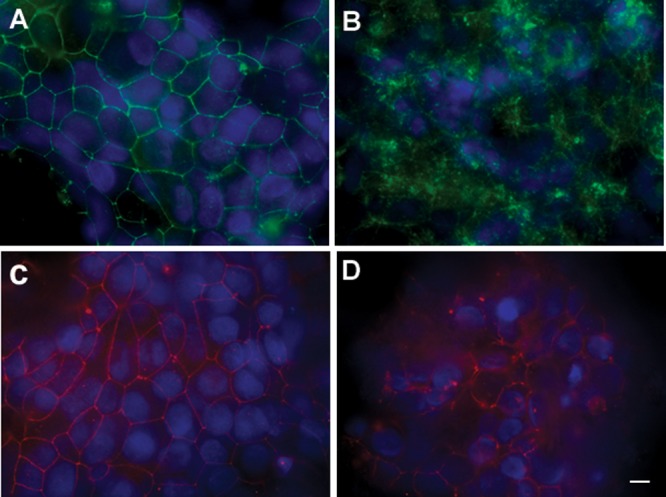
Fig 1
Fig 1
H. pylori disrupts tight junction proteins ZO-1 and claudin-1. Fluorescence microscopy of NCI-N87 monolayers labeled with antibodies specific for claudin-1 (A, B) or ZO-1 (C, D). NCI-N87 polarized monolayers were infected with H. pylori (MOI, 50:1) for 48 h, washed with PBS, fixed, and stained, along with uninfected controls. (A) Claudin-1 staining in uninfected monolayers displayed the characteristic chicken wire patterning. (B) Claudin-1 staining in H. pylori-treated monolayers. Claudin-1 appears completely removed from the cell-cell boundary and is localized in the cytoplasm, visible as punctuate staining. (C) Highly organized ZO-1 chicken wire pattern staining in uninfected monolayers. (D) Disrupted ZO-1 organization in H. pylori-infected monolayer. Bar, 10 μm.
Fig 2
Fig 2
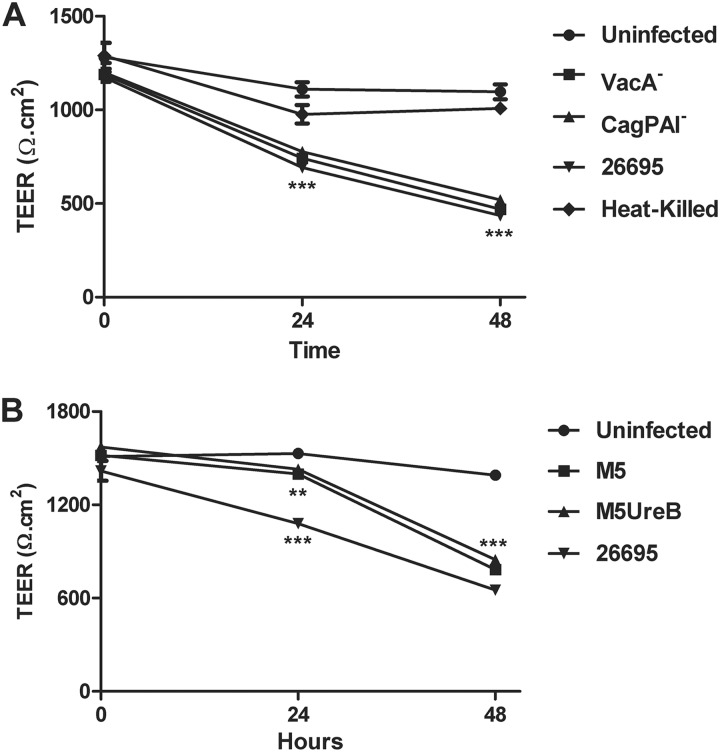
H. pylori-induced decreases in transepithelial electric resistance (TEER) of NCI-N87 cell monolayers. (A) Monolayers were incubated with live or heat-killed H. pylori strain 26695 or the VacA or CagPAI isogenic mutant at an MOI of 50:1 for 48 h. (B) Monolayers incubated with live H. pylori M5, isogenic M5:UreB, or 26695 as a control at an MOI of 50:1 for 48 h. Data are expressed as means ± SEM of triplicate samples for all conditions tested. Statistical comparison with uninfected control at the same time point: **, P < 0.01; ***, P < 0.0001.
Fig 3
Fig 3
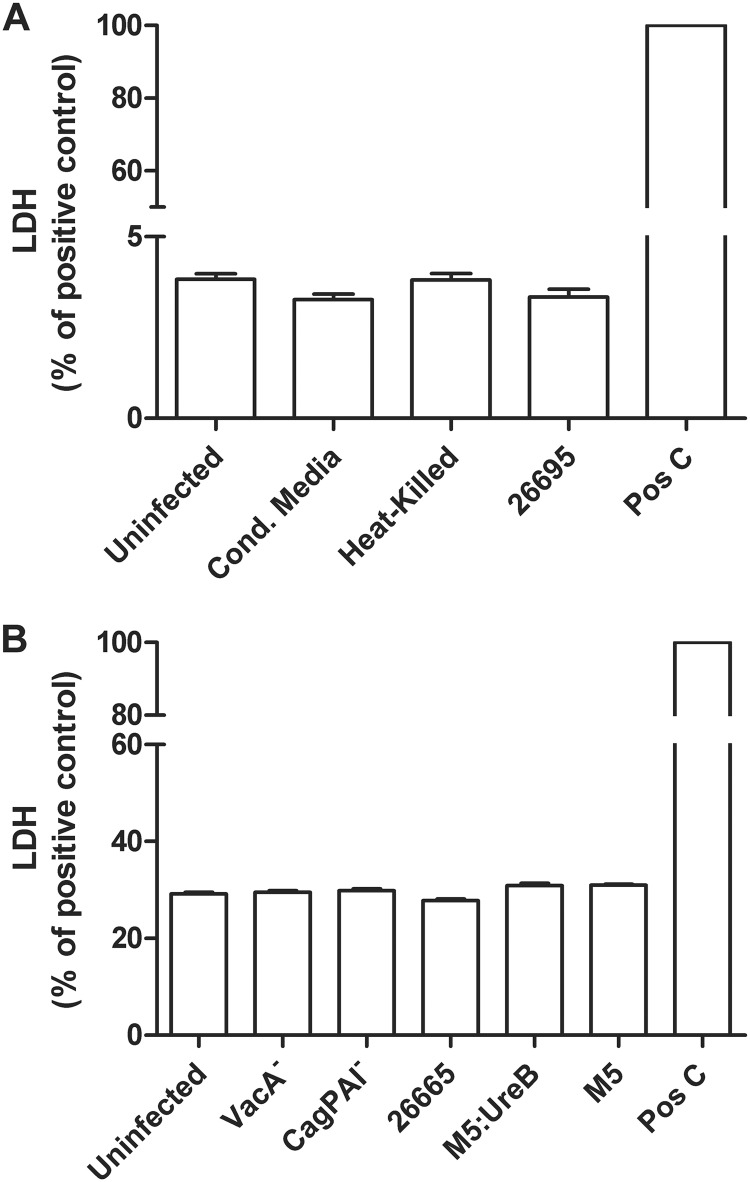
Coculture of NCI-N87 monolayers with H. pylori does not decrease cell viability. (A) LDH release from NCI-N87 monolayers treated with viable H. pylori strain 26695 or heat-killed bacteria (MOI, 50:1) or an equivalent volume of bacterial culture supernatants for 48 h. (B) LDH release was measured in monolayers treated with H. pylori strain 26695 and its VacA and CagPAI isogenic mutants and strain M5 and its M5:UreB isogenic mutant (MOI, 50:1) for 48 h. Apical media was collected at 48 h postinfection for LDH release measurement. Results are shown as percentage of those for the positive control (Triton X-100-treated monolayers).
Fig 4
Fig 4
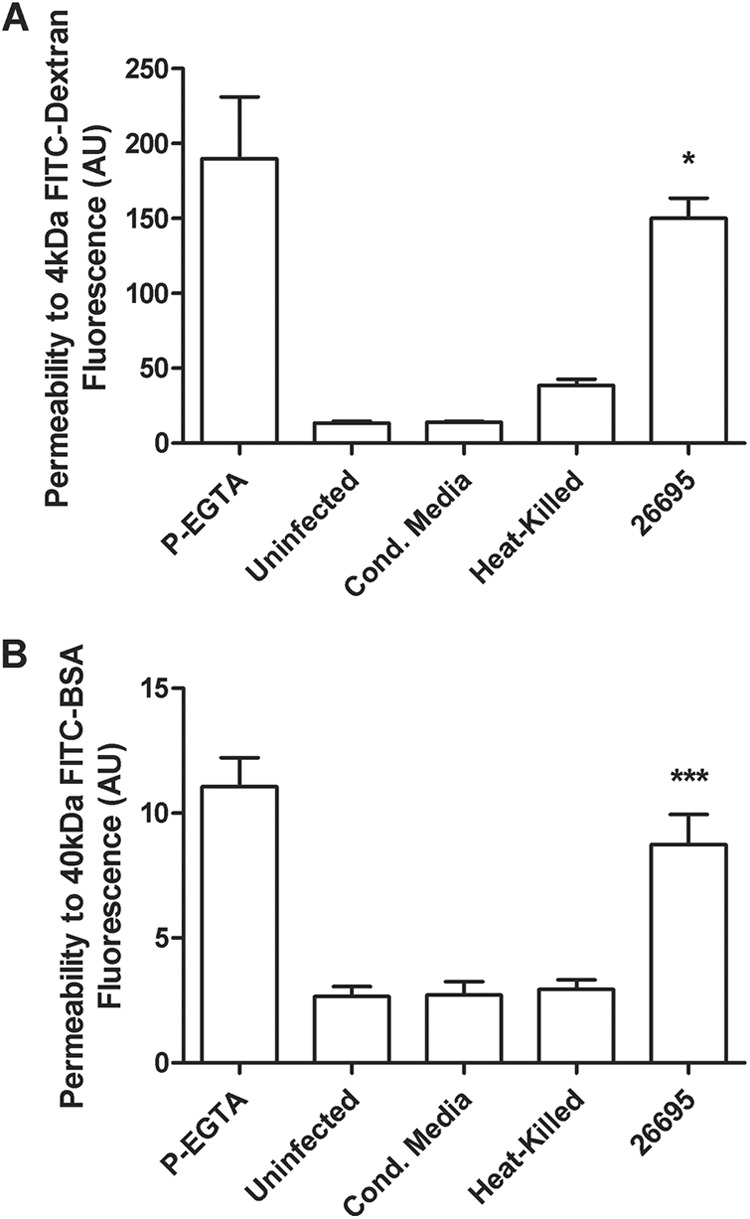
Paracellular permeability in NCI-N87 cell monolayer increases after infection with H. pylori strain 26695. H. pylori strain 26695, heat-killed bacteria (MOI, 50:1), or an equivalent volume of culture supernatant was used to inoculate NCI-N87 cells for 48 h. FITC-labeled markers were added to the apical medium reservoir. After 3 h, aliquots of the basolateral medium were removed and the amount of labeled markers that passed through the monolayer was determined. (A) FITC-dextran (4 kDa) net transport after infection with H. pylori. (B) FITC-BSA (40 kDa) net transport after infection with H. pylori. Calcium-free medium supplemented with EGTA to disrupt TJs served as a positive control. Results are expressed as means ± SEM of triplicate samples for each condition. Statistical comparison with uninfected control: *, P < 0.05; ***, P < 0.001.
Fig 5
Fig 5
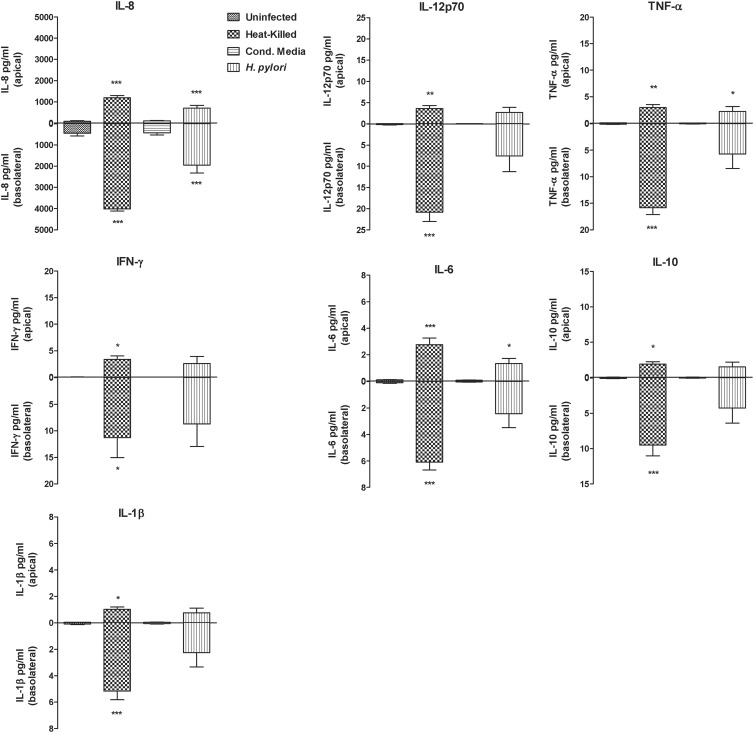
H. pylori triggers cytokine secretion from NCI-N87 monolayers into basolateral culture supernatants. H. pylori strain 26695, heat-killed bacteria (MOI, 50:1), or an equivalent volume of culture supernatant was used to inoculate NCI-N87 cells. Media were collected to quantify the amounts of IL-8, IL-12p70, TNF, IFN, IL-6, IL-10, and IL-1 in the apical and basolateral compartments. Results are representative of means ± SEM of triplicate samples for each condition. Statistical comparison with uninfected control: ***, P < 0. 0001; **, P < 0.001; *, P < 0.05.

References

    1. Turner JR. 2006. Molecular basis of epithelial barrier regulation: from basic mechanisms to clinical application. Am. J. Pathol. 169: 1901–1909 - PMC - PubMed
    1. Marshall BJ, Warren JR. 1984. Unidentified curved bacilli in the stomach of patients with gastritis and peptic ulceration. Lancet i: 1311–1315 - PubMed
    1. Everhart JE. 2000. Recent developments in the epidemiology of Helicobacter pylori. Gastroenterol. Clin. North Am. 29: 559–578 - PubMed
    1. NIH Consensus Conference 1994. Helicobacter pylori in peptic ulcer disease. JAMA 272: 65–69 - PubMed
    1. Parsonnet J, Hansen S, Rodriguez L, Gelb AB, Warnke RA, Jellum E, Orentreich N, Vogelman JH, Friedman GD. 1994. Helicobacter pylori infection and gastric lymphoma. N. Engl. J. Med. 330: 1267–1271 - PubMed

Publication types

LinkOut - more resources