. 2013 Jan;133(1):483-94.
doi: 10.1121/1.4770241.

Toddlers' recognition of noise-vocoded speech

Affiliations

Toddlers' recognition of noise-vocoded speech

Rochelle Newman et al. J Acoust Soc Am. 2013 Jan.

Abstract

Despite their remarkable clinical success, cochlear-implant listeners today still receive spectrally degraded information. Much research has examined normally hearing adult listeners' ability to interpret spectrally degraded signals, primarily using noise-vocoded speech to simulate cochlear implant processing. Far less research has explored infants' and toddlers' ability to interpret spectrally degraded signals, despite the fact that children in this age range are frequently implanted. This study examines 27-month-old typically developing toddlers' recognition of noise-vocoded speech in a language-guided looking study. Children saw two images on each trial and heard a voice instructing them to look at one item ("Find the cat!"). Full-spectrum sentences or their noise-vocoded versions were presented with varying numbers of spectral channels. Toddlers showed equivalent proportions of looking to the target object with full-speech and 24- or 8-channel noise-vocoded speech; they failed to look appropriately with 2-channel noise-vocoded speech and showed variable performance with 4-channel noise-vocoded speech. Despite accurate looking performance for speech with at least eight channels, children were slower to respond appropriately as the number of channels decreased. These results indicate that 2-yr-olds have developed the ability to interpret vocoded speech, even without practice, but that doing so requires additional processing. These findings have important implications for pediatric cochlear implantation.


Figures
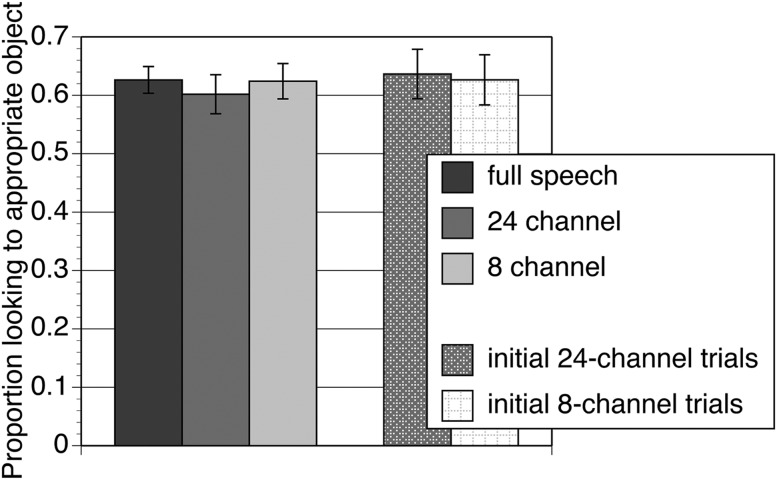
Figure 1
Figure 1
Proportion of time spent looking to the target object in full speech, 24-channel noise-vocoded speech, and 8-channel noise-vocoded speech (left side of graph) in Experiment 1. Bars to the right show performance on noise vocoded trials not preceded by a full-speech sentence. Baseline performance was approximately 50% in all cases.
Figure 2
Figure 2
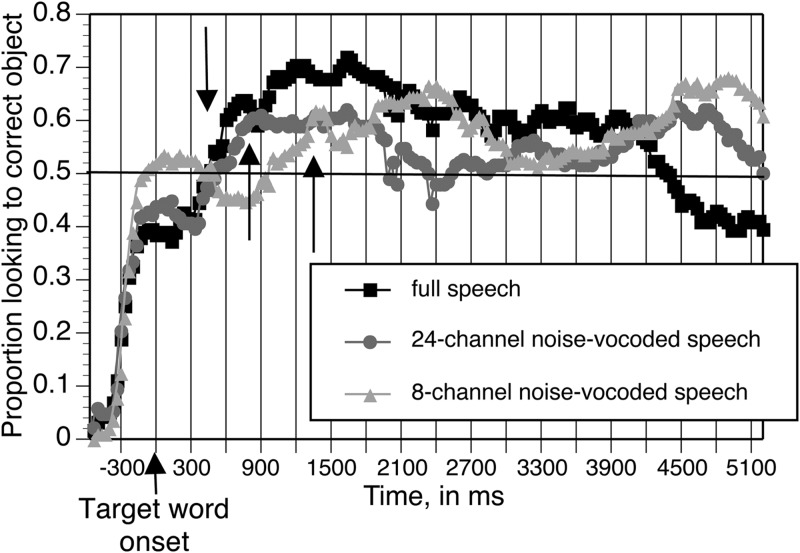
Looking time to the target object as a function of time, for full speech, 24-channel noise-vocoded speech, and 8-channel noise-vocoded speech in Experiment 1. Arrows indicate the points at which each curve shows looking time significantly greater than chance.
Figure 3
Figure 3
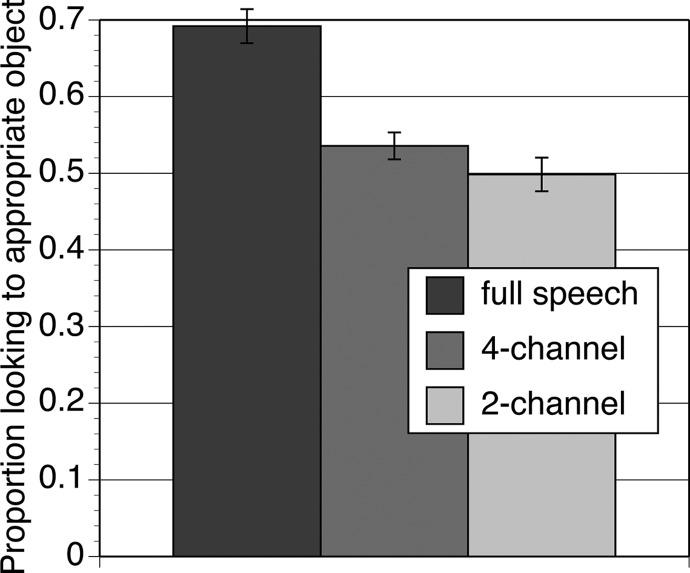
Proportion of time spent looking to the target object in full speech, 4-channel noise-vocoded speech, and 2-channel noise-vocoded speech in Experiment 2. Baseline performance was approximately 50% in all cases.
Figure 4
Figure 4
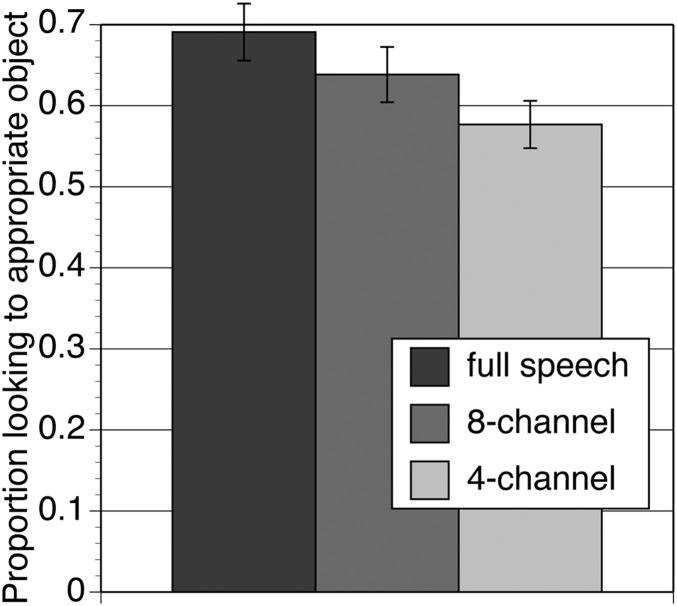
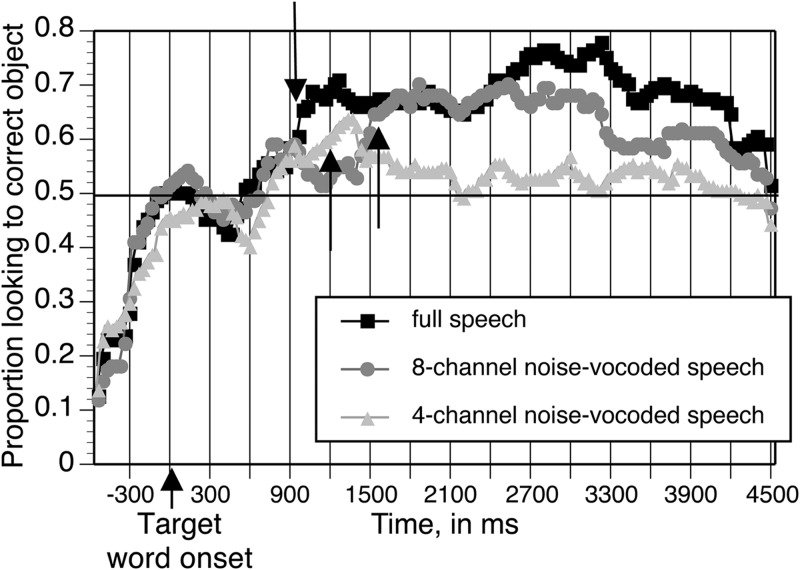
Proportion of time spent looking to the target object in full speech, 8-channel noise-vocoded speech, and 4-channel noise-vocoded speech in Experiment 3. Baseline performance was approximately 50% in all cases.
Figure 5
Figure 5
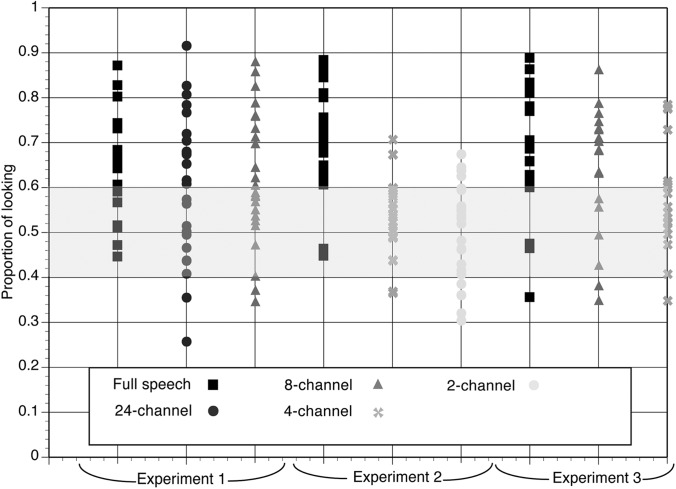
Individual participants' proportion of looking time to the appropriate object in the three experiments and the different speech conditions. Shaded region represents 40% to 60% looking to the target object or roughly chance performance.
Figure 6
Figure 6
Looking time to the target object as a function of time, for full speech, 8-channel noise-vocoded speech, and 4-channel noise-vocoded speech in Experiment 3. Arrows indicate the points at which each curve shows looking time significantly greater than chance.

References

    1. Baskent, D., and Shannon, R. V. (2003). “ Speech recognition under conditions of frequency-place compression and expansion,” J. Acoust. Soc. Am. 113(4 ), 2064–2076. 10.1121/1.1558357 - DOI - PubMed
    1. Baskent, D., and Shannon, R. V. (2006). “ Frequency transposition around dead regions simulated with a noiseband vocoder,” J. Acoust. Soc. Am. 119(2 ), 1156–1163. 10.1121/1.2151825 - DOI - PubMed
    1. Baskent, D., and Shannon, R. V. (2007). “ Combined effects of frequency compression-expansion and shift on speech recognition,” Ear Hear. 28(3 ), 277–289. 10.1097/AUD.0b013e318050d398 - DOI - PubMed
    1. Brokx, J. P. L., and Nooteboom, S. G. (1982). “ Intonation and the perceptual separation of simultaneous voices,” J. Phon. 10, 23–36.
    1. Chatterjee, M., and Peng, S. C. (2008). “Processing F0 with cochlear implants: Modulation frequency discrimination and speech intonation recognition,” Hear. Res. 235, 143–156. 10.1016/j.heares.2007.11.004 - DOI - PMC - PubMed

Publication types