Review
. 2013:31:317-43.
doi: 10.1146/annurev-immunol-032712-095906. Epub 2013 Jan 3.

Interleukin-4- and interleukin-13-mediated alternatively activated macrophages: roles in homeostasis and disease

Affiliations
Review

Interleukin-4- and interleukin-13-mediated alternatively activated macrophages: roles in homeostasis and disease

Steven J Van Dyken et al. Annu Rev Immunol. 2013.

Abstract

The macrophage, a versatile cell type prominently involved in host defense and immunity, assumes a distinct state of alternative activation in the context of polarized type 2 immune responses such as allergic inflammation and helminth infection. This alternatively activated phenotype is induced by the canonical type 2 cytokines interleukin (IL)-4 and IL-13, which mediate expression of several characteristic markers along with a dramatic shift in macrophage metabolic pathways that influence surrounding cells and tissues. We discuss recent advances in the understanding of IL-4- and IL-13-mediated alternatively activated macrophages and type 2 immune responses; such advances have led to an expanded appreciation for functions of these cells beyond immunity, including maintenance of physiologic homeostasis and tissue repair.


Figures
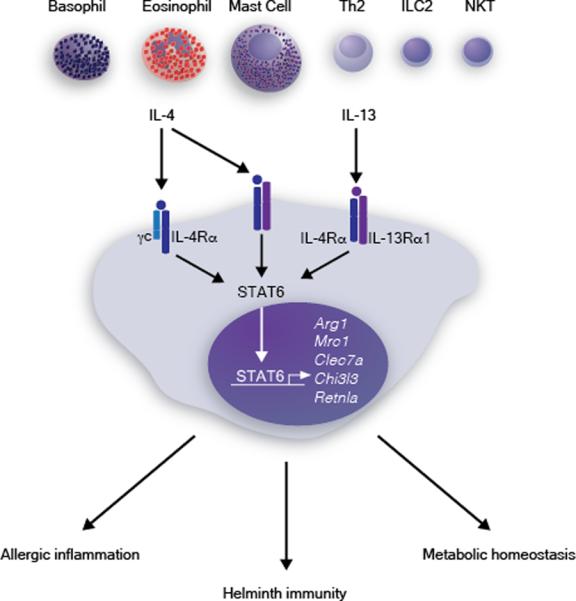
FIGURE 1
FIGURE 1. Alternatively activated macrophages in disease and homeostasis
Various cell types involved in type 2 immune responses or maintenance of metabolic homeostasis are capable of producing the canonical type 2 cytokines IL-4 and IL-13. These cytokines induce the alternatively activated phenotype in macrophages, which is characterized by the expression of a distinct set of genes (examples shown for mouse macrophages). Alternatively activated macrophages are induced in tissues associated with type 2 immune responses such as those that occur with allergic inflammation and helminth infection as well as in adipose tissue during maintenance of metabolic homeostasis. Abbreviations: ILC2, innate lymphoid type 2 cell; NKT, natural killer T cell; STAT6, signal transducer and activator of transcription 6; Th2, type 2 helper T cell.
FIGURE 2
FIGURE 2. Functional aspects of alternatively activated macrophages (AAMs) during immunity and homeostasis
(a) IL-4 and/or IL-13 produced in the context of Schistosoma mansoni–induced granuloma formation in the liver induces AAMs. In mouse tissues, arginase 1 (Arg1) is produced by AAMs and mediates T cell suppression by catabolizing available L-arginine into L-ornithine and urea, thereby depleting an essential T cell proliferative factor. Relmαis also produced by AAMs and mediates T cell suppressive effects. (b) IL-4/IL-13 production and/or receptor signaling is suppressed in the steady state by induced T regulatory (iTreg) cells and inhibitory phosphatases such as SHIP and SHP-1. In their absence, the AAM phenotype is spontaneously induced, resulting in excessive expression in vivo of Arg1 and Ym1, which leads to Ym1 crystal formation and type 2 inflammation in the lungs. (c) Adipose tissue in lean animals contains eosinophils and AAMs, which mediate maintenance of metabolic homeostasis via lipolysis, insulin sensitivity, and stress-induced thermogenesis; in obese animals, AAMs are replaced by classically activated macrophages and these effects are diminished.

References

    1. Nussbaum JC, Locksley RM. Infectious (non)tolerance—frustrated commensalism gone awry? Cold Spring Harb. Perspect. Biol. 2012;4:a007328. - PMC - PubMed
    1. Chen G, Zhuchenko O, Kuspa A. Immune-like phagocyte activity in the social amoeba. Science. 2007;317:678–81. - PMC - PubMed
    1. Medzhitov R. Recognition of microorganisms and activation of the immune response. Nature. 2007;449:819–26. - PubMed
    1. Takeuchi O, Akira S. Pattern recognition receptors and inflammation. Cell. 140:805–20. - PubMed
    1. Hoffmann JA. The immune response of Drosophila. Nature. 2003;426:33–38. - PubMed

Publication types
