


Genetic and environmental influences on the relationship between mastery and alcohol dependence
- PMID: 23298220
- PMCID: PMC3667976
- DOI: 10.1111/acer.12058
Genetic and environmental influences on the relationship between mastery and alcohol dependence
Abstract
Background: Sense of mastery, a personal resource, is likely to have an inverse association with alcohol dependence. Previous evidence, however, is sparse. In addition, the extent to which an association is due to genetic or environmental factors is unknown.
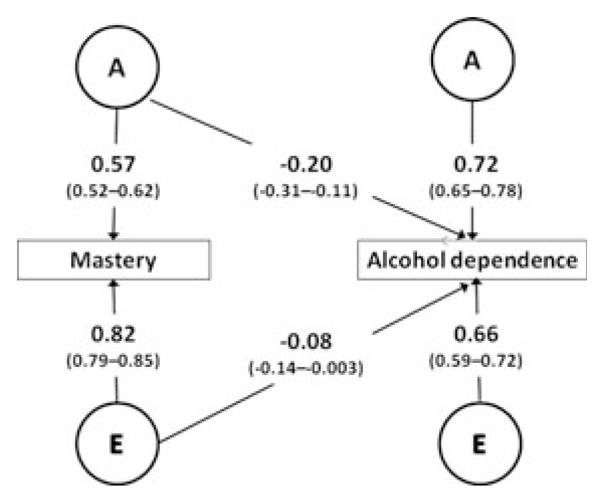
Methods: Data were from 3,983 male twins and 2,630 female twins who had ever used alcohol, interviewed in the Virginia Adult Twin Study of Psychiatric and Substance Use Disorders. Mastery was measured by a 6-item scale. Lifetime diagnosis of alcohol dependence was based on DSM-IV criteria assessed in a structured diagnostic interview. Univariate analyses modeled the relative contributions of genetic and environmental factors to mastery and alcohol dependence using Mx software. Bivariate Cholesky models were fit to the mastery and alcohol dependence raw data.
Results: In the best-fitting model of mastery, genetic factors accounted for about 33% of the observed variance. Nonshared environmental factors, including random measurement error, accounted for the remaining 67%. Fifty-six percent of the variance in liability to alcohol dependence was genetic, and the other 44% was explained by the nonshared environment. The phenotypic polychoric correlation between mastery and alcohol dependence of -0.18 was primarily (67% in the best-fitting model) explained by genes common to both low mastery and alcohol dependence; the rest was explained by nonshared environmental factors.
Conclusions: The findings indicate that genetic risk for alcohol dependence overlaps with genetic factors that influence sense of mastery. Key challenges for future research are to identify the genes that influence mastery and alcohol dependence, as well as the environmental pathways by which they come to be linked.
Copyright © 2013 by the Research Society on Alcoholism.
Figures

References
-
- Akaike H. Factor-Analysis and Aic. Psychometrika. 1987;52:317–332.
-
- Bandura A. A sociocognitive analysis of substance abuse: an agentic perspective. Psychol Sci. 1999;10:214–217.
-
- Bandura A. Toward a psychology of human agency. Perspect Psychol Sci. 2006;1:164–180. - PubMed
-
- Bovier PA, Chamot E, Perneger TV. Perceived stress, internal resources, and social support as determinants of mental health among young adults. Qual Life Res. 2004;13:161–170. - PubMed
-
- Dubow EF, Boxer P, Huesmann LR. Childhood and adolescent predictors of early and middle adulthood alcohol use and problem drinking: the Columbia County Longitudinal Study. Addiction. 2008;103(Suppl 1):36–47. - PubMed
Publication types
MeSH terms
Grants and funding
LinkOut - more resources
Full Text Sources
Other Literature Sources
Medical
