Concurrent use of diuretics, angiotensin converting enzyme inhibitors, and angiotensin receptor blockers with non-steroidal anti-inflammatory drugs and risk of acute kidney injury: nested case-control study
- PMID: 23299844
- PMCID: PMC3541472
- DOI: 10.1136/bmj.e8525
Concurrent use of diuretics, angiotensin converting enzyme inhibitors, and angiotensin receptor blockers with non-steroidal anti-inflammatory drugs and risk of acute kidney injury: nested case-control study
Abstract
Objectives: To assess whether a double therapy combination consisting of diuretics, angiotensin converting enzyme inhibitors, or angiotensin receptor blockers with addition of non-steroidal anti-inflammatory drugs (NSAIDs) and the triple therapy combination of two of the aforementioned antihypertensive drugs to which NSAIDs are added are associated with an increased risk of acute kidney injury.
Design: Retrospective cohort study using nested case-control analysis.
Setting: General practices contributing data to the UK Clinical Practice Research Datalink linked to the Hospital Episodes Statistics database.
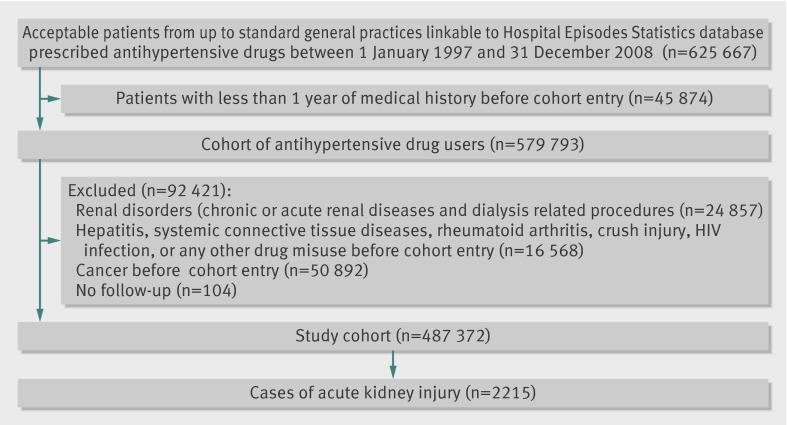
Participants: A cohort of 487,372 users of antihypertensive drugs.
Main outcome measures: Rate ratios with 95% confidence intervals of acute kidney injury associated with current use of double and triple therapy combinations of antihypertensive drugs with NSAIDs.
Results: During a mean follow-up of 5.9 (SD 3.4) years, 2215 cases of acute kidney injury were identified (incidence rate 7/10,000 person years). Overall, current use of a double therapy combination containing either diuretics or angiotensin converting enzyme inhibitors or angiotensin receptor blockers with NSAIDs was not associated with an increased rate of acute kidney injury. In contrast, current use of a triple therapy combination was associated with an increased rate of acute kidney injury (rate ratio 1.31, 95% confidence interval 1.12 to 1.53). In secondary analyses, the highest risk was observed in the first 30 days of use (rate ratio 1.82, 1.35 to 2.46).
Conclusions: A triple therapy combination consisting of diuretics with angiotensin converting enzyme inhibitors or angiotensin receptor blockers and NSAIDs was associated with an increased risk of acute kidney injury. The risk was greatest at the start of treatment. Although antihypertensive drugs have cardiovascular benefits, vigilance may be warranted when they are used concurrently with NSAIDs.
Conflict of interest statement
Competing interests: All authors have completed the ICMJE uniform disclosure form at
Comment in
-
Safety of coprescribing NSAIDs with multiple antihypertensive agents: triple drug combinations are associated with increased hospital admission for acute kidney injury,but questions remain.BMJ. 2013 Jan 8;346:e8713. doi: 10.1136/bmj.e8713. BMJ. 2013. PMID: 23299846 No abstract available.
-
A few clarifications please.BMJ. 2013 Feb 19;346:f1015. doi: 10.1136/bmj.f1015. BMJ. 2013. PMID: 23423366 No abstract available.
-
Authors' reply to Moore.BMJ. 2013 Feb 19;346:f1016. doi: 10.1136/bmj.f1016. BMJ. 2013. PMID: 23423367 No abstract available.
-
More evidence of nephrotoxicity with renin-angiotensin-aldosterone system blockers.BMJ. 2013 Feb 19;346:f661. doi: 10.1136/bmj.f661. BMJ. 2013. PMID: 23423371 No abstract available.
-
The nephrotoxic "triple whammy" of combining diuretics, ACE inhibitors, and NSAIDs [corrected].BMJ. 2013 Feb 19;346:f678. doi: 10.1136/bmj.f678. BMJ. 2013. PMID: 23423372 No abstract available.
-
Use of diuretics with ACE inhibitors or angiotensin receptor blockers and NSAIDs increases the risk of acute kidney injury.Evid Based Med. 2013 Dec;18(6):232-3. doi: 10.1136/eb-2013-101273. Epub 2013 Apr 19. Evid Based Med. 2013. PMID: 23604181 No abstract available.
References
-
- World Health Organization (Europe). Databases. www.euro.who.int/en/what-we-do/data-and-evidence/databases.
-
- Liangos O, Wald R, O’Bell JW, Price L, Pereira BJ, Jaber BL. Epidemiology and outcomes of acute renal failure in hospitalized patients: a national survey. Clin J Am Soc Nephrol 2006;1:43-51. - PubMed
Publication types
MeSH terms
Substances
Grants and funding
LinkOut - more resources
Full Text Sources
Other Literature Sources
Medical