


Identification of propofol binding sites in a nicotinic acetylcholine receptor with a photoreactive propofol analog
- PMID: 23300078
- PMCID: PMC3585054
- DOI: 10.1074/jbc.M112.435909
Identification of propofol binding sites in a nicotinic acetylcholine receptor with a photoreactive propofol analog
Abstract
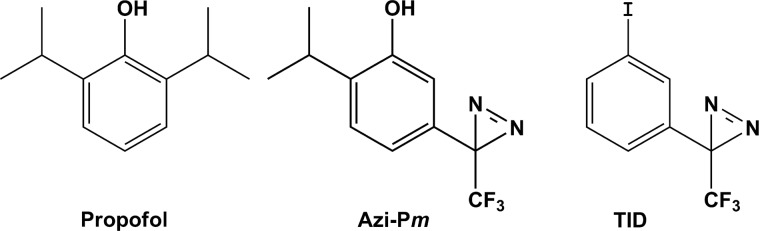
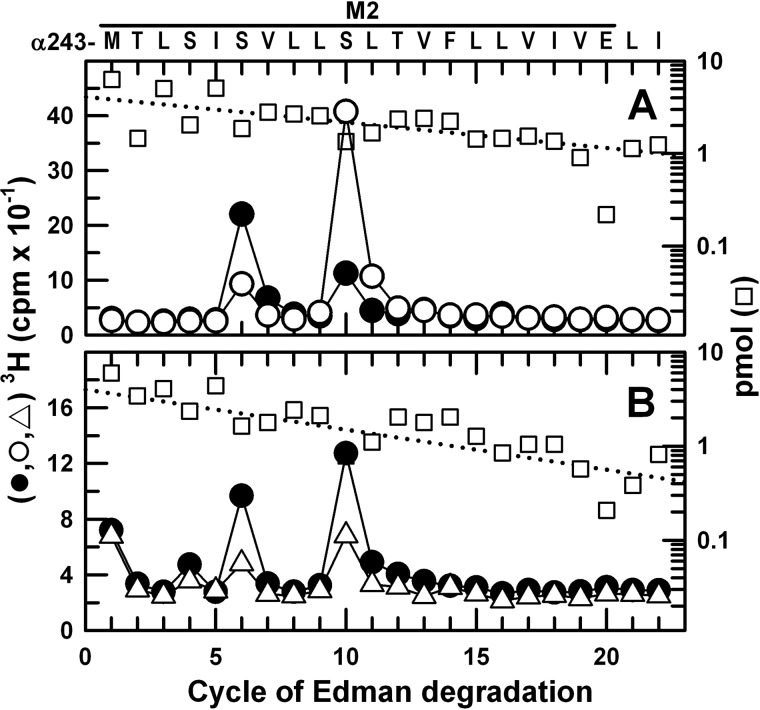
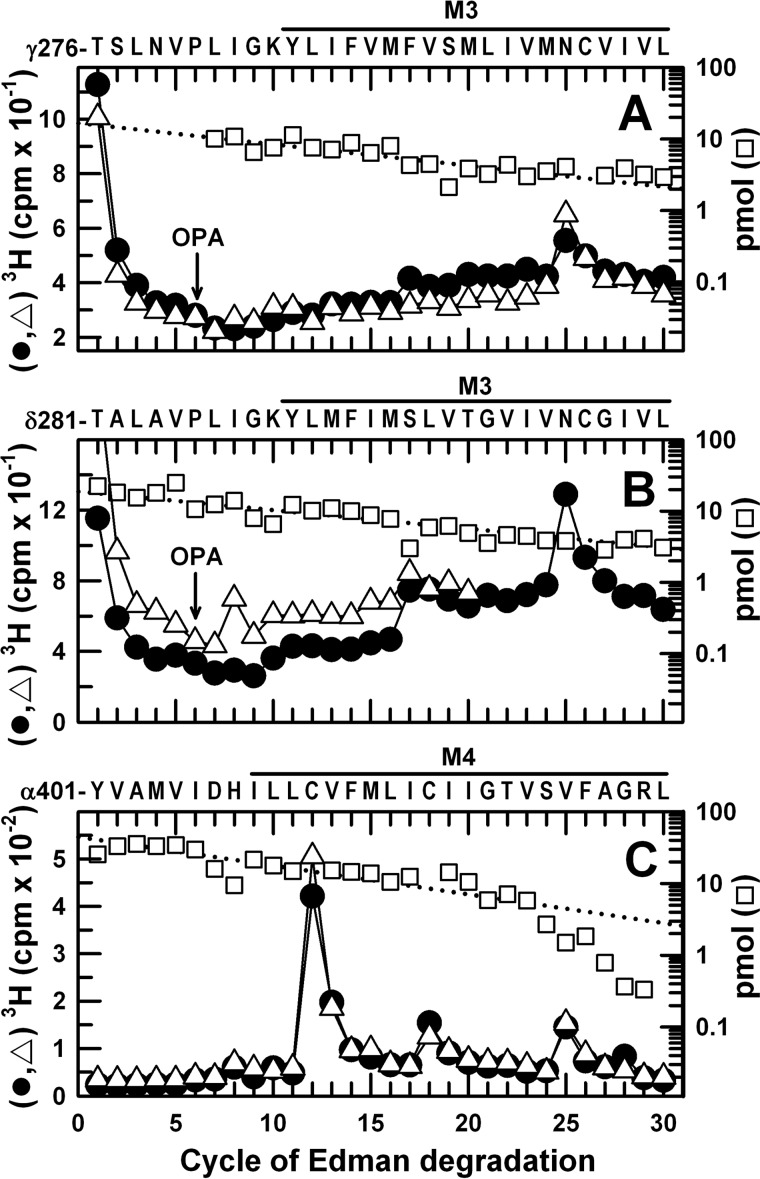
Propofol, a widely used intravenous general anesthetic, acts at anesthetic concentrations as a positive allosteric modulator of γ-aminobutyric acid type A receptors and at higher concentration as an inhibitor of nicotinic acetylcholine receptors (nAChRs). Here, we characterize propofol binding sites in a muscle-type nAChR by use of a photoreactive analog of propofol, 2-isopropyl-5-[3-(trifluoromethyl)-3H-diazirin-3-yl]phenol (AziPm). Based upon radioligand binding assays, AziPm stabilized the Torpedo nAChR in the resting state, whereas propofol stabilized the desensitized state. nAChR-rich membranes were photolabeled with [(3)H]AziPm, and labeled amino acids were identified by Edman degradation. [(3)H]AziPm binds at three sites within the nAChR transmembrane domain: (i) an intrasubunit site in the δ subunit helix bundle, photolabeling in the nAChR desensitized state (+agonist) δM2-18' and two residues in δM1 (δPhe-232 and δCys-236); (ii) in the ion channel, photolabeling in the nAChR resting, closed channel state (-agonist) amino acids in the M2 helices (αM2-6', βM2-6' and -13', and δM2-13') that line the channel lumen (with photolabeling reduced by >90% in the desensitized state); and (iii) at the γ-α interface, photolabeling αM2-10'. Propofol enhanced [(3)H]AziPm photolabeling at αM2-10'. Propofol inhibited [(3)H]AziPm photolabeling within the δ subunit helix bundle at lower concentrations (IC50 = 40 μm) than it inhibited ion channel photolabeling (IC50 = 125 μm). These results identify for the first time a single intrasubunit propofol binding site in the nAChR transmembrane domain and suggest that this is the functionally relevant inhibitory binding site.
Figures




References
-
- Krasowski M. D., Jenkins A., Flood P., Kung A. Y., Hopfinger A. J., Harrison N. L. (2001) General anesthetic potencies of a series of propofol analogs correlate with potency for potentiation of γ-aminobutyric acid (GABA) current at the GABA(A) receptor but not with lipid solubility. J. Pharmacol. Exp. Ther. 297, 338–351 - PubMed
-
- Rudolph U., Antkowiak B. (2004) Molecular and neuronal substrates for general anaesthetics. Nat. Rev. Neurosci. 5, 709–720 - PubMed
-
- Franks N. P. (2008) General anaesthesia: from molecular targets to neuronal pathways of sleep and arousal. Nat. Rev. Neurosci. 9, 370–386 - PubMed
-
- Flood P., Ramirez-Latorre J., Role L. (1997) α4β2 neuronal nicotinic acetylcholine receptors in the central nervous system are inhibited by isoflurane and propofol, but α7-type nicotinic acetylcholine receptors are unaffected. Anesthesiology 86, 859–865 - PubMed
-
- Violet J. M., Downie D. L., Nakisa R. C., Lieb W. R., Franks N. P. (1997) Differential sensitivities of mammalian neuronal and muscle nicotinic acetylcholine receptors to general anesthetics. Anesthesiology 86, 866–874 - PubMed
Publication types
MeSH terms
Substances
Grants and funding
LinkOut - more resources
Full Text Sources
Other Literature Sources
