


Psychomotor function in chronic daily Cannabis smokers during sustained abstinence
- PMID: 23301031
- PMCID: PMC3534640
- DOI: 10.1371/journal.pone.0053127
Psychomotor function in chronic daily Cannabis smokers during sustained abstinence
Abstract
Background: The present study assessed psychomotor function in chronic, daily cannabis smokers during 3 weeks continuously monitored abstinence on a secure research unit. We hypothesized that psychomotor performance would improve during abstinence of chronic, daily cannabis smokers.
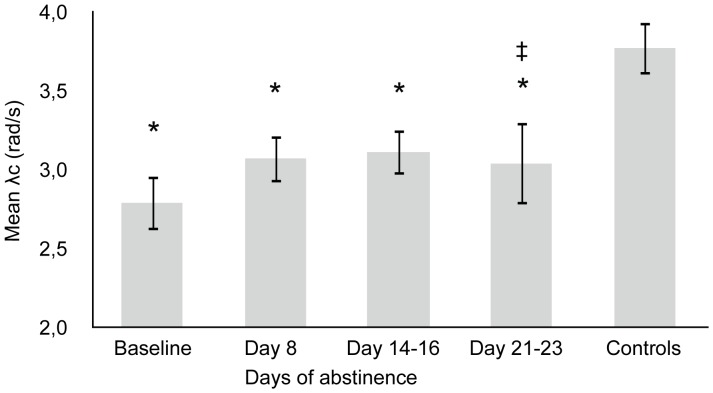
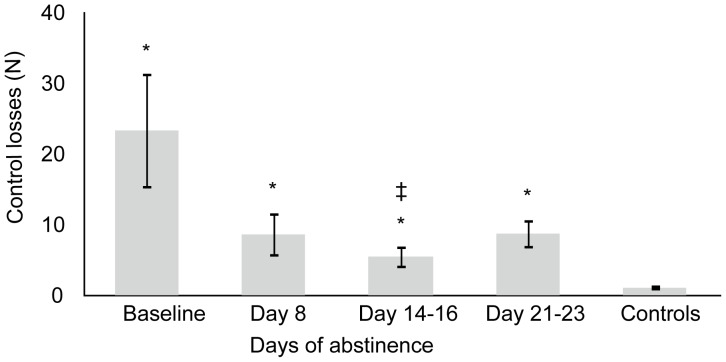
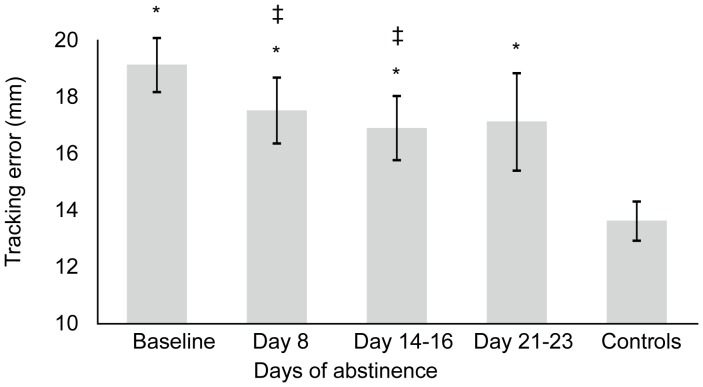
Methodology/principal findings: Performance on the critical tracking (CTT) and divided attention (DAT) tasks was assessed in 19 male chronic, daily cannabis smokers at baseline and after 8, 14-16 and 21-23 days of continuously monitored abstinence. Psychomotor performance was compared to a control group of non-intoxicated occasional drug users. Critical frequency (λ(c)) of the CTT and tracking error and control losses of the DAT were the primary outcome measures. Results showed that chronic cannabis smokers' performance on the CTT (p<0.001) and the DAT (p<0.001) was impaired during baseline relative to the comparison group. Psychomotor performance in the chronic cannabis smokers improved over 3 weeks of abstinence, but did not recover to equivalent control group performance.
Conclusions/significance: Sustained cannabis abstinence moderately improved critical tracking and divided attention performance in chronic, daily cannabis smokers, but impairment was still observable compared to controls after 3 weeks of abstinence. Between group differences, however, need to be interpreted with caution as chronic smokers and controls were not matched for education, social economic status, life style and race.
Conflict of interest statement
Figures
References
-
- UNODC (2010) World drug report 2010. New York: United Nations Publications, Sales No. E.10.XI.13.
-
- SAMHSA (2010) Results from the 2009 National Survey on Drug Use and Health: Volume I. Summary of National Findings: Office of Applied Studies, NSDUH Series H-36, HHS Publication No. SMA 09–4434). Rockville, MD.
-
- EMCDDA (2010) Annual report 2010: the state of the drugs problem in Europe: Luxembourg: Publications Office of the European Union.
-
- Solowij N, Battisti R (2008) The chronic effects of cannabis on memory in humans: a review. Curr Drug Abuse Rev 1: 81–98. - PubMed
-
- Solowij N, Stephens RS, Roffman RA, Babor T, Kadden R, et al. (2002) Cognitive functioning of long-term heavy cannabis users seeking treatment. JAMA 287: 1123–1131. - PubMed
Publication types
MeSH terms
Substances
Grants and funding
LinkOut - more resources
Full Text Sources
Other Literature Sources
Medical
