


doi: 10.1128/JVI.02657-12.
Epub 2013 Jan 9.
Viral inhibition of BAK promotes murine cytomegalovirus dissemination to salivary glands
Affiliations
- PMID: 23302869
- PMCID: PMC3592122
- DOI: 10.1128/JVI.02657-12
Item in Clipboard
Viral inhibition of BAK promotes murine cytomegalovirus dissemination to salivary glands
J Virol.
2013 Mar.
Abstract
Apoptosis induction is an important host defense mechanism to control viral infection, which is antagonized by viral proteins. Murine cytomegalovirus m41.1 encodes a viral inhibitor of BAK oligomerization (vIBO) that blocks the mitochondrial apoptosis mediator BAK. However, its importance for viral fitness in vivo has not been investigated. Here, we show that an m41.1-deficient virus attains reduced titers in salivary glands of wild-type but not Bak1(-/-) mice, indicating a requirement of BAK inhibition for optimal dissemination in vivo.
Figures
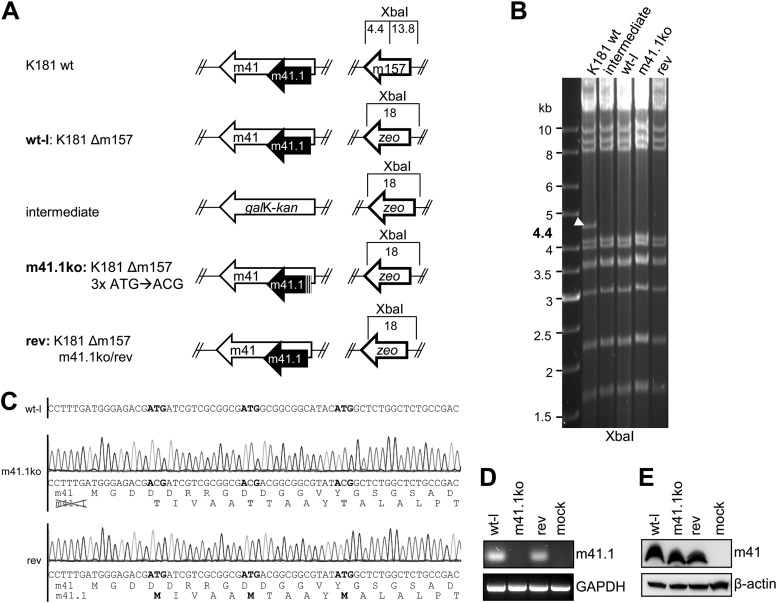
Construction and genetic analysis of mutant MCMVs. (A) The m157 gene was replaced by a zeo marker within the MCMV K181 BAC to facilitate infection of C57BL/6 mice. This K181Δm157 virus was used as a wild-type-like (wt-l) virus in all experiments. To generate an m41.1ko virus, the m41 locus was first replaced by galK-kan followed by reinsertion of a mutated m41 ORF, in which the three ATGs of m41.1 had been changed to ACG. The revertant virus was constructed using the same two-step strategy. (B) BAC DNA of wt and mutant MCMV genomes was digested to check for m157 deletion with XbaI and separated on 0.6% agarose gels. A 4.4-kb fragment in the parental K181 BAC is indicated by an arrowhead. (C) Sequencing of wt-l, m41.1ko, and rev BAC DNA. In the wt-l sequence, ATG is highlighted in boldface. Point mutations within the m41.1 ATG codons are indicated in gray. Translated amino acid sequences are shown beneath the nucleotide sequences. (D) 10.1 fibroblasts were infected with wt-l, m41.1ko, and rev viruses. At 24 hpi, m41.1 expression was analyzed by RT-PCR using a forward primer that ends on the T of the second m41.1 ATG codon (5′-ATGATCGTCGCGGCGAT-3′ and 5′-GGAGGGCGCGACGAAAG-3′). GAPDH, glyceraldehyde-3-phosphate dehydrogenase. (E) Expression of m41 was analyzed by immunoblotting in virus-infected RAW264.7 macrophages using the m41-specific antibody 2A6 (18).
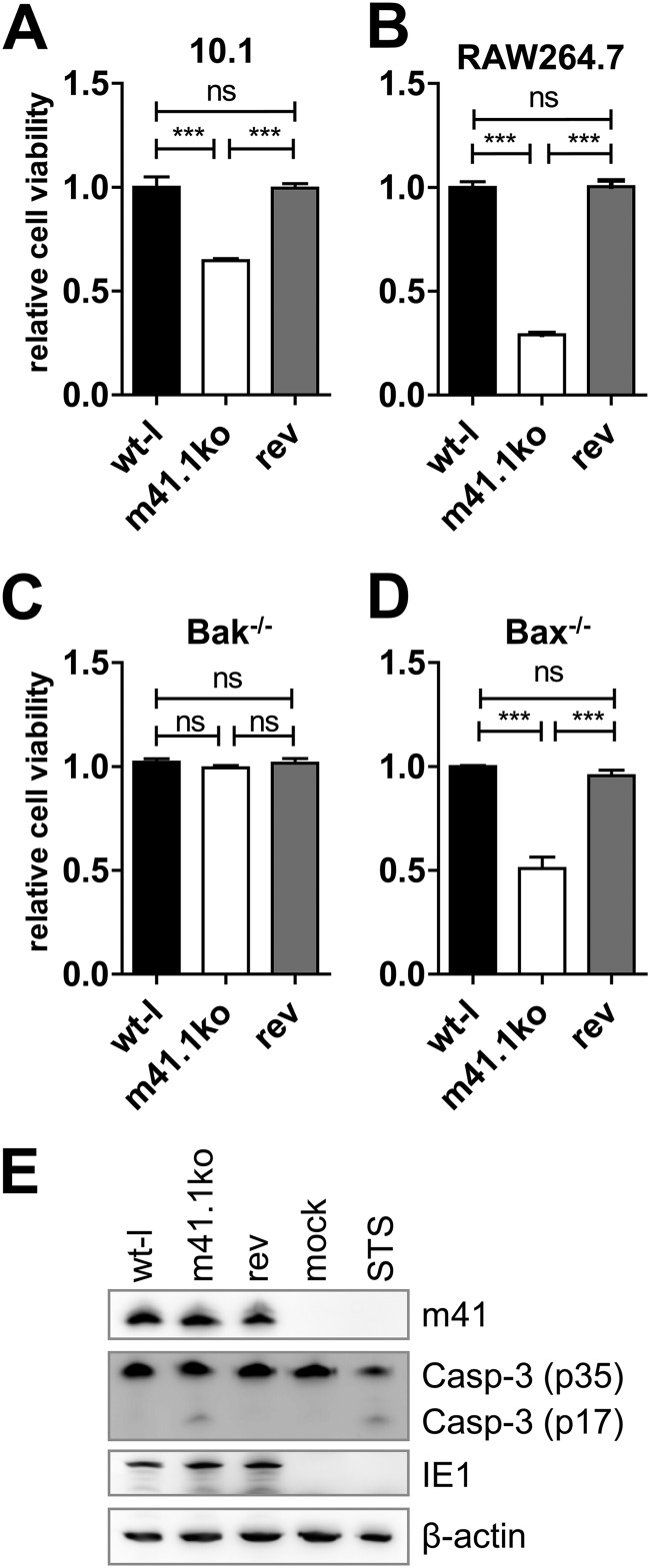
Characterization of mutant MCMVs in cell culture. (A) 10.1 fibroblasts were infected with wt-l, m41.1ko, and rev viruses at an MOI of 5. Six hours postinfection, cells were stimulated with staurosporine (STS). Cell viability was analyzed by MTS assay at 24 hpi. (B) RAW264.7 macrophages were infected with the indicated viruses (MOI of 5). Cell viability was measured 48 hpi by MTS assay. (C and D) Bak- or Bax-deficient mouse embryonic fibroblasts (MEFs) were infected with wt-l, m41.1ko, or rev. Cell viability was determined 72 hpi. Experiments were done with 5 or more replicates; means and standard errors of the means (SEM) are shown. Statistical significance was assessed by Student's t test (***, P < 0.001; ns, not significant). (E) 10.1 fibroblasts were infected with wt-l, m41.1ko, and rev virus or treated with STS to induce apoptosis. At 21 hpi, caspase-3 cleavage was analyzed by immunoblotting using a capase-3 (Casp-3)-specific antibody (no. 9662; Cell Signaling). IE1 was detected as an infection control and β-actin as a loading control using monoclonal antibodies (MAbs) CROMA101 and Ac-74 (Sigma), respectively.
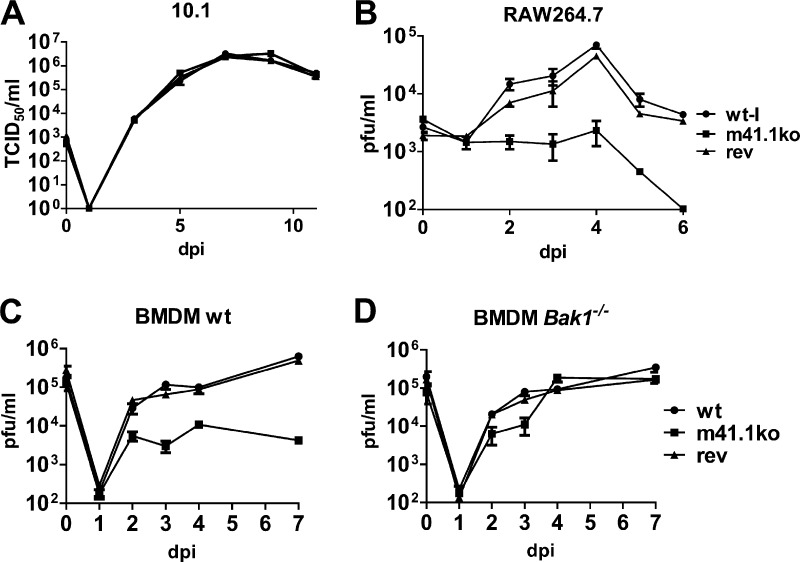
Replication of mutant MCMVs in cell culture. (A and B) 10.1 fibroblasts or RAW264.7 macrophages were infected with wt-l, m41.1ko, or rev virus at an MOI of 0.02. Supernatants were collected, and viral titers were determined by plaque assay or the TCID50 method. (C and D) BMDMs were isolated as described previously (31). On day 7 after isolation, cells were infected with wt-l, m41.1ko, or rev virus at an MOI of 0.02. Supernatants were collected and viral titers were determined by plaque assay. All experiments were done in duplicate or triplicate; means and SEM are shown.
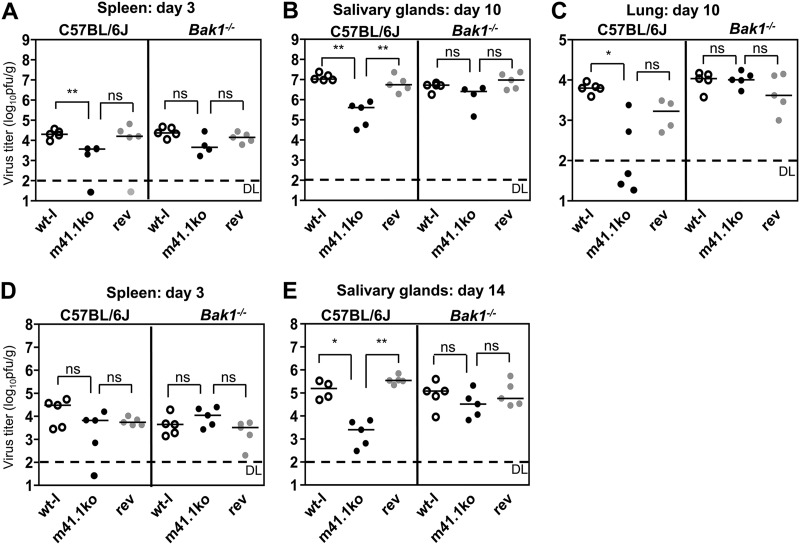
Replication of the m41.1ko virus in C57BL/6 and Bak1−/− mice. C57BL/6 or Bak1−/− mice were infected either intravenously (A to C) or intraperitoneally (D and E) with 2 × 10⁵ PFU/mouse. On days 3 (A and D) and 10 (B and C) or 14 (E) postinfection, mice were sacrificed. Virus titers in the spleen, lungs, and SGs were determined by plaque assay. Statistical significance was assessed using the Mann-Whitney test (*, P < 0.05; **; P < 0.01; ns, not significant). DL, detection limit.
References
-
- Benedict CA, Norris PS, Ware CF. 2002. To kill or be killed: viral evasion of apoptosis. Nat. Immunol. 3:1013–1018 - PubMed
-
- de Lima BD, May JS, Marques S, Simas JP, Stevenson PG. 2005. Murine gammaherpesvirus 68 bcl-2 homologue contributes to latency establishment in vivo. J. Gen. Virol. 86:31–40 - PubMed
-
- Feng P, Liang C, Shin YC, Xiaofei E, Zhang W, Gravel R, Wu TT, Sun R, Usherwood E, Jung JU. 2007. A novel inhibitory mechanism of mitochondrion-dependent apoptosis by a herpesviral protein. PLoS Pathog. 3:e174 doi:10.1371/journal.ppat.0030174 - DOI - PMC - PubMed
Publication types
MeSH terms
Substances
LinkOut - more resources
Full Text Sources
Other Literature Sources
