


Dual inhibition of endocannabinoid catabolic enzymes produces enhanced antiwithdrawal effects in morphine-dependent mice
- PMID: 23303065
- PMCID: PMC3629394
- DOI: 10.1038/npp.2012.269
Dual inhibition of endocannabinoid catabolic enzymes produces enhanced antiwithdrawal effects in morphine-dependent mice
Abstract
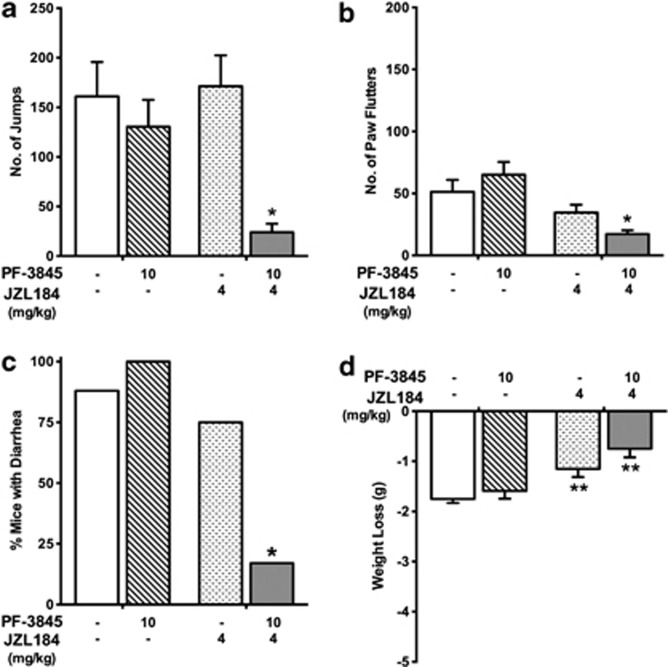
Inhibition of the endocannabinoid catabolic enzymes, monoacylglycerol lipase (MAGL) or fatty acid amide hydrolase (FAAH) attenuates naloxone-precipitated opioid withdrawal signs in mice via activation of CB1 receptors. Complete FAAH inhibition blocks only a subset of withdrawal signs, whereas complete MAGL inhibition elicits enhanced antiwithdrawal efficacy, but is accompanied with some cannabimimetic side effects. Thus, the primary objective of the present study was to determine whether combined, full FAAH inhibition and partial MAGL represents an optimal strategy to reduce opioid withdrawal. To test this hypothesis, we examined whether combined administration of high-dose of the FAAH inhibitor PF-3845 and low-dose of the MAGL inhibitor JZL184, as well as the novel dual FAAH-MAGL inhibitor SA-57, which is 100-fold more potent in inhibiting FAAH than MAGL, would prevent spontaneous withdrawal in morphine-dependent mice, a model with greater face validity than precipitating withdrawal with μ-opioid receptor antagonists. Strikingly, a combination of low-dose JZL184 and high-dose PF-3845 as well as the dual inhibitor SA-57 reduced all abrupt withdrawal signs (ie, platform jumping, paw flutters, head shakes, diarrhea, and total body weight loss), but did not elicit any cannabimimetic side effects. In addition, JZL184 or PF-3845 blocked naloxone-precipitated hypersecretion in morphine-dependent small intestinal tissue. Collectively, these results are the first to show that endocannabinoid catabolic enzyme inhibitors reduce abrupt withdrawal in morpine-dependent mice and are effective in a novel in vitro model of opioid withdrawal. More generally, these findings support the idea that joint MAGL and FAAH inhibition represents a promising approach for the treatment of opioid dependence.
Figures




References
-
- Bhargava HN. Effect of some cannabinoids on naloxone-precipitated abstinence in morphine-dependent mice. Psychopharmacology. 1976;49:267–270. - PubMed
-
- Birch EA. The use of Indian hemp in the treatment of chronic chloral and chronic opium poisoning. The Lancet. 1889;133:625.
-
- Blanco C, Alderson D, Ogburn E, Grant BF, Nunes EV, Hatzenbuehler ML, et al. Changes in the prevalence of non-medical prescription drug use and drug use disorders in the United States: 1991–1992 and 2001–2002. Drug Alcohol Depend. 2007;90:252–260. - PubMed
Publication types
MeSH terms
Substances
Grants and funding
- R01DA032933/DA/NIDA NIH HHS/United States
- T32 DA007027/DA/NIDA NIH HHS/United States
- R01AI49316/AI/NIAID NIH HHS/United States
- R01 AI049316/AI/NIAID NIH HHS/United States
- P01 DA009789/DA/NIDA NIH HHS/United States
- P50DA005274/DA/NIDA NIH HHS/United States
- T32DA007027/DA/NIDA NIH HHS/United States
- R25 GM090084/GM/NIGMS NIH HHS/United States
- R01 DA032933/DA/NIDA NIH HHS/United States
- P50 DA005274/DA/NIDA NIH HHS/United States
- P01 DA017259/DA/NIDA NIH HHS/United States
- R25 GM089614/GM/NIGMS NIH HHS/United States
- P01DA009789/DA/NIDA NIH HHS/United States
- P01DA017259/DA/NIDA NIH HHS/United States
LinkOut - more resources
Full Text Sources
Other Literature Sources
Research Materials
