


Neurocircuitry underlying the preferential sensitivity of prefrontal catecholamines to low-dose psychostimulants
- PMID: 23303075
- PMCID: PMC3629407
- DOI: 10.1038/npp.2013.6
Neurocircuitry underlying the preferential sensitivity of prefrontal catecholamines to low-dose psychostimulants
Abstract
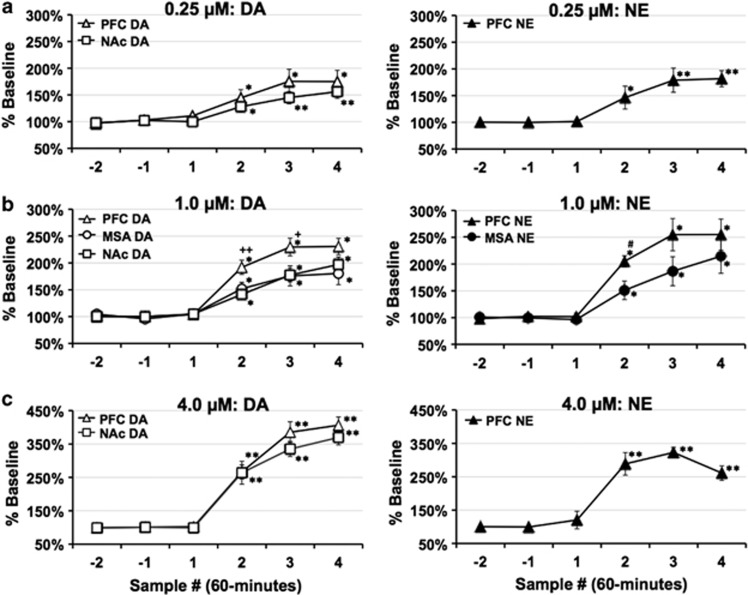
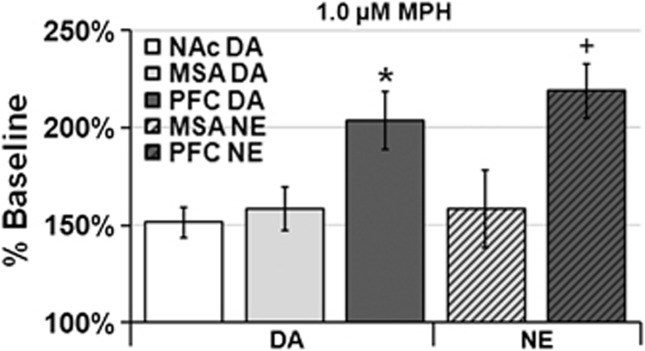
Low doses of psychostimulants, including methylphenidate (MPH), are highly effective in the treatment of attention-deficit/hyperactivity disorder (ADHD). At these doses, psychostimulants improve prefrontal cortex (PFC)-dependent function. Recent evidence indicates that low and clinically relevant doses of psychostimulants target norepinephrine (NE) and dopamine (DA) signaling preferentially in the PFC. To better understand the neural mechanisms responsible for the regional selectivity of low-dose psychostimulant action, it is important to first identify the underlying neurocircuitry. The current study used reverse microdialysis to test the hypothesis that the preferential targeting of PFC catecholamines by low-dose psychostimulants involves direct action within the PFC, reflecting an intrinsic property of this region. For these studies, the effects of varying concentrations of MPH (0.25, 1.0, and 4.0 μM) on NE and DA efflux were examined within the PFC and select subcortical fields in unanesthetized rats. Low concentrations of MPH elicited significantly larger increases in extracellular levels of NE and DA in the PFC than in subcortical regions linked to motor-activating and arousal-promoting actions of psychostimulants (nucleus accumbens and medial septal area, respectively). The differential action of MPH across regions disappeared at higher concentrations. The enhanced sensitivity of PFC catecholamines to low and clinically relevant doses of psychostimulants, at least in part, reflects a unique sensitivity of this region to NE/DA transporter blockade. Available evidence suggests that the increased sensitivity of PFC catecholamines likely involves DA clearance through the NE transporter within the PFC.
Figures
References
-
- Arnsten AF. Toward a new understanding of attention-deficit hyperactivity disorder pathophysiology: an important role for prefrontal cortex dysfunction. CNS Drugs. 2009;23 (Suppl 1:33–41. - PubMed
-
- Arnsten AFT, Castellanos FX.2002Neurobiology of attention regulation and its disordersIn: Martin A, Scahill L, Charney D, Leckman J, (eds)Textbook of Child and Adolescent Psychopharmacology Oxford University Press: New York; 99–109.
-
- Berridge CW. Neural substrates of psychostimulant-induced arousal. Neuropsychopharmacology. 2006;31:2332–2340. - PubMed
-
- Berridge CW, Devilbiss DM, Andrzejewski ME, Arnsten AF, Kelley AE, Schmeichel B, et al. Methylphenidate preferentially increases catecholamine neurotransmission within the prefrontal cortex at low doses that enhance cognitive function. Biol Psychiatry. 2006;60:1111–1120. - PubMed
Publication types
MeSH terms
Substances
Grants and funding
LinkOut - more resources
Full Text Sources
Other Literature Sources
Medical
Miscellaneous
