


Comparative analysis of lymph node metastases in patients with ypT0-2 rectal cancers after neoadjuvant chemoradiotherapy
- PMID: 23303140
- PMCID: PMC3547326
- DOI: 10.1097/DCR.0b013e318278ff8a
Comparative analysis of lymph node metastases in patients with ypT0-2 rectal cancers after neoadjuvant chemoradiotherapy
Abstract
Background: Neoadjuvant chemoradiotherapy before total mesorectal excision for rectal cancer is associated with improved local tumor control, primary tumor regression, and pathologic downstaging. Therefore, tumor response in the bowel wall has been proposed to be used to identify patients for organ-preserving strategies.
Objective: The aim of this study was to determine the rate of residual lymph node involvement following neoadjuvant chemoradiotherapy among patients with ypT0-2 residual bowel wall tumor and to comparatively assess their oncologic outcomes following total mesorectal excision.
Design: This is a retrospective consecutive cohort study, 1993 to 2008.
Setting and patients: Patients with stage cII to III rectal carcinoma treated with preoperative chemoradiotherapy and total mesorectal excision were included.
Main outcome measures: The primary outcomes measured were the rate of lymph node metastasis by ypT stage, recurrence-free survival, and the frequencies of distant metastasis and local recurrence.
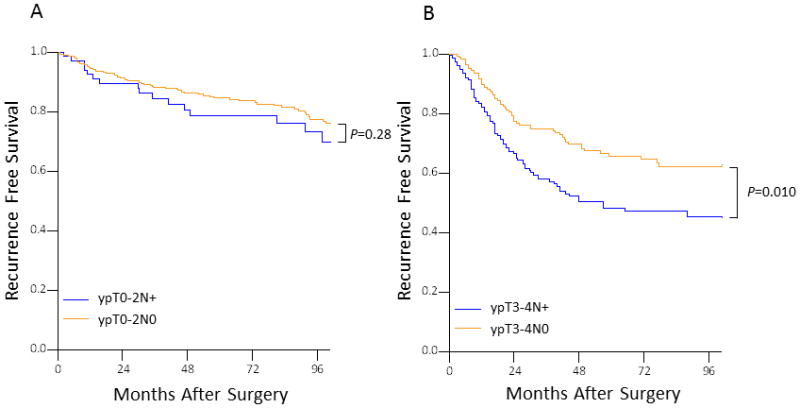
Results: Among all 406 ypT0-2 patients, 66 (16.3%) had lymph node metastasis: 20.8% among ypT2, 17.1% among ypT1, and 9.1% among ypT0 patients. Local recurrences (2.0% vs 5.5%; p = 0.038) but not distant metastases (9.3% vs 13.5%; p = 0.38) occurred more frequently in ypN+ than in ypN0 patients. Recurrence-free survival was 85.2% among ypT0-2N0 and 79.6% for ypT0-2N+ patients (p = 0.28). The lack of difference in recurrence-free survival persisted after covariate adjustment (HR, 1.29; 95% CI, 0.77-2.16; p = 0.37). However, among ypT3-4 patients, 5-year recurrence-free survival was significantly lower with lymph node metastasis (HR, 1.51; 95% CI, 1.07-2.12; p = 0.019).
Limitations: Low local recurrence event rate limited further comparison by ypT0-2 subgroups.
Conclusions: Residual mesorectal lymph node metastasis risk remains high even with good neoadjuvant chemoradiotherapy response within the bowel wall. Complete removal of the mesorectal burden results in excellent disease control. Given the uniquely good outcomes with standard therapy among patients with ypT0-2 disease, the use of ypT stage to stratify patients for local excision risks undertreatment of an unacceptably high proportion of patients.
Figures
References
-
- Hartley A, Ho KF, McConkey C, Geh JI. Pathological complete response following pre-operative chemoradiotherapy in rectal cancer: analysis of phase II/III trials. Br J Radiol. 2005;78:934–938. - PubMed
-
- Maas M, Nelemans PJ, Valentini V, et al. Long-term outcome in patients with a pathological complete response after chemoradiation for rectal cancer: a pooled analysis of individual patient data. Lancet Oncol. 2010;11:835–844. - PubMed
-
- Maas M, Beets-Tan RG, Lambregts DM, et al. Wait-and-see policy for clinical complete responders after chemoradiation for rectal cancer. J Clin Oncol. 2011;29:4633–4640. - PubMed
Publication types
MeSH terms
Grants and funding
LinkOut - more resources
Full Text Sources
Other Literature Sources
Medical
