


Mechanisms and causes of wear in tooth enamel: implications for hominin diets
- PMID: 23303220
- PMCID: PMC3565742
- DOI: 10.1098/rsif.2012.0923
Mechanisms and causes of wear in tooth enamel: implications for hominin diets
Abstract
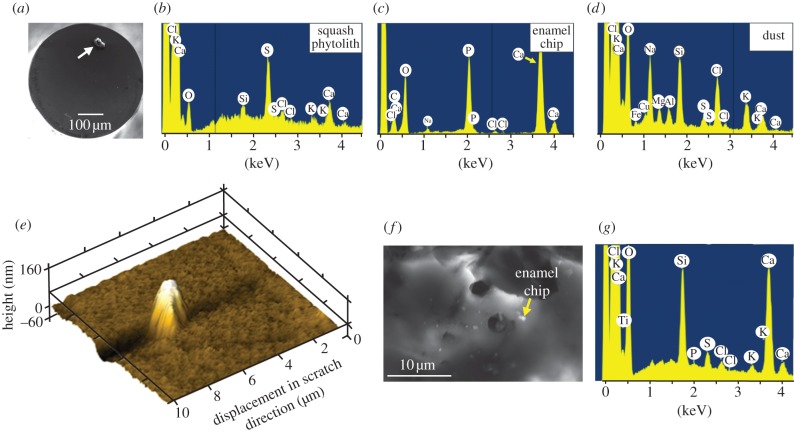
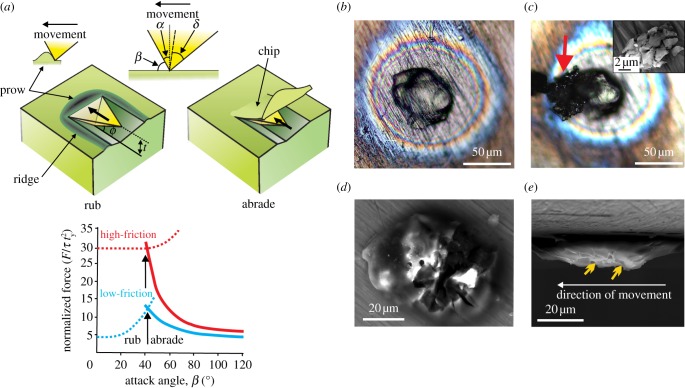
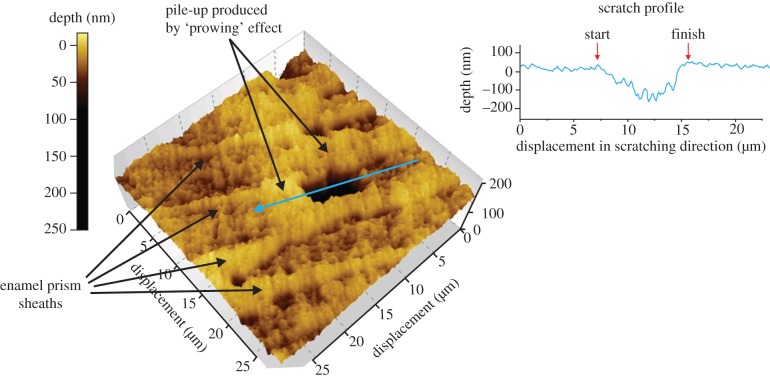
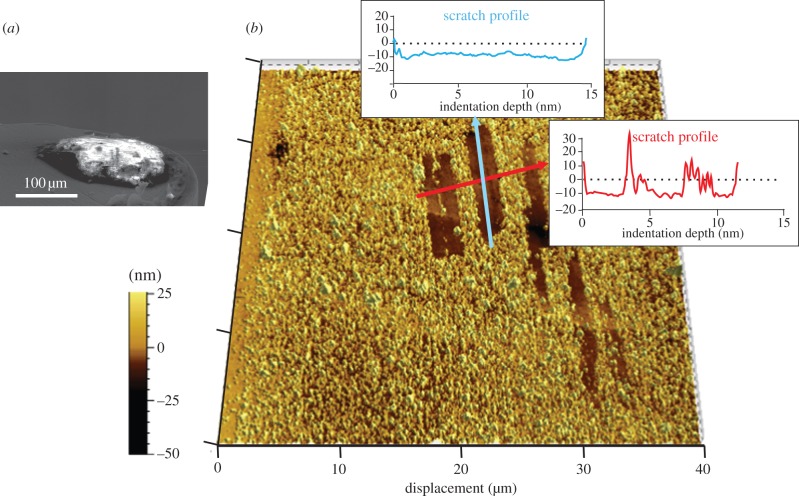
The wear of teeth is a major factor limiting mammalian lifespans in the wild. One method of describing worn surfaces, dental microwear texture analysis, has proved powerful for reconstructing the diets of extinct vertebrates, but has yielded unexpected results in early hominins. In particular, although australopiths exhibit derived craniodental features interpreted as adaptations for eating hard foods, most do not exhibit microwear signals indicative of this diet. However, no experiments have yet demonstrated the fundamental mechanisms and causes of this wear. Here, we report nanowear experiments where individual dust particles, phytoliths and enamel chips were slid across a flat enamel surface. Microwear features produced were influenced strongly by interacting mechanical properties and particle geometry. Quartz dust was a rigid abrasive, capable of fracturing and removing enamel pieces. By contrast, phytoliths and enamel chips deformed during sliding, forming U-shaped grooves or flat troughs in enamel, without tissue loss. Other plant tissues seem too soft to mark enamel, acting as particle transporters. We conclude that dust has overwhelming importance as a wear agent and that dietary signals preserved in dental microwear are indirect. Nanowear studies should resolve controversies over adaptive trends in mammals like enamel thickening or hypsodonty that delay functional dental loss.
Figures
Comment in
-
Scratching the surface: a critique of Lucas et al. (2013)'s conclusion that phytoliths do not abrade enamel.J Hum Evol. 2014 Sep;74:130-133. doi: 10.1016/j.jhevol.2014.02.001. Epub 2014 Mar 7. J Hum Evol. 2014. PMID: 24613598 No abstract available.
References
-
- Logan M, Sanson GD. 2002. The effects of tooth wear on the feeding behaviour of free-ranging koalas (Phascolarctos cinereus Goldfuss). J. Zool. 256, 63–69 10.1017/S0952836902000080 (doi:10.1017/S0952836902000080) - DOI
-
- King SJ, Arrigo-Nelson SJ, Pochron ST, Semprebon GM, Godfrey LR, Wright PC, Jernvall J. 2005. Dental senescence in a long-lived primate links infant survival to rainfall. Proc. Natl Acad. Sci. USA 102, 16 579–16 583 10.1073/pnas.0508377102 (doi:10.1073/pnas.0508377102) - DOI - PMC - PubMed
-
- Cuozzo FP, Sauther ML. 2006. Severe wear and tooth loss in wild ring-tailed lemurs (Lemur catta): a function of feeding ecology, dental structure, and individual life history. J. Hum. Evol. 51, 490–505 10.1016/j.jhevol.2006.07.001 (doi:10.1016/j.jhevol.2006.07.001) - DOI - PubMed
-
- Butler PM. 1952. The milk-molars of Perissodactyla, with remarks on molar occlusion. Proc. Zool. Soc. Lond. 121, 777–817 10.1111/j.1096-3642.1952.tb00784.x (doi:10.1111/j.1096-3642.1952.tb00784.x) - DOI
-
- Walker A, Hoeck H, Perez L. 1978. Microwear of mammalian teeth as an indicator of diet. Science 201, 908–910 10.1126/science.684415 (doi:10.1126/science.684415) - DOI - PubMed
MeSH terms
LinkOut - more resources
Full Text Sources
Other Literature Sources
