


Cutting edge: Type I IFN drives emergency myelopoiesis and peripheral myeloid expansion during chronic TLR7 signaling
- PMID: 23303674
- PMCID: PMC3552021
- DOI: 10.4049/jimmunol.1202739
Cutting edge: Type I IFN drives emergency myelopoiesis and peripheral myeloid expansion during chronic TLR7 signaling
Abstract
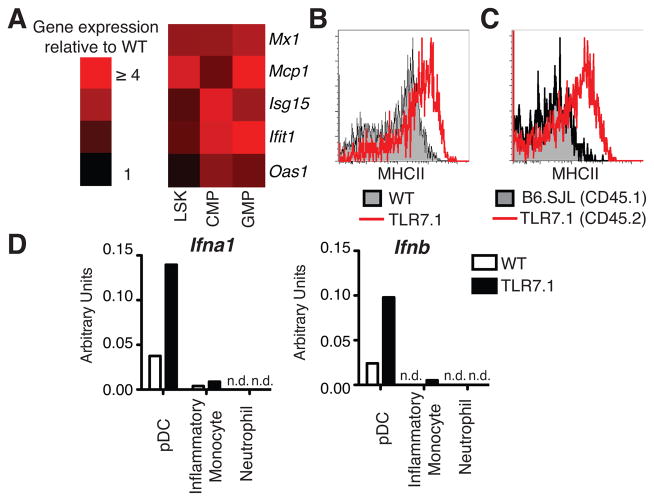
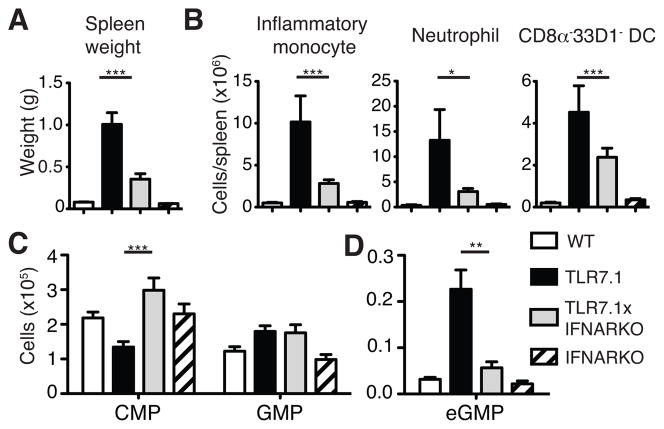
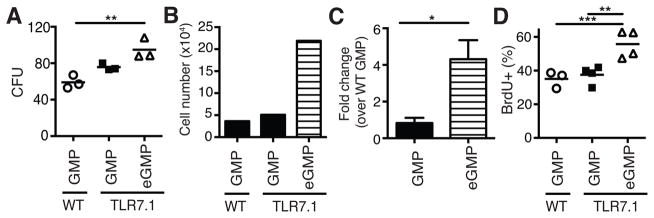
Mice overexpressing TLR7 (TLR7.1 mice) are a model of systemic lupus erythematosus pathogenesis and exhibit peripheral myeloid expansion. We show that TLR7.1 mice have a dramatic expansion of splenic cells that derive from granulocyte/macrophage progenitors (GMP) compared with wild-type mice. In the bone marrow, TLR7.1 mice exhibited hallmarks of emergency myelopoiesis and contained a discrete population of Sca-1(+) GMP, termed emergency GMP, which are more proliferative and superior myeloid precursors than classical Sca-1(-) GMP. The emergency myelopoiesis and peripheral myeloid expansion in TLR7.1 mice was dependent on type I IFN signaling. TLR7 agonist administration to nontransgenic mice also drove type I IFN-dependent emergency myelopoiesis. TLR7.1 plasmacytoid dendritic cells were cell-intrinsically activated by TLR7 overexpression and constitutively produced type I IFN mRNA. This study shows that type I IFN can act upon myeloid progenitors to promote the development of emergency GMP, which leads to an expansion of their progeny in the periphery.
Conflict of interest statement
The authors have no conflicting financial interests.
Figures


References
-
- Takizawa H, Boettcher S, Manz MG. Demand-adapted regulation of early hematopoiesis in infection and inflammation. Blood. 2012;119:2991–3002. - PubMed
-
- Essers MAG, Offner S, Blanco-Bose WE, Waibler Z, Kalinke U, Duchosal MA, Trumpp A. IFNalpha activates dormant haematopoietic stem cells in vivo. Nature. 2009;458:904–908. - PubMed
Publication types
MeSH terms
Substances
Grants and funding
LinkOut - more resources
Full Text Sources
Other Literature Sources
Molecular Biology Databases
Research Materials
