. 2013 Feb 1;41(4):2255-66.
doi: 10.1093/nar/gks1454. Epub 2013 Jan 8.

Oxygen-dependent expression of cytochrome c oxidase subunit 4-2 gene expression is mediated by transcription factors RBPJ, CXXC5 and CHCHD2

Affiliations

Oxygen-dependent expression of cytochrome c oxidase subunit 4-2 gene expression is mediated by transcription factors RBPJ, CXXC5 and CHCHD2

Siddhesh Aras et al. Nucleic Acids Res. .

Abstract

Cytochrome c oxidase (COX) is the terminal enzyme of the electron transport chain, made up of 13 subunits encoded by both mitochondrial and nuclear DNA. Subunit 4 (COX4), a key regulatory subunit, exists as two isoforms, the ubiquitous isoform 1 and the tissue-specific (predominantly lung) isoform 2 (COX4I2). COX4I2 renders lung COX about 2-fold more active compared with liver COX, which lacks COX4I2. We previously identified a highly conserved 13-bp sequence in the proximal promoter of COX4I2 that functions as an oxygen responsive element (ORE), maximally active at a 4% oxygen concentration. Here, we have identified three transcription factors that bind this conserved ORE, namely recombination signal sequence-binding protein Jκ (RBPJ), coiled-coil-helix-coiled-coil-helix domain 2 (CHCHD2) and CXXC finger protein 5 (CXXC5). We demonstrate that RBPJ and CHCHD2 function towards activating the ORE at 4% oxygen, whereas CXXC5 functions as an inhibitor. To validate results derived from cultured cells, we show using RNA interference a similar effect of these transcription factors in the gene regulation of COX4I2 in primary pulmonary arterial smooth muscle cells. Depending on the oxygen tension, a concerted action of the three transcription factors regulates the expression of COX4I2 that, as we discuss, could augment both COX activity and its ability to cope with altered cellular energy requirements.


Figures
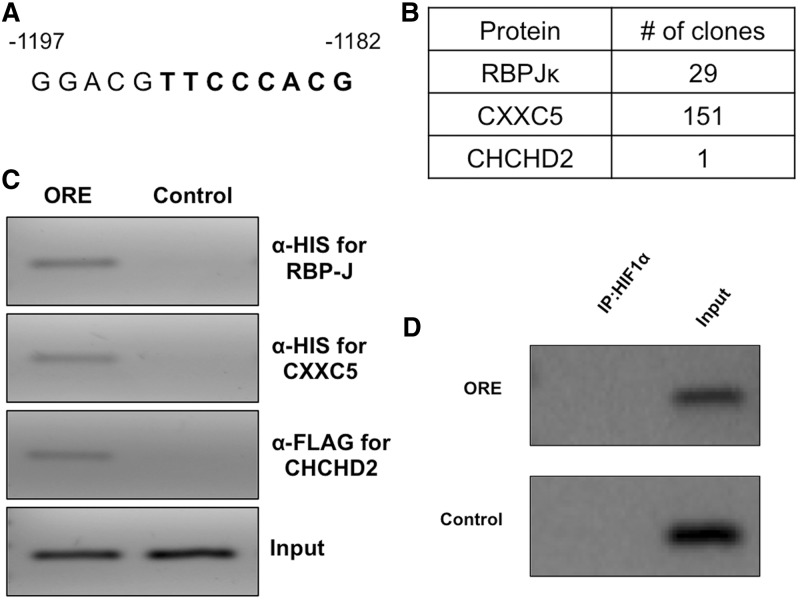
Figure 1.
Figure 1.
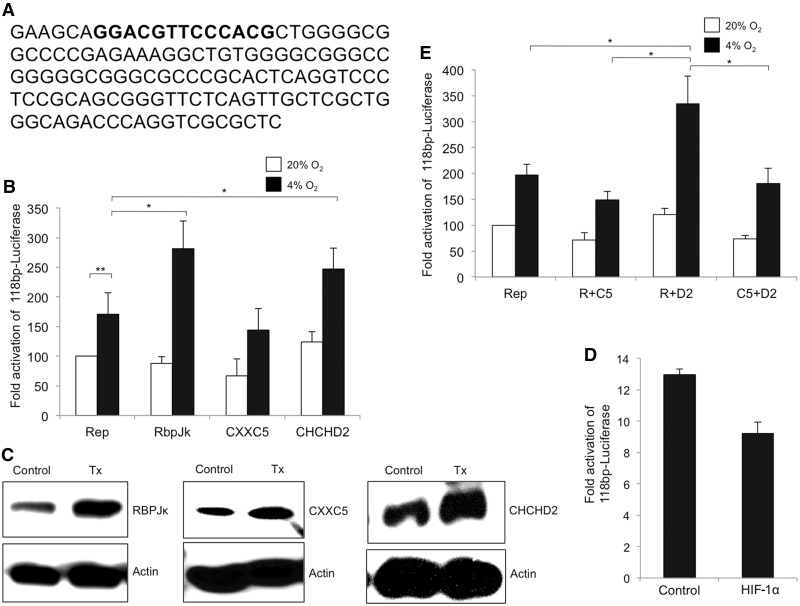
The COX4I2 promoter ORE binds three proteins, RBPJ, CXXC5 and CHCHD2. (A) The conserved 13-bp ORE in human COX4I2 promoter upstream of exon I is shown, with coordinates from the translation start site located in exon II. Bases shown in boldface form the consensus RBPJ binding site. (B) HeLa cell yeast one-hybrid analysis was performed to identify binding proteins of the ORE. Three proteins were identified that specifically bound the bait sequence. (C) DNA binding assay was performed in 293 cells to confirm binding to the ORE of the proteins identified in the one-hybrid screen. (D) HIF-1α fails to bind the ORE in the DNA binding assay described in the ‘Materials and Methods’ section.
Figure 2.
Figure 2.
Transactivation of the 118 bp minimal luciferase reporter. (A) Sequence of the 118-bp minimal ORE used in the study with the conserved ORE depicted in boldface. (B) Effect of overexpression of each of the three proteins on the ORE reporter was analysed in transient transfection assays in 293 cells. Reporter constructs and the effector plasmids were co-transfected (1 µg each). Reporter activity (Rep) observed over control at normoxia was set to 100% in this and subsequent figures. Open bars show activity at 20% oxygen and filled bars show activity at 4% oxygen in all figures. The data represents an average of at least three experiments. (C) Representative blots for overexpression of RBPJ, CXXC5 and CHCHD2 as used in reporter assays. (D) Overexpression of HIF-1α does not affect the activity of the 118 bp-conserved luciferase reporter. The 293 cells were co-transfected with the reporter and HIF-1α and maintained at 4% O2. Cells were analysed for reporter activity as described in the ‘Materials and Methods’ section. Data represents an average of three experiments. (E) Effect of co-overexpressing the three proteins on the ORE luciferase reporter. Cells were co-transfected with 1 µg each of RBPJ and CXXC5 (R+C5), RBPJ and CHCHD2 (R+D2) and CXXC5 and CHCHD2 (C5+D2) along with the 118-bp reporter. The data represent an average of at least three experiments (*P < 0.05; **P < 0.01).
Figure 3.
Figure 3.
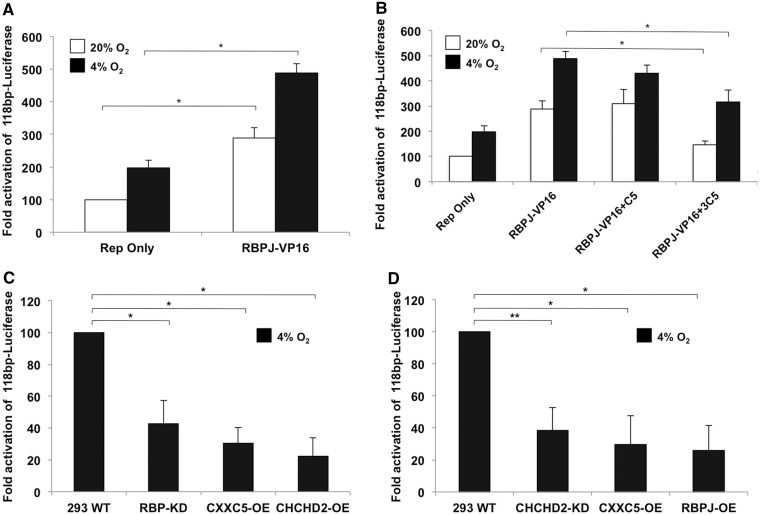
Role of RBPJ and CHCHD2 in the regulation of the COX4I2 ORE. (A) The effect of a constitutively active version of RBPJ (RBPJ-VP16) was used to dissect the role of this protein in the hypoxic activation of COX4I2. RBPJ-VP16 shows the activation of RBPJ-VP16 under 20% O2 (open bars) and 4% O2 (filled bars) conditions. (B) Effect of the repressor CXXC5 on RBPJ-VP16. CXXC5 overexpression repressed the activator effect of RBPJ-VP16 on the COX4I2 promoter. A higher concentration (3 µg of reporter construct; 3C5) was required for the inhibitory effect. (C) Reporter assay in 293 RBPJ-KD cells under hypoxic conditions. Reporter plasmid (100 ng) was transiently transfected and analysed for reporter levels. CXXC5 and CHCHD2 (100 ng) were co-transfected along with the reporter (CXXC5-OE and CHCHD2-OE). (D) Reporter assay in 293 CHCHD2-KD cells under 4% O2. Reporter plasmid (100 ng) was used in the assay along with 100 ng of CXXC5 and RBPJ (CXXC5-OE and RBPJ-OE) (*P < 0.05; **P < 0.01).
Figure 4.
Figure 4.
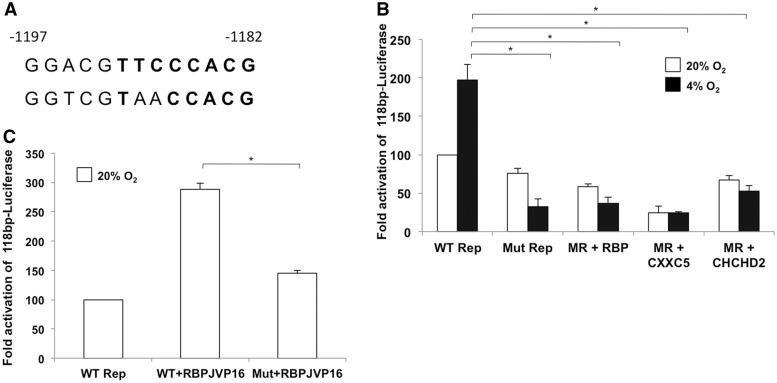
A mutant ORE abolishes the hypoxic response. (A) The wild-type (top) and mutant (bottom) ORE used in this study. Two of the three mutations are in the consensus RBPJ binding site. (B) Activity of the mutant reporter in cells overexpressing the individual proteins that bind the ORE. The hypoxic effect is completely abolished in cells transfected with 1 µg each of the reporter alone or with overexpressed individual proteins. (C) Effect of RBPJ-VP16 on the mutant reporter. RBPJ-VP16 was tested for its ability to activate the mutant ORE under normoxia, a condition where this chimera activates the reporter (*P < 0.05).
Figure 5.
Figure 5.
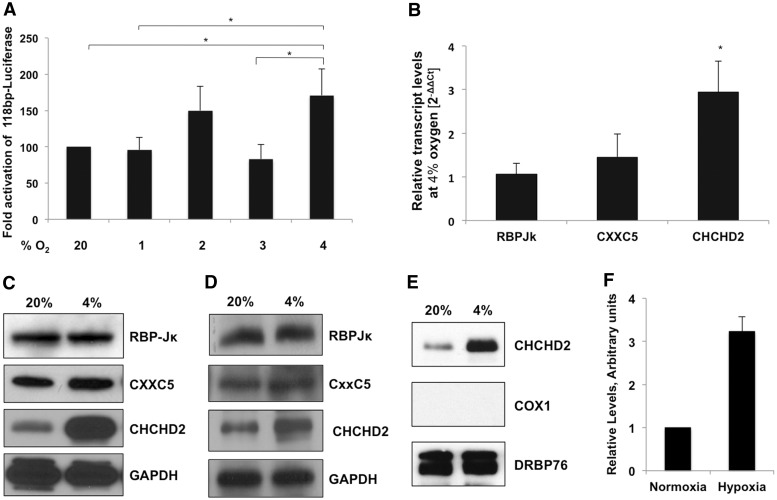
The minimal ORE of the COX4I2 promoter is maximally active at 4% oxygen. (A) ORE reporter activity at varying oxygen tensions. The 293 cells were transfected with 1 µg of the reporter plasmid and maintained at the indicated oxygen tensions for 48 h, followed by analysis of reporter activity relative to normoxia. (B) Real-time PCR analysis of COX4I2 transcript levels of RBPJ, CXXC5 and CHCHD2 at 4% oxygen. (C) Endogenous protein levels of RBPJ, CXXC5 and CHCHD2 analysed by immunoblotting of whole cell lysates from cells maintained at 20% and 4% oxygen for 48 h. (D) Expression levels of the individual proteins in transfected cells maintained under normoxic and hypoxic conditions for 48 h. GAPDH was used as a loading control (*P <0 .05). (E) CHCHD2 is localized in the nucleus. Nuclear fraction of cells maintained at 20% and 4% oxygen were immunoblotted for the levels of CHCHD2. DRBP76 is the nuclear marker and COX1 is the mitochondrial marker. A representative blot has been shown. (F) Quantitation of the level of nuclear CHCHD2 at normoxia (20% O2) and hypoxia (4% O2).
Figure 6.
Figure 6.
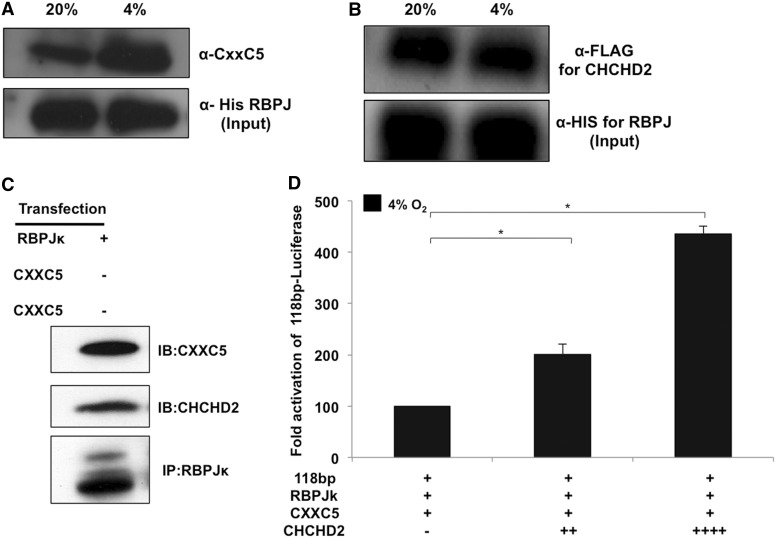
CXXC5 and CHCHD2 interact with RBPJ in vivo. (A) The 293 cells were transfected with C-terminal His-tag expression plasmids for RBPJ and either CXXC5 or CHCHD2. After 48 h at 20% or 4% oxygen, RBPJ was immunoprecipitated using the anti-His-tag antibody. The eluted protein was immunoblotted and probed using anti-CXXC5 antibody. (B) Immunoprecipitation was performed as described above for cell extracts at 20% and 4% oxygen and the eluted protein was probed for CHCHD2 using the anti-FLAG antibody. The blot was reprobed using the anti-His antibody to show the input fraction. (C) RBPJ interacts with endogenous CXXC5 and CHCHD2. The 293 cells were transfected with an expression plasmid for RBPJ followed by an immunoprecipitation of the nuclear extracts. The elution fraction was probed for the presence of endogenous CXXC5 and CHCHD2. (D) CHCHD2 overrides CXXC5 mediated inhibition under hypoxia. The 293 cells were transfected with 200 ng of the CXXC5, RBPJ and the reporter plasmids along with increasing concentrations of the CHCHD2 expression plasmid. Cells were analysed for reporter activity 48 h after incubation under hypoxic conditions (*P < 0.05).
Figure 7.
Figure 7.
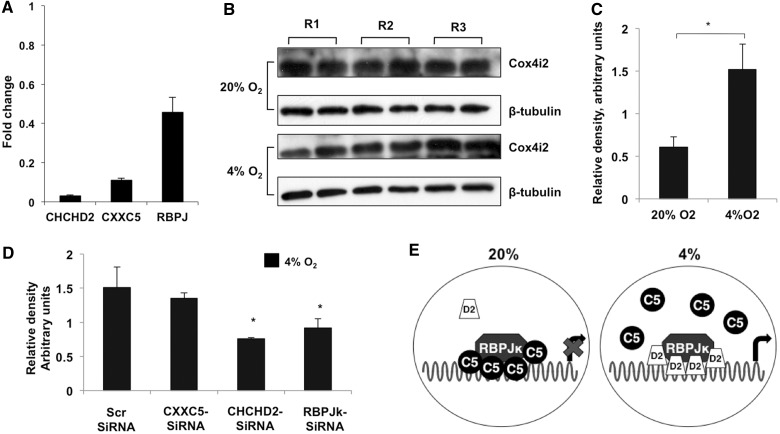
Knockdown of RBPJ and CHCHD2 affects the hypoxic induction of COX4I2 in rat primary lung cells. (A) Real-time analysis of the level of knockdown of the individual proteins in PASMCs transfected with siRNA. Analysis was performed using the ΔΔCt method. (B) Immunoblot analysis of COX4I2 levels in primary cells isolated from three rats (R1, R2 and R3). (C) Density of the COX4I2 bands relative to β-tubulin. (D) Quantitative analysis of the COX4I2-β-tubulin ratio in cells transfected with the indicated siRNAs as detailed in the ‘Materials and Methods’ section (*P < 0.05). (E) Model for the regulation of the COX4I2 ORE. CXXC5 (C5)-bound RBPJ (left) is not able to activate transcription, whereas CHCHD2 (D2) binding to RBPJ (right) displaces C5 and activates transcription.

References

    1. Napiwotzki J, Kadenbach B. Extramitochondrial ATP/ADP-ratios regulate cytochrome c oxidase activity via binding to the cytosolic domain of subunit IV. Biol. Chem. 1998;379:335–339. - PubMed
    1. Hüttemann M, Kadenbach B, Grossman LI. Mammalian subunit IV isoforms of cytochrome c oxidase. Gene. 2001;267:111–123. - PubMed
    1. Hüttemann M, Lee I, Gao X, Pecina P, Pecinova A, Liu J, Aras S, Sommer N, Sanderson TH, Tost M, et al. Cytochrome c oxidase subunit 4 isoform 2-knockout mice show reduced enzyme activity, airway hyporeactivity, and lung pathology. FASEB J. 2012;26:3916–3930. - PMC - PubMed
    1. Cooperstein SJ, Lazarow A. A microspectrophotometric method for the determination of cytochrome oxidase. J. Biol. Chem. 1951;189:665–670. - PubMed
    1. Huttemann M, Lee I, Liu J, Grossman LI. Transcription of mammalian cytochrome c oxidase subunit IV-2 is controlled by a novel conserved oxygen responsive element. FEBS J. 2007;274:5737–5748. - PubMed

Publication types

MeSH terms