


Multidisciplinary pharmacotherapeutic options for nonalcoholic Fatty liver disease
- PMID: 23304532
- PMCID: PMC3523542
- DOI: 10.1155/2012/950693
Multidisciplinary pharmacotherapeutic options for nonalcoholic Fatty liver disease
Abstract
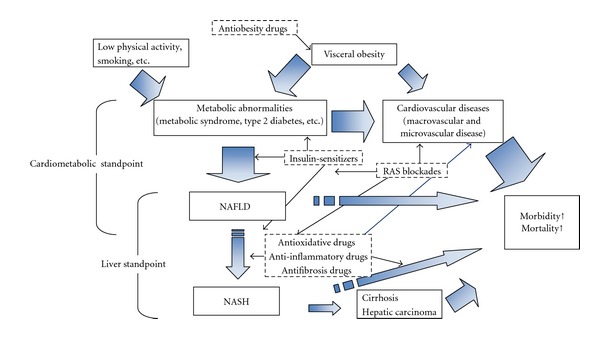
Nonalcoholic fatty liver disease (NAFLD) and non-alcoholic steatohepatitis (NASH) are multidisciplinary liver diseases that often accompany type 2 diabetes or metabolic syndrome, which are characterized by insulin resistance. Therefore, effective treatment of type 2 diabetes and metabolic syndrome should target not only the cardiometabolic abnormalities, but also the associated liver disorders. In the last decade, it has been shown that metformin, thiazolidinediones, vitamin E, ezetimibe, n-3 polyunsaturated fatty acids, renin-angiotensin system (RAS) blockers, and antiobesity drugs may improve hepatic pathophysiological disorders as well as clinical parameters. Accordingly, insulin sensitizers, antioxidative agents, Niemann-Pick C1-like 1 (NPC1L1) inhibitors, RAS blockers, and drugs that target the central nervous system may represent candidate pharmacotherapies for NAFLD and possibly NASH. However, the efficacy, safety, and tolerability of long-term treatment (potentially for many years) with these drugs have not been fully established. Furthermore, clinical trials have not comprehensively examined the efficacy of lipid-lowering drugs (i.e., statins, fibrates, and NPC1L1 inhibitors) for the treatment of NAFLD. Although clinical evidence for RAS blockers and incretin-based agents (GLP-1 analogs and dipeptidyl peptidase-4 inhibitors) is also lacking, these agents are promising in terms of their insulin-sensitizing and anti-inflammatory effects without causing weight gain.
Figures
References
-
- Grundy SM, Cleeman JI, Daniels SR, et al. Diagnosis and management of the metabolic syndrome: an American Heart Association/National Heart, Lung, and Blood Institute scientific statement. Circulation. 2005;112(17):2735–2752. - PubMed
-
- Kopelman P. Health risks associated with overweight and obesity. Obesity Reviews. 2007;8(supplement 1):13–17. - PubMed
-
- Dixon JB. The effect of obesity on health outcomes. Molecular and Cellular Endocrinology. 2010;316(2):104–108. - PubMed
-
- Neuschwander-Tetri BA, Caldwell SH. Nonalcoholic steatohepatitis: summary of an AASLD Single Topic Conference. Hepatology. 2003;37(5):1202–1219. - PubMed
-
- Chalasani N, Younossi Z, Lavine JE, et al. The diagnosis and management of non-alcoholic fatty liver disease: practice Guideline by the American Association for the Study of Liver Diseases, American College of Gastroenterology, and the American Gastroenterological Association. Hepatology. 2012;55:2005–2023. - PubMed
LinkOut - more resources
Full Text Sources
Other Literature Sources
