


Review
doi: 10.3390/ijms14011278.
ANRIL: molecular mechanisms and implications in human health
Affiliations
- PMID: 23306151
- PMCID: PMC3565320
- DOI: 10.3390/ijms14011278
Item in Clipboard
Review
ANRIL: molecular mechanisms and implications in human health
Int J Mol Sci.
.
Abstract
ANRIL is a recently discovered long non-coding RNA encoded in the chromosome 9p21 region. This locus is a hotspot for disease-associated polymorphisms, and it has been consistently associated with cardiovascular disease, and more recently with several cancers, diabetes, glaucoma, endometriosis among other conditions. ANRIL has been shown to regulate its neighbor tumor suppressors CDKN2A/B by epigenetic mechanisms and thereby regulate cell proliferation and senescence. However, the clear role of ANRIL in the pathogenesis of these conditions is yet to be understood. Here, we review the recent findings on ANRIL molecular characterization and function, with a particular focus on its implications in human disease.
Figures
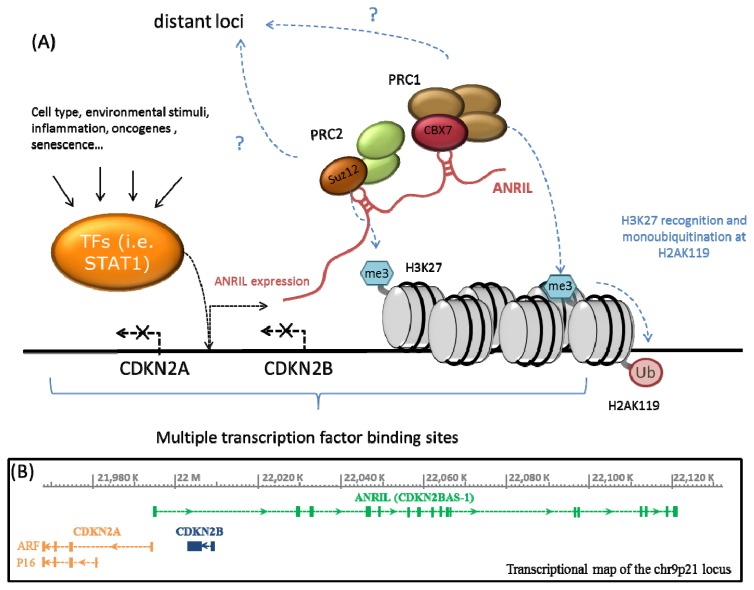
(A) Chr9p21 region is rich in regulatory elements and several transcription factor (TF) binding sites have been predicted along its sequence. These transcription factors are activated in response to external factors and signaling pathways, in a cell-type specific manner. TF binding possibly activates or represses the expression of ANRIL. Polycomb protein complexes 1 and 2 (PRC1 and PRC2), have RNA binding domains in their subunits CBX7 and SUZ12 respectively. ANRIL binds SUZ12 subunit of PRC2 to induce methylation of histone 3 in the lysine 27 (H3K27) and consequent silencing of the CDKN2A/B locus. ANRIL binds CBX7 in PRC1 which allows the recognition of H3K27 necessary for the monoubiquitination at histone 2A at lysine 119 (H2AK119) and maintenance of silencing. Therefore, ANRIL modulation impacts in the repressing ability of Polycomb proteins, inducing or inhibiting expression of CDKN2A/B and possibly other distant loci by histone modification. The disease-associated alleles might impair TF binding and response to different stimuli, alter ANRIL/CDKN2A/B expression (and possibly other loci) and contribute to disease development and progression; (B) Diagram showing the transcripts encoded in the 9p21 locus. ANRIL is represented in the diagram as the longest variant reported (CDKN2BAS-1), but several other alternative isoforms have been described.
References
-
- Broadbent H.M., Peden J.F., Lorkowski S., Goel A., Ongen H., Green F., Clarke R., Collins R., Franzosi M.G., Tognoni G., et al. Susceptibility to coronary artery disease and diabetes is encoded by distinct, tightly linked, SNPs in the ANRIL locus on chromosome 9p. Hum. Mol. Genet. 2008;17:806–814. - PubMed
-
- Cugino D., Gianfagna F., Santimone I., de Gaetano G., Donati M.B., Iacoviello L., di Castelnuovo A. Type 2 diabetes and polymorphisms on chromosome 9p21: A meta-analysis. Nutr. Metab. Cardiovasc. Dis. 2012;22:619–625. - PubMed
-
- Emanuele E., Lista S., Ghidoni R., Binetti G., Cereda C., Benussi L., Maletta R., Bruni A.C., Politi P. Chromosome 9p21.3 genotype is associated with vascular dementia and Alzheimer’s disease. Neurobiol. Aging. 2011;32:1231–1235. - PubMed
-
- Burdon K.P., Macgregor S., Hewitt A.W., Sharma S., Chidlow G., Mills R.A., Danoy P., Casson R., Viswanathan A.C., Liu J.Z. Genome-wide association study identifies susceptibility loci for open angle glaucoma at TMCO1 and CDKN2BAS1. Nat. Genet. 2011;43:574–578. - PubMed
Publication types
MeSH terms
Substances
LinkOut - more resources
Full Text Sources
Other Literature Sources
Miscellaneous
