


doi: 10.1039/c2lc90148j.
Probing circulating tumor cells in microfluidics
Affiliations
- PMID: 23306378
- PMCID: PMC3990734
- DOI: 10.1039/c2lc90148j
Item in Clipboard
Probing circulating tumor cells in microfluidics
Lab Chip.
.
Abstract
Circulating tumor cells (CTCs) are important targets for study as we strive to better understand, diagnose, and treat cancers. However, CTCs are found in blood at extremely low concentrations; this makes isolation, enrichment, and characterization of CTCs technically challenging. Recently, the development of CTC separation devices has grown rapidly in both academia and industry. Part of this development effort centered on microfluidic platforms, exploiting the advantages of microfluidics to improve CTC separation performance and device integration. In this Focus article, we highlight some of the recent work in microfluidic CTC separation and detection systems and discuss our appraisal of what the field should do next.
Figures

(a) Schematic of a microfluidic device using magnets placed under a main flow channel, along with magnetically-labeled CTCs, to accomplish CTC isolation from a blood sample. (b) Microfluidic device with magnets placed under perpendicularly-oriented side chambers used for collection of magnetically-labeled CTCs; the low fluid shear stresses in the dead-ended side chambers keep the collected CTCs viable. (c) Microfluidic device with a flow-focusing configuration to establish a single-file stream of cells through a microfluidic channel. Device is bonded to a micro-Hall detector array, such that each magnetically-labeled CTC passing over the array induces a Hall voltage and is thus counted. Reproduced from Refs. , , with permission from RSC and AAAS.
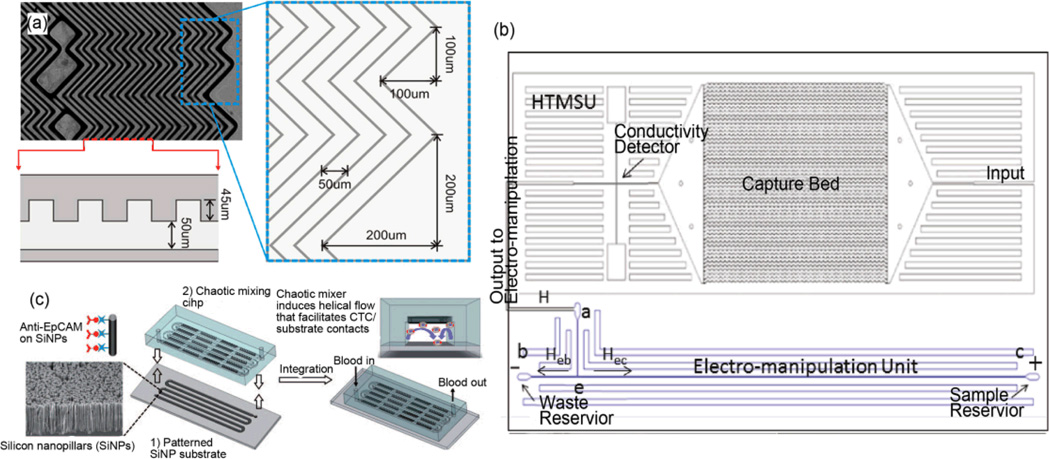
(a) Herringbone pattern in the channel ceiling of a microfluidic device for CTC isolation via affinity chromatography. (b) Schematic of a microfluidic device with integrated systems for CTC capture, enumeration, and electro-manipulation. (c) Image of a substrate whose surface consists of silicon nanopillars coated in anti-EpCAM antibodies, and schematic of the overall microfluidic device featuring a serpentine channel with a herringbone-patterned ceiling to constantly bring sample cells into contact with the substrate for CTC capture. Reproduced from Refs. , , with permission from NAS, ACS and Wiley.
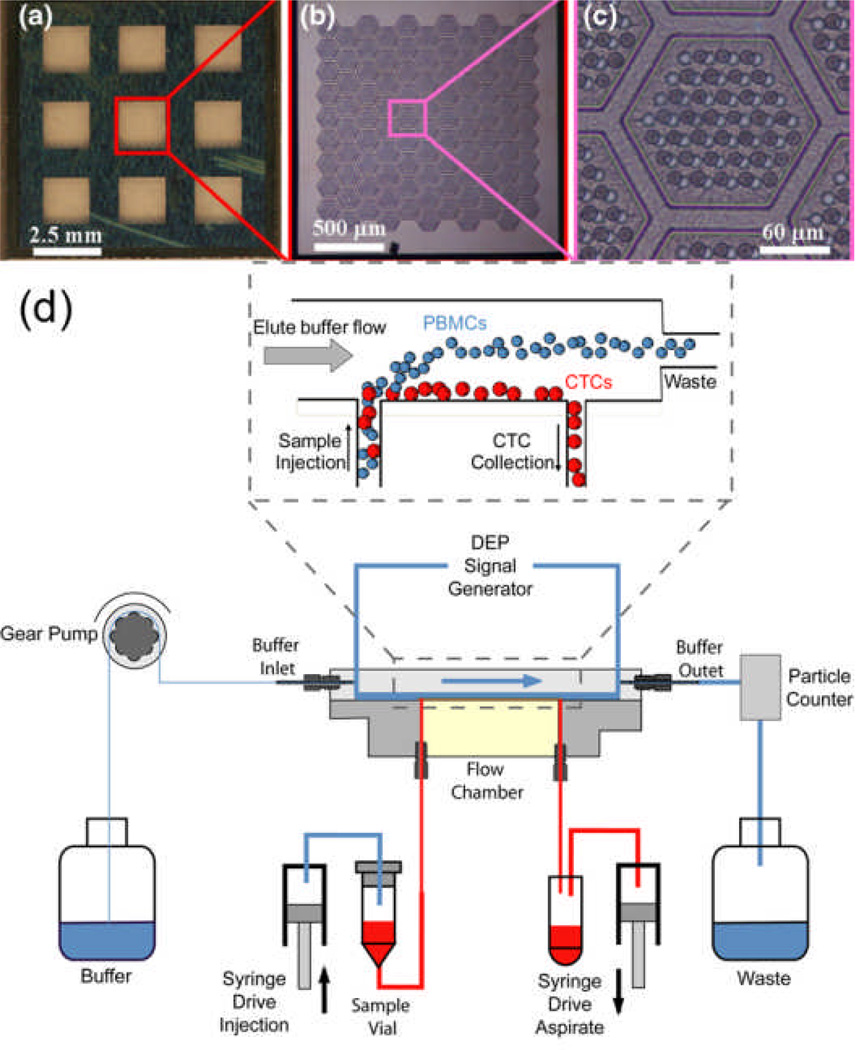
(a-c) Images of a 3-D microfilter, used for size-based mechanical separation of CTCs, at different magnifications. (d) Schematic of a dielectrophoretic CTC separation device, with detail provided for the flow chamber where an electrode sheet along the chamber floor generates an AC voltage to spatially separate CTCs from PBMCs via a DEP force. Reproduced from Refs. , with permission from AIP and Springer.
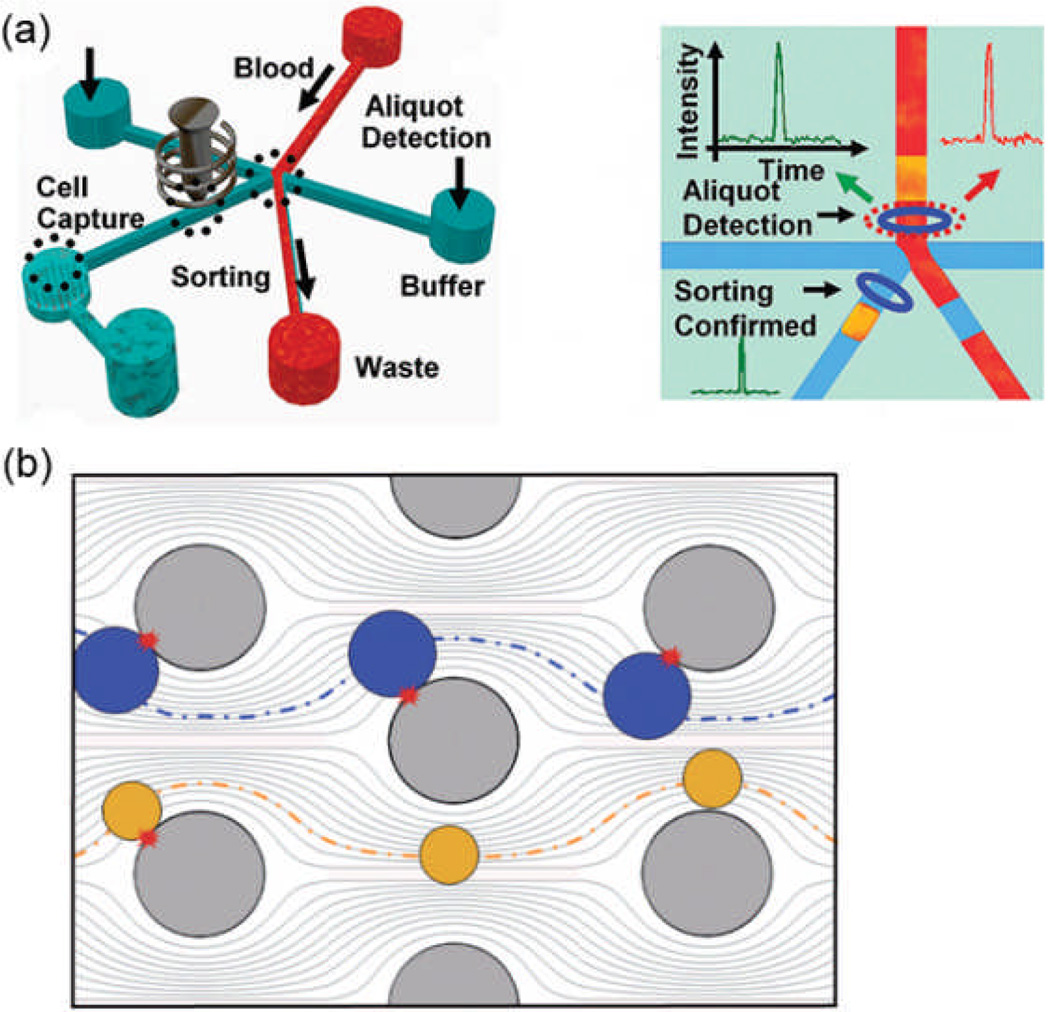
(a) Schematic of device setup for ensemble-decision aliquot ranking CTC sorting, and a drawing of virtual volume aliquots being separated from the blood sample to form actual volume aliquots. (b) Schematic of geometrically-enhanced differential immunocapture obstacles distorting the streamlines of a flowing fluid, leading to increased cell-surface collisions for the larger cells (the targeted CTCs) and fewer cell-surface collisions for the smaller cells (other cells in the sample). Reproduced from Refs. , with permission from Wiley and RSC.
References
-
- Alunni-Fabbroni M, Sandri MT. Methods. 2010;50:289–297. - PubMed
-
- Botteri E, Sandri MT, Bagnardi V, Munzone E, Zorzino L, Rotmensz N, Casadio C, Cassatella MC, Esposito A, Curigliano G, Salvatici M, Verri E, Adamoli L, Goldhirsch A, Nole F. Breast Cancer Res. Treat. 2010;122:211–217. - PubMed
-
- Pierga JY, Bidard FC, Mathiot C, Brain E, Delaloge S, Giachetti S, de Cremoux P, Salmon R, Vincent-Salomon A, Marty M. Clin. Cancer Res. 2008;14:7004–7010. - PubMed
Publication types
MeSH terms
Grants and funding
LinkOut - more resources
Full Text Sources
Other Literature Sources
